Saves instantly, no account needed. Already a member? Sign in.
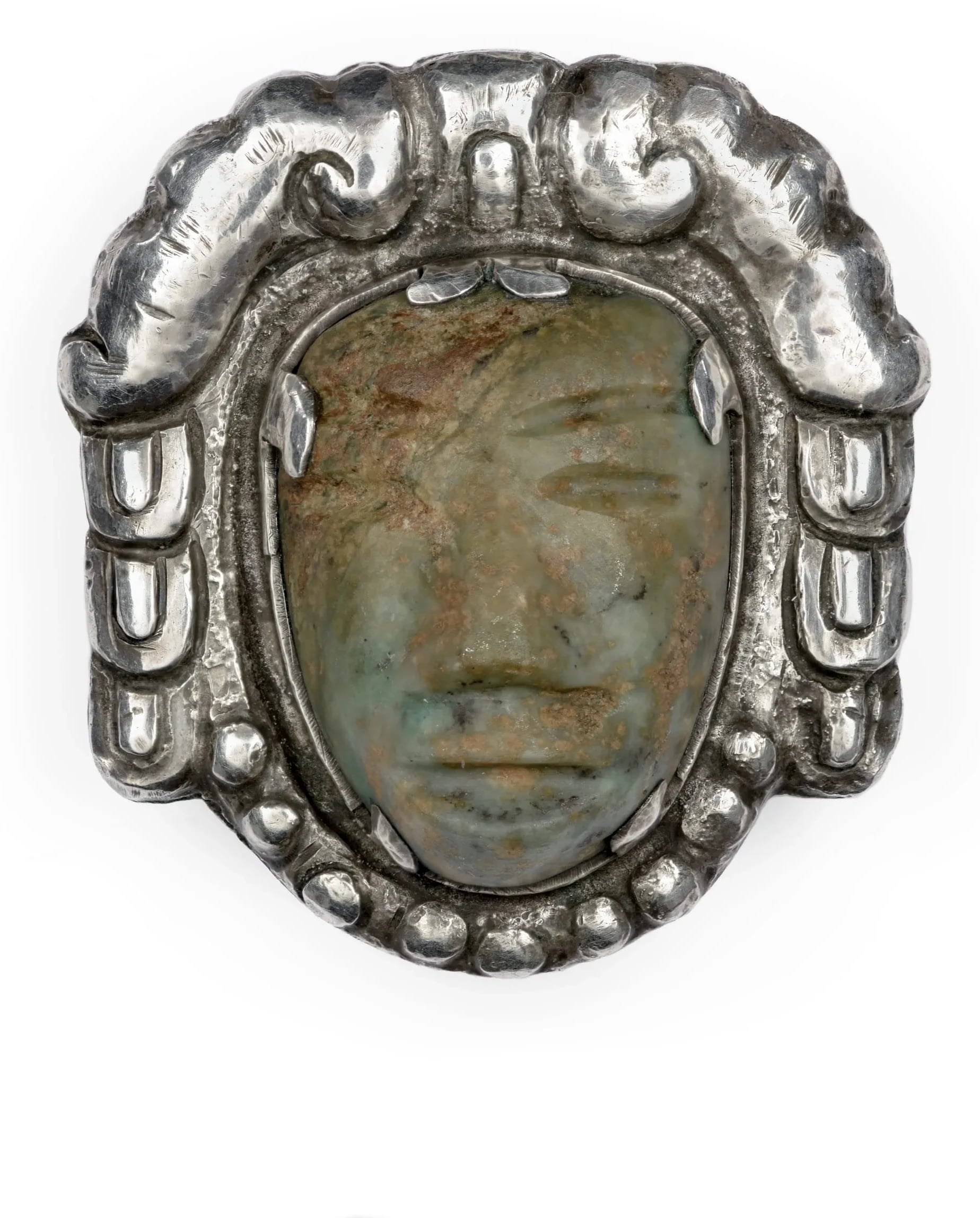
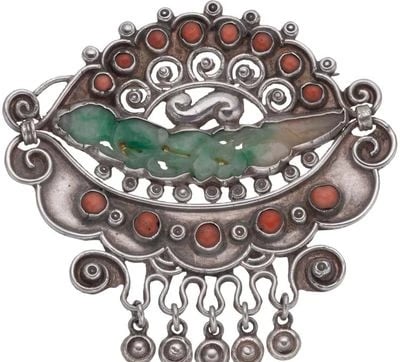
This small brooch concentrates MATL’s early vocabulary into a compact face and frame. The reverse mark, MATL with 0.900, is visible in LACMA’s image and accords with the museum’s dating of the object to 1934 to 1940. A carved green stone face fills the center, held within a close silver bezel and surrounded by a scalloped, relief-worked frame. The face is quiet and frontal, its features reduced to planes and shallow lines. Around it, the silver is restless: scrolls curl across the crown, small projecting forms grip the stone, rounded beads gather along the lower edge, and the darkened recesses make the raised forms read with greater depth.
The brooch depends on the contrast between the inward stillness of the mask and the active metalwork around it. The green stone is mottled with russet and darker inclusions, so the face carries color as irregular mineral presence rather than as smooth luxury. Its expression is softened by wear and by the nature of the carving, which gives the mouth, nose, and eyes the character of an old image without requiring a precise source identification. The silver frame answers that softened face with emphatic modeling. Its upper scrolls recall vegetal ornament and crown forms, while the side elements descend like stacked plaques. The setting does more than secure the stone. It creates a small architectural surround, a portable niche in which the carved face can be read as image, material, and ornament at the same time.
Matilde Poulat’s MATL work occupied a distinctive position within the Mexican silver renaissance because it did not pursue the severe geometric modernism associated with several Taxco workshops. Morrill and Berk describe her work as part of the postrevolutionary search for a Mexican aesthetic grounded in Pre-Conquest art and the art of Mexican pueblos, with particular inspiration drawn from the Mixtec gold jewelry found at Monte Albán. In this brooch, that context appears less as quotation than as method: a face, a frame, applied relief, and color are compressed into a dense object that treats jewelry as a site for historical imagination. Hougart records that Poulat was trained at the San Carlos Academy, began as a painter and designer, opened her shop in 1934, and used MATL as a registered trademark connected to a word for water. Those facts help explain the brooch’s pictorial structure. Its surface is organized by a designer’s concern for contrast and enclosure, but realized through the raised, tactile means of silver.
The object also belongs to a collaborative workshop history. Morrill and Berk note that Ricardo Salas worked closely with Poulat from childhood, trained in silversmithing, and perfected the carving of ivory, coral, turquoise, and other stones used in MATL jewelry and figures. That history should not be used to assign the carving of this stone without further evidence, but it clarifies why stone and silver in MATL work so often feel conceived together rather than assembled as separate decorative parts. The brooch is valuable to a museum collection for that reason. It preserves an early MATL mark, an early fineness standard, and a compact example of the workshop’s characteristic union of carved image, dense relief, and Mexican modernist revival. In the broader history of twentieth century Mexican silver, it shows how one important strand of the renaissance developed through color, figuration, and tactile abundance rather than through streamlined abstraction alone.
Museum of Mexican Silver. “Carved Stone Face Brooch.” Catalog no. MoMS-002276. https://museumofmexicansilver.com/pieces/matl-carved-stone-face-brooch
See something wrong with this record? Suggest a correction and the piece details fill in automatically.
MATL (Matilde Poulat)
Jade-Center Scrollwork Brooch with Coral
1934 or later
Coral