Saves instantly, no account needed. Already a member? Sign in.
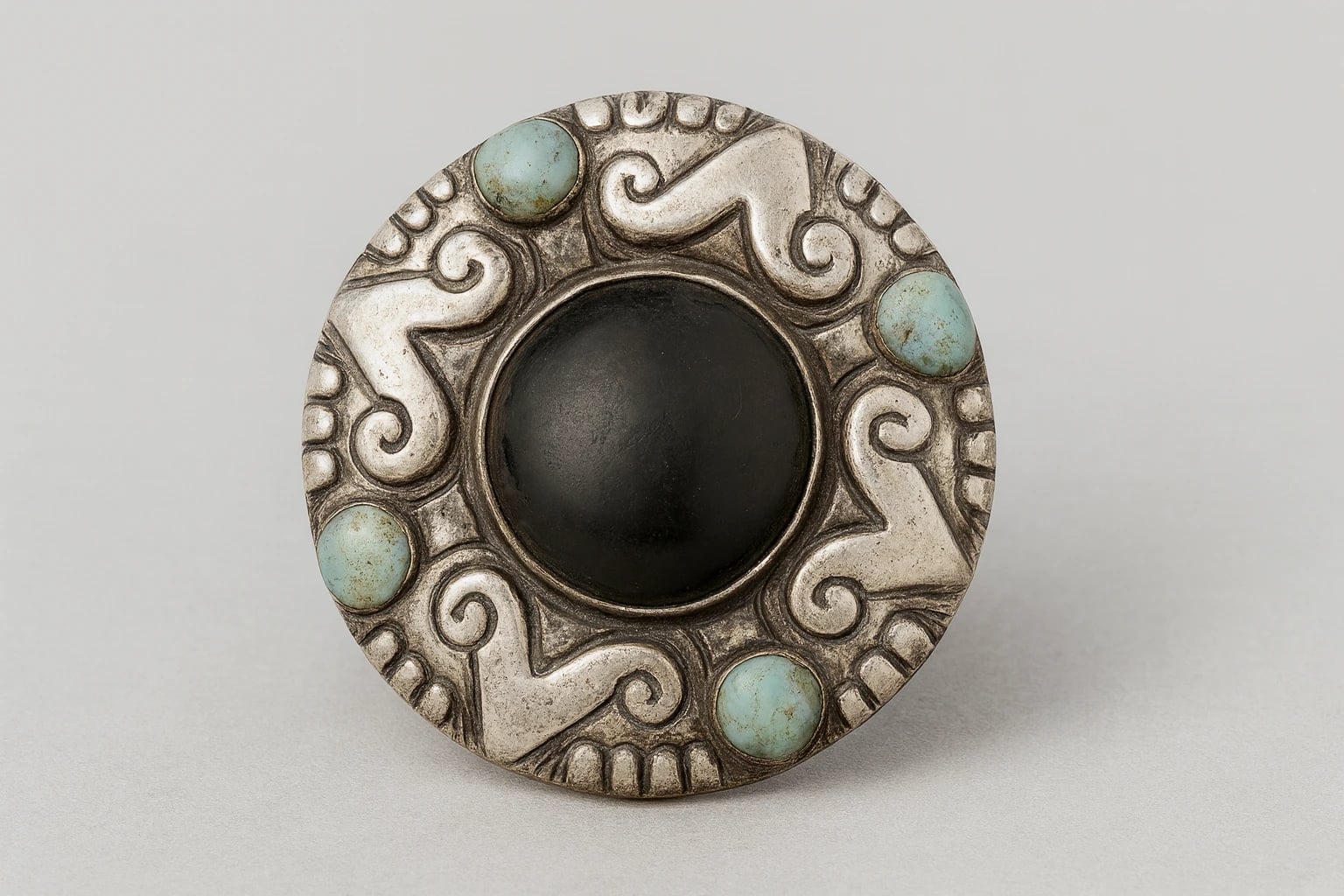
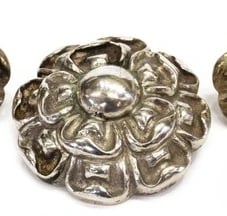
A ring of black onyx frames a small silver bouquet at the center of this brooch, and that opposition of dense dark ground against bright ornament is the design's organizing idea. Matilde Poulat built her reputation on dense, devotional silverwork populated with birds, flowers, and hearts, and here she disciplines that vocabulary into a circle. The onyx does not merely surround the silver; it isolates it, giving the flowering center the concentrated presence of a medallion or a reliquary boss. Turquoise punctuates the composition with warm blue against the black, a color pairing that Poulat returned to throughout her jewelry.
The construction rewards close looking. The floral cluster is worked in silver with the small curling leaves and beaded accents characteristic of Poulat's shop, then set so that it reads as raised sculpture against the flat onyx plane. Turquoise cabochons carry the eye inward. Where much Mexican silver of the period pursued streamlined geometry, this brooch keeps ornament frankly ornamental, layering elements until the surface feels full. The circular onyx border performs real formal work, containing that density and preventing the composition from spreading. Poulat trained as a painter and designer at the San Carlos Academy before opening her shop in 1934, and the brooch shows a painter's instinct for figure and ground, for placing a bright, complicated motif inside a calm dark field.
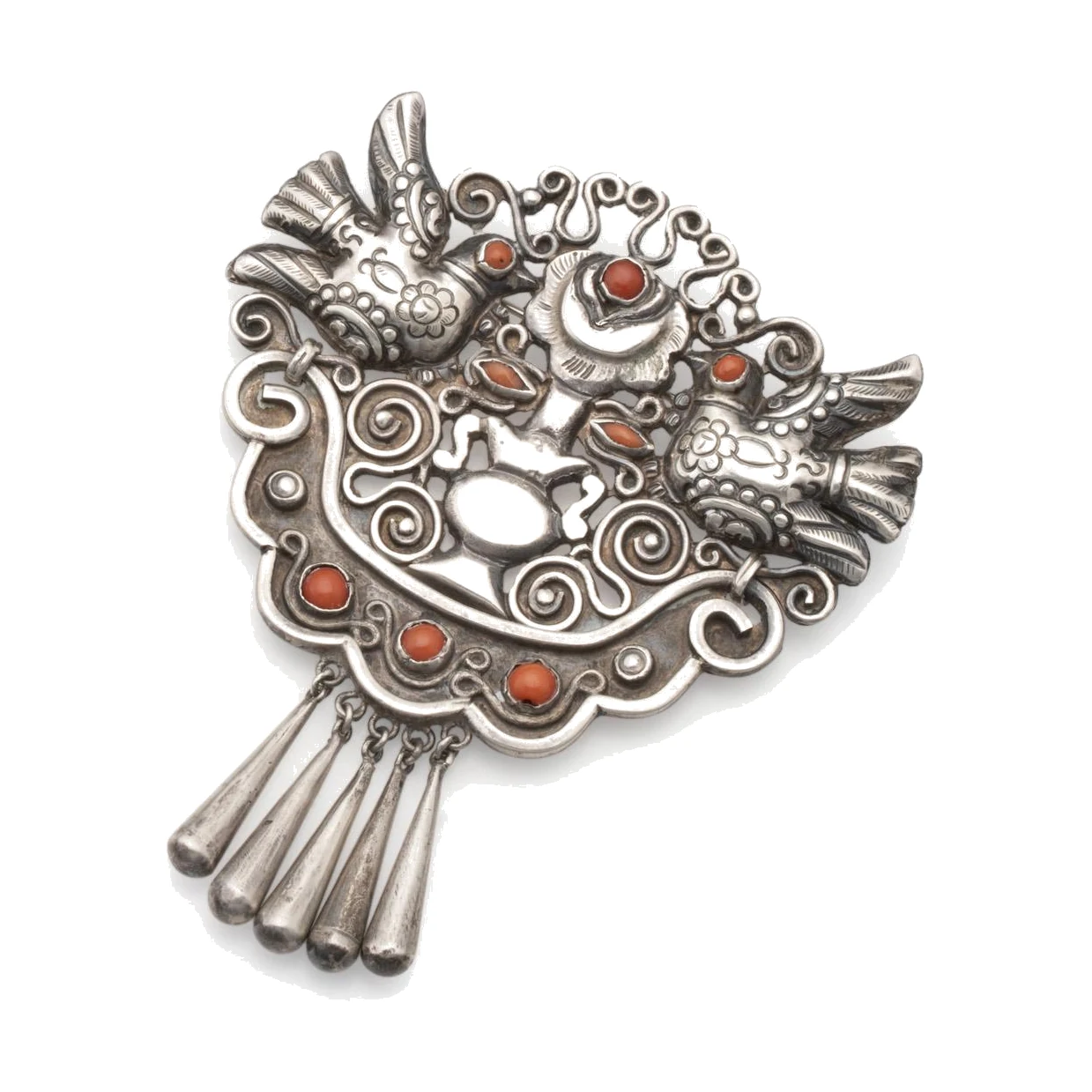
Poulat's work occupies a distinct position within the Mexican silver renaissance. She drew less from international modernism than from Mexican colonial and popular religious art, the retablos, milagros, and church ornament whose flowering hearts and birds she recast in silver and turquoise. Her mark, MATL, adapts an Aztec word associated with water and was registered as trademark 142093, a number that appears on her jewelry and decorative objects. After her death in 1960 her nephew Ricardo Salas continued the designs, eventually supervising as many as several dozen silversmiths and marking later work MS-12 alongside the Matl name. That continuity means the Matl style outlived its originator, which makes secure dating of any single example a matter of reading the specific mark rather than the design alone. The early script and fineness marks Hougart records for the years of Poulat's own production differ from the registered and etched marks of the Salas decades, so the hallmark on this brooch, not its ornament, locates it in time.
Within a silver collection, this brooch represents the strand of the renaissance that looked inward to Mexican devotional and folk sources rather than outward to Bauhaus or Deco geometry. Poulat's flowering silver, framed and concentrated by onyx, shows how a designer trained as a painter translated the visual language of the church and the popular altar into wearable form. It is a characteristic and clearly resolved example of that vocabulary, and it documents a workshop tradition that Matilde Poulat established and Ricardo Salas carried forward for decades after her.
Museum of Mexican Silver. “Circular Onyx Brooch with Turquoise.” Catalog no. MoMS-002254. https://museumofmexicansilver.com/pieces/matl-circular-onyx-brooch-with-turquoise
See something wrong with this record? Suggest a correction and the piece details fill in automatically.
MATL (Matilde Poulat)
Floral Rosette Brooch
1934 or later
Silver