Saves instantly, no account needed. Already a member? Sign in.
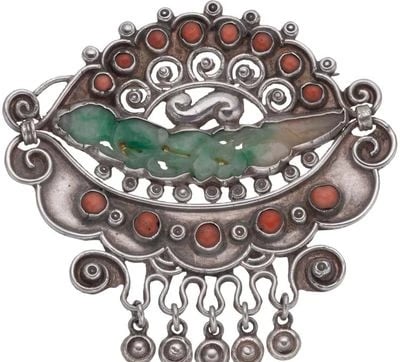
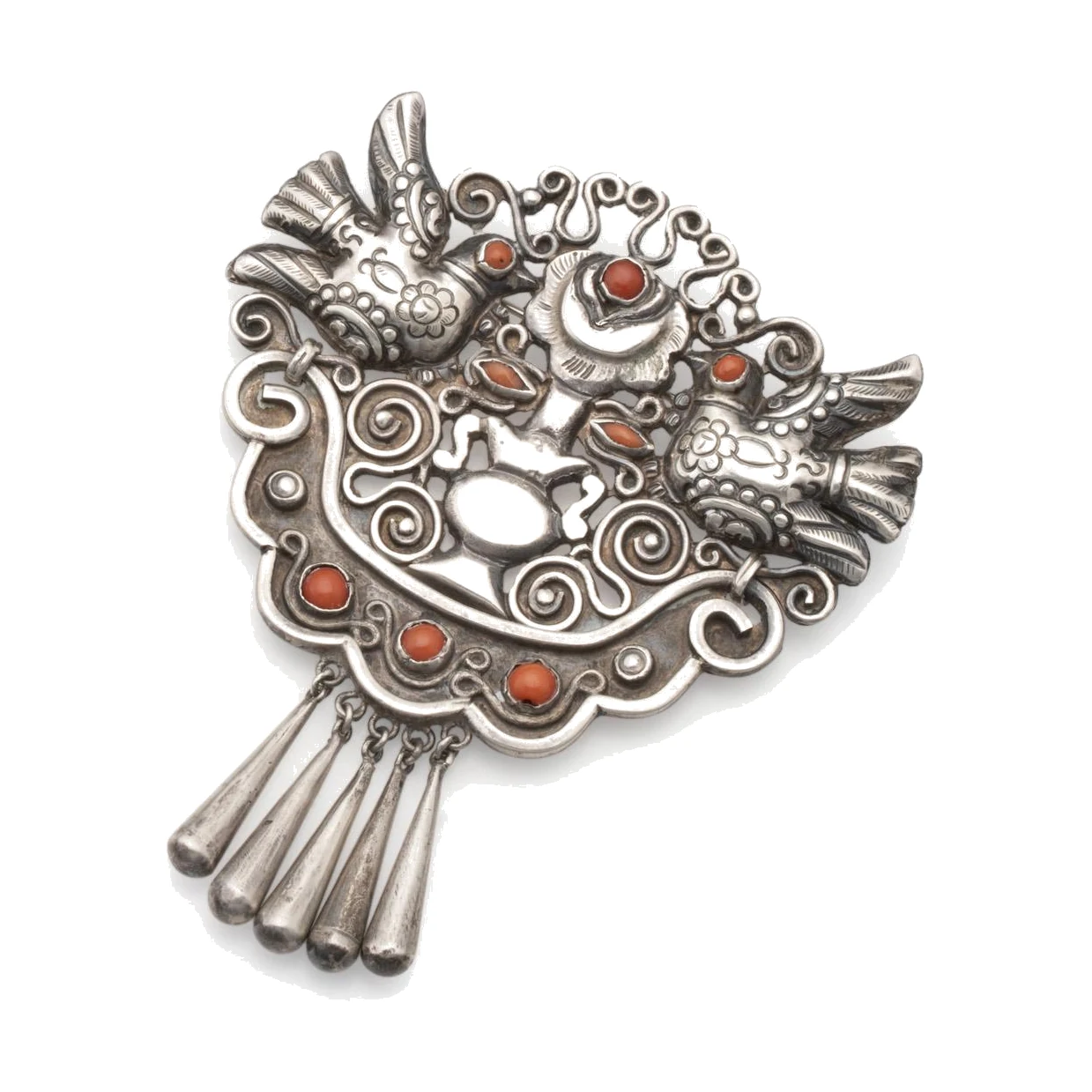
The brooch organizes a small devotional world through paired birds, a central flower, and a crescent of scrolling silver. Two repoussé doves face inward across the upper field, their rounded bodies, patterned wings, and fanned tails lifted above a vessel and rose. Beneath them, a crescent-shaped ground carries coral cabochons set at measured intervals, while five polished teardrop pendants hang from short loops along the lower edge. The result is compact but not crowded. Openwork curls and pierced spaces allow light to pass through the design, so that the brooch reads less as a solid plaque than as a layered construction of line, relief, color, and movement.
The coral is used with particular economy. Small red cabochons punctuate the silver scrolls, the birds’ eyes, the rose, and the lower border, warming the surface without overtaking it. Their placement gives the brooch a rhythm close to embroidery or painted lacquer, where color appears in repeated notes rather than broad fields. The five dangling drops extend that rhythm beyond the fixed body of the brooch. They would have shifted slightly with the wearer, translating the MATL vocabulary of birds, flowers, bells, and devotional ornament into a bodily object. The doves are not naturalistic studies. They are built from embossed volume, stamped or chased feather lines, applied beads, and ornamental curls, closer to the symbolic birds of Mexican popular art and religious silver than to academic representation.
Stamped MATL and dated in the Museum record to about 1935 to 1948, the brooch belongs to the early decades of Matilde Eugenia Poulat’s Mexico City workshop. Hougart records that Poulat studied at the San Carlos Academy of Art, opened her shop in 1934, and used MATL as a registered trademark, number 142093. The same reference documents several MATL marks in use from 1934 to 1948, including script MATL stamps with 0.925 and “Hecho en Mexico DF,” as well as MATL with 925 or 950. Morrill and Berk place Poulat’s designs within postrevolutionary searches for a Mexican aesthetic and note her inspiration in the Mixtec gold jewelry discovered at Monte Albán in 1932, while also identifying her recurring motifs of doves, flowers, and tiny bells as related to the subjects of Mexican folk art.
This brooch is especially useful for understanding how MATL silver differs from the more severe geometries often used to define Mexican modernist jewelry. Its modernism does not depend on reduction. It works through accumulation, compression, and translation: repoussé birds, wire scrolls, cabochon color, and pendant forms are coordinated into a clear ornamental structure. Morrill and Berk observed that MATL surfaces were decorated with applied wire and elaborated with embossing and repoussé of remarkable complexity, and this brooch shows that complexity on an intimate scale. Within the Mexican silver renaissance, it represents a parallel current to Taxco’s streamlined modernism, one in which popular devotion, archaeological memory, workshop skill, and painterly color became the materials of modern jewelry design.
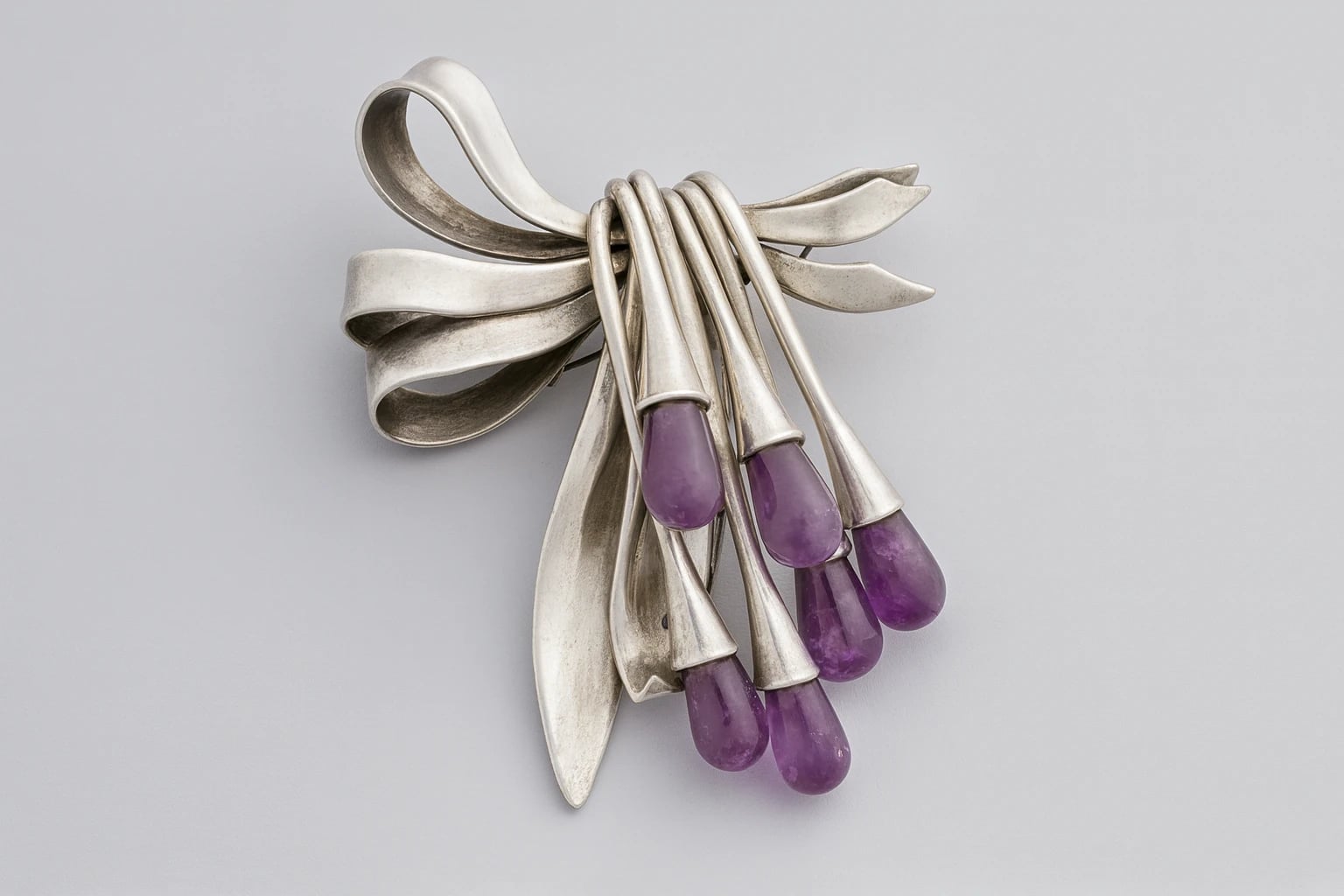
Sold as one of two MATL bird brooches in a single lot (John Moran Auctioneers 2020); the companion amethyst brooch is matl-turquoise-amethyst-bird-pin in this collection.
Museum of Mexican Silver. “Paired-Dove Drop Brooch with Coral.” Catalog no. MoMS-002199. https://museumofmexicansilver.com/pieces/matl-coral-doves-pin
See something wrong with this record? Suggest a correction and the piece details fill in automatically.
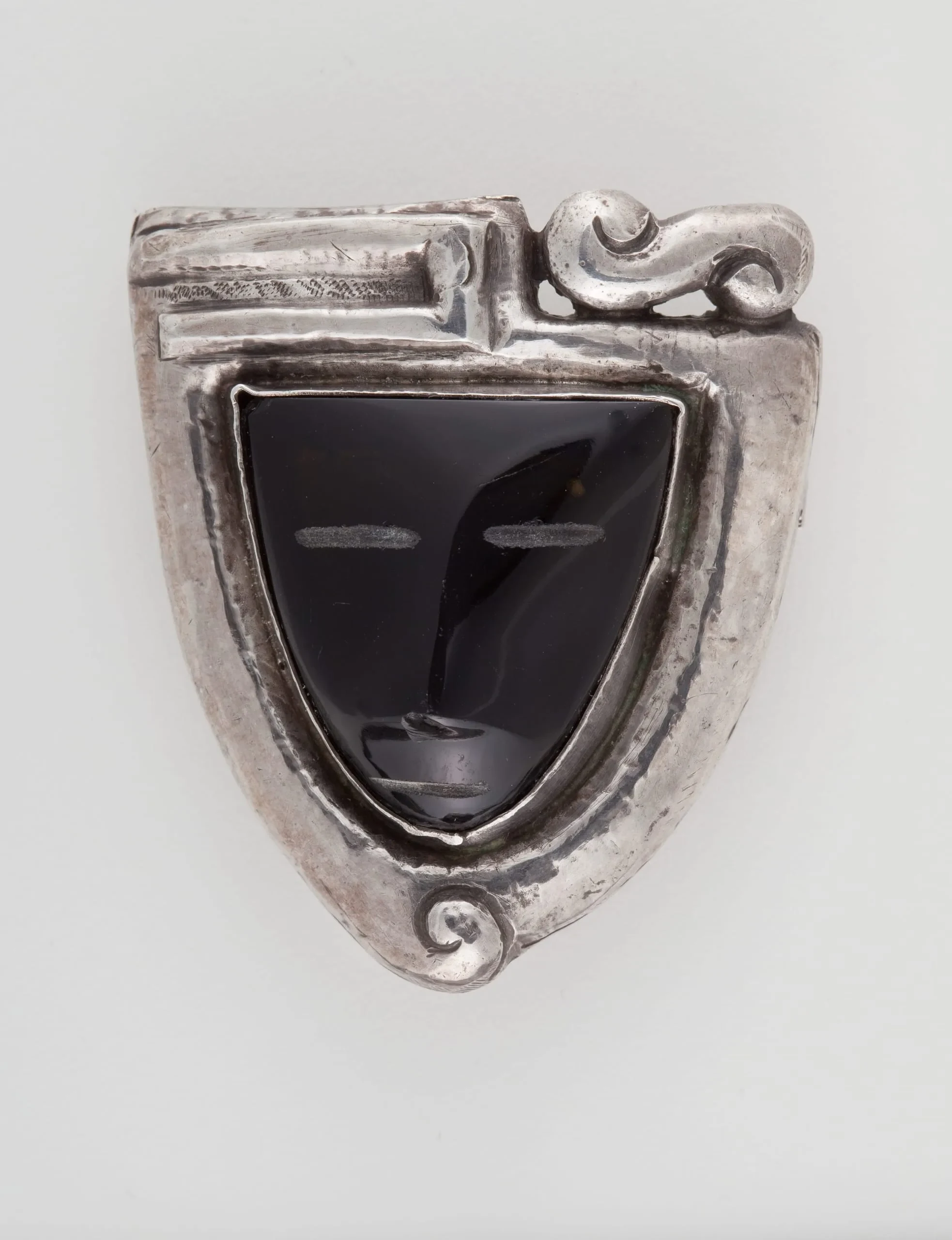
MATL (Matilde Poulat)
Framed Obsidian Mask Brooch
circa 1940
Silver