Saves instantly, no account needed. Already a member? Sign in.
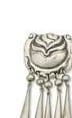
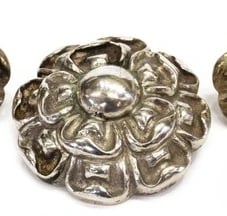
A dense floral rosette gathers into a single radiant mass, its petals overlapping toward a raised center where a cabochon sits like the flower's seed. This is the design vocabulary that made MATL jewelry recognizable at a glance: a devotional, folk-rooted ornamentation that treats silver as something to be crowded, layered, and enlivened rather than pared down. Where much of the Taxco renaissance moved toward flat planes and modernist restraint, Matilde Poulat pursued the opposite instinct, filling the field with organic detail and small accents of color. The brooch belongs to that ornamental current, and it shows how a Mexico City workshop built an entire identity on abundance instead of reduction.
The rosette form is organized around symmetry and depth. Petals radiate from the center in concentric ranks, each layer set slightly proud of the one beneath it, so that the surface reads as built up rather than stamped out. The raised central stone anchors the composition and gives the eye a fixed point around which the silverwork turns. MATL pieces characteristically combine silver with small colored stones and, frequently, red and green accents that recall the palette of Mexican popular art and colonial devotional objects. That contrast of warm color against oxidized silver is integral to the effect: the darkened recesses between petals deepen the sense of relief, while the brighter raised edges catch light. The design depends on this interplay of shadow and highlight, which is why the piece is worked in high relief rather than kept shallow.
Matilde Eugenia Poulat trained as a painter and designer at the San Carlos Academy, and she opened her own shop in 1934, registering the "Matl" trademark, number 142093, a name drawn from an Aztec word associated with water. Her formation as a painter helps explain the pictorial density of her jewelry, which favors composition and color over the engineering of articulation. The recurring flowers, birds, and foliate motifs in the MATL repertoire draw on Mexican folk art and on the visual language of colonial religious silver, sources that Poulat reworked into a personal ornamental style. After her death in 1960, her nephew Ricardo Salas continued the MATL designs, at times supervising several dozen silversmiths, so that the same forms remained in production for decades. Dating a given MATL object therefore requires attention to its mark. The earliest fineness stamps carry 0.900 or a script MATL with "Hecho en Mexico DF," while the registration number 142093 appears on marks documented from roughly 1950 onward, and post-1980 Salas-era pieces add MS-12 alongside the familiar MATL stamp.
Museum of Mexican Silver. “Floral Rosette Brooch.” Catalog no. MoMS-002260. https://museumofmexicansilver.com/pieces/matl-floral-rosette-brooch
See something wrong with this record? Suggest a correction and the piece details fill in automatically.
Without the specific hallmark on this brooch, it can be placed securely within the MATL design tradition rather than assigned to a single year or hand, since Poulat and Salas produced closely related work across a long span. What the object contributes is a clear example of that tradition's central proposition: a floral, high-relief, color-accented ornamentation that stood deliberately apart from the geometric modernism of Taxco. For a collection tracing the range of the Mexican silver renaissance, the MATL rosette marks the point where the movement drew on folk art and colonial devotion rather than on Bauhaus or Art Deco geometry, and it records the work of one of the few women to build a lasting workshop and registered brand within that renaissance.
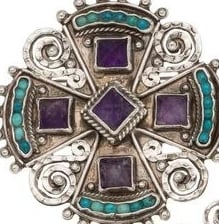
MATL (Matilde Poulat)
Lobed Cross Brooch with Turquoise and Amethyst
1934 or later
Turquoise