Saves instantly, no account needed. Already a member? Sign in.
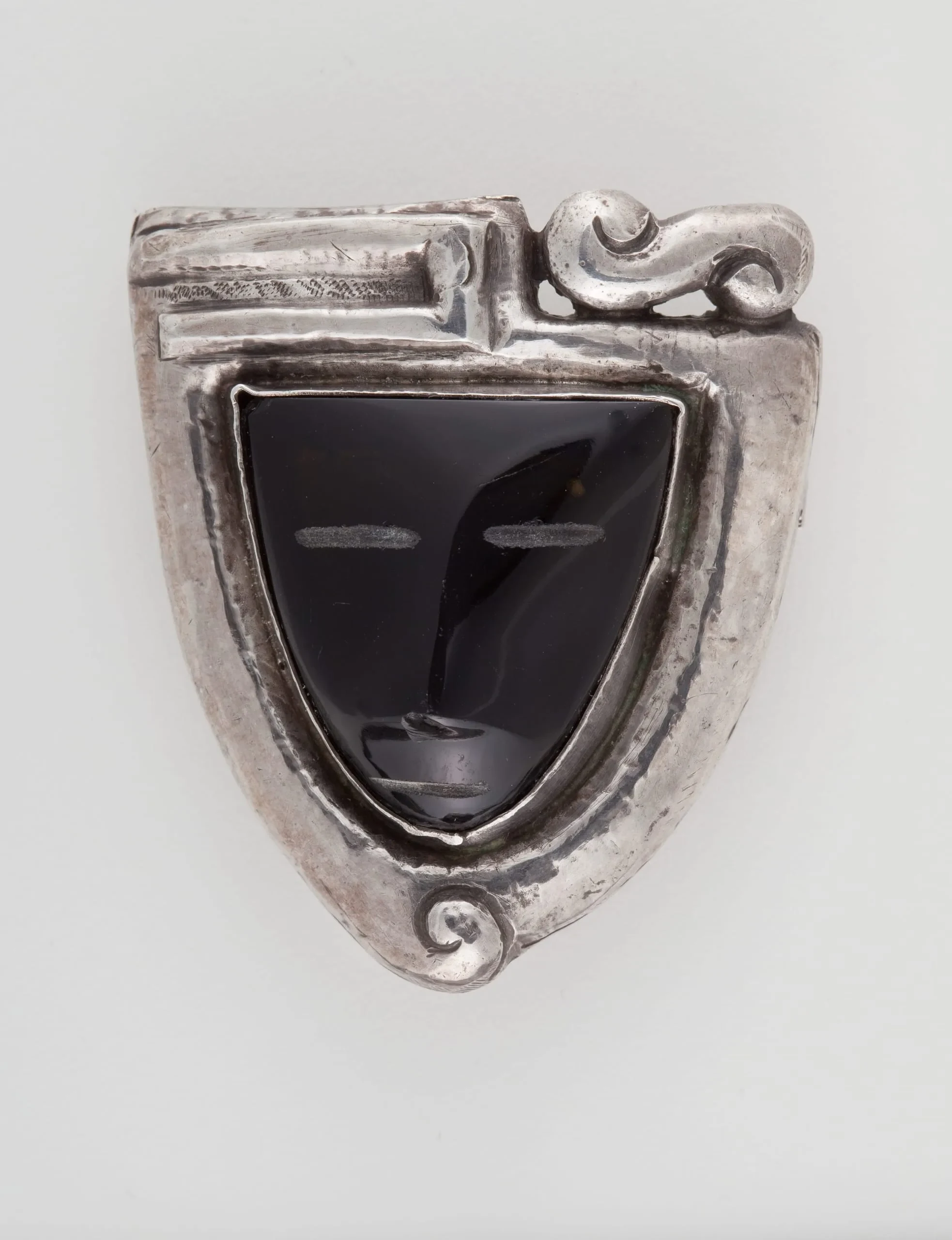
The framed mask brooch reduces the face to a few controlled incidents in darkness: a polished obsidian field, two pale horizontal eyes, a long recessed nose, and a short mouth set low in the stone. Around it, the silver frame is not a neutral border. It thickens, bends, and curls, with scrolls at the upper right and lower left that keep the shield-like outline from becoming static. At only two inches high, LACMA accession M.2013.4.23 has the frontal force of a small relief sculpture, but its scale and pin mechanism return that force to the body.
The contrast between silver and obsidian is the brooch’s organizing effect. The stone absorbs light until the carved features appear to hover just beneath the surface, while the worked silver catches light unevenly across its raised edges, scratches, and hammered passages. The face is simplified almost to a sign, yet the asymmetry of the frame gives it a handmade immediacy. A straight upper bar steadies the composition, and the descending sides narrow toward a rounded point, so the brooch reads as a protected image rather than a loose stone setting. The scrolls are especially important. They soften the severity of the mask and connect this object to Matl’s broader language of curling forms, incised textures, and compact ornament.
Matilde Poulat, who signed her work MATL, was trained first as a painter and designer and opened her shop in Mexico City in 1934. Hougart records that the name Matl was a registered trademark, number 142093, and identifies several MATL marks, including early script forms used during the 1930s and 1940s. The script mark on the reverse of this brooch therefore belongs to the early identity of the workshop rather than to the later Matl Salas period. Morrill and Berk describe Poulat’s work as part of the postrevolutionary search for a Mexican aesthetic, shaped by ancient art, popular tradition, and especially the visual richness of Mixtec jewelry from Monte Albán. This brooch participates in that world without copying a single archaeological model. Its source is generalized through material, format, and frontal presence: obsidian becomes both image and ground, while silver supplies the modern frame.
The design also belongs to a Mexico City current within the silver renaissance, not only to the better known Taxco story. LACMA’s own record places this brooch within a group of Matl objects that responded to earlier designs by Frederick Walter Davis, who helped establish the use of small carved obsidian masks mounted in silver. That connection is useful because it shows how quickly a compelling material idea could move through Mexican silver design and be transformed by different hands. Davis favored a crisp modern framing of archaeological reference. Matl’s version is denser, more intimate, and more tactile. The mask remains central, but the silver seems to have grown around it, pressing close to the stone and carrying the touch of the workshop across every edge.
Museum of Mexican Silver. “Framed Obsidian Mask Brooch.” Catalog no. MoMS-002273. https://museumofmexicansilver.com/pieces/matl-framed-obsidian-mask-brooch
See something wrong with this record? Suggest a correction and the piece details fill in automatically.
Within a museum collection, this brooch helps clarify the breadth of Mexican modernism in silver. It is not a derivative ornament attached to a larger artistic movement. It is a small object in which material history, archaeological imagination, personal design language, and workshop practice meet at wearable scale. The carved obsidian face links the brooch to ancient Mexican forms, but the silver setting belongs unmistakably to the design culture of the 1930s and 1940s, when artists and silversmiths in Mexico were reworking inherited forms through modern objects made for contemporary use. Matl’s brooch preserves that exchange in concentrated form: dark stone held in bright metal, an old material given a new social life on the body.
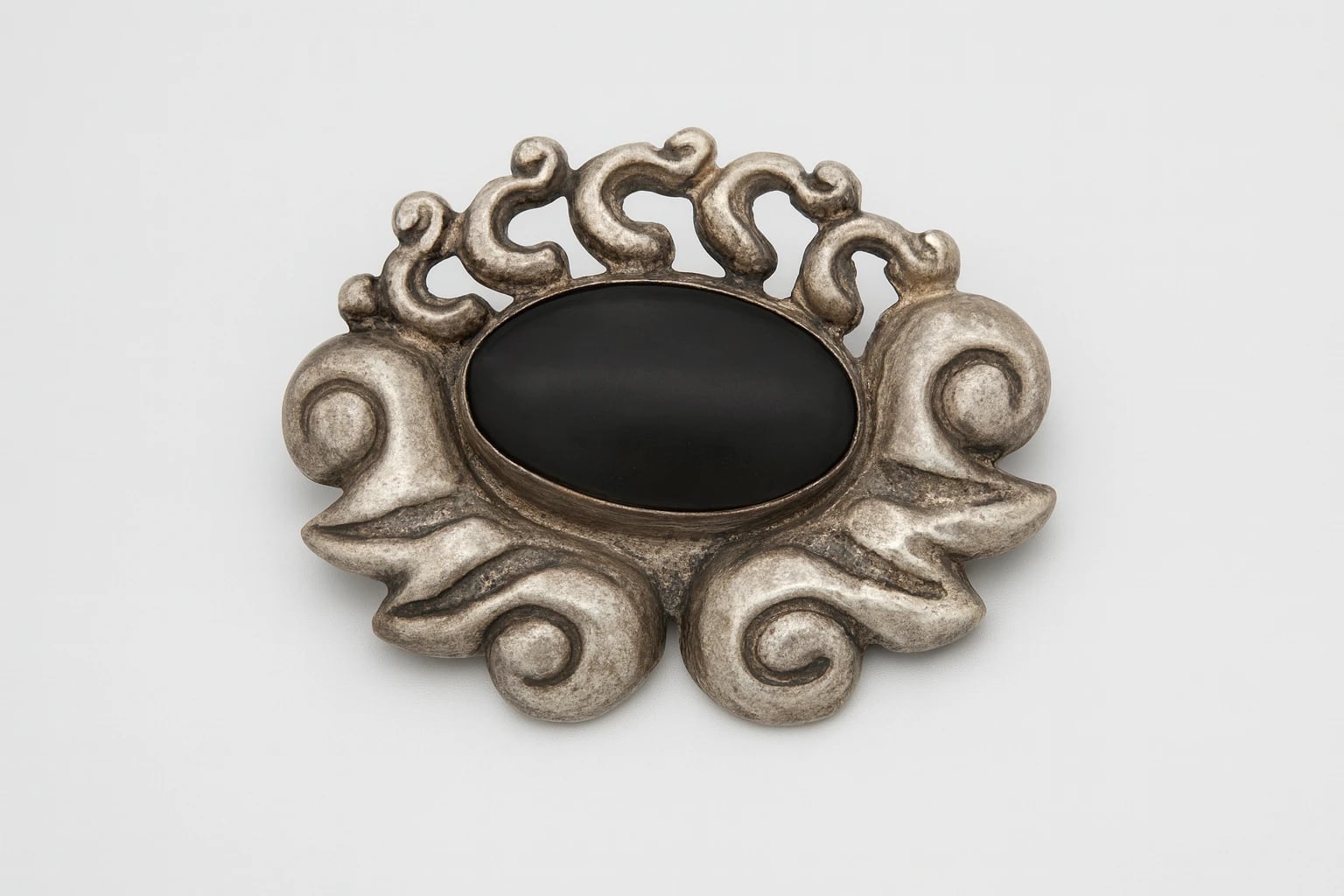
MATL (Matilde Poulat)
Oval Onyx Scrollwork Brooch
1934 or later
Onyx