Saves instantly, no account needed. Already a member? Sign in.
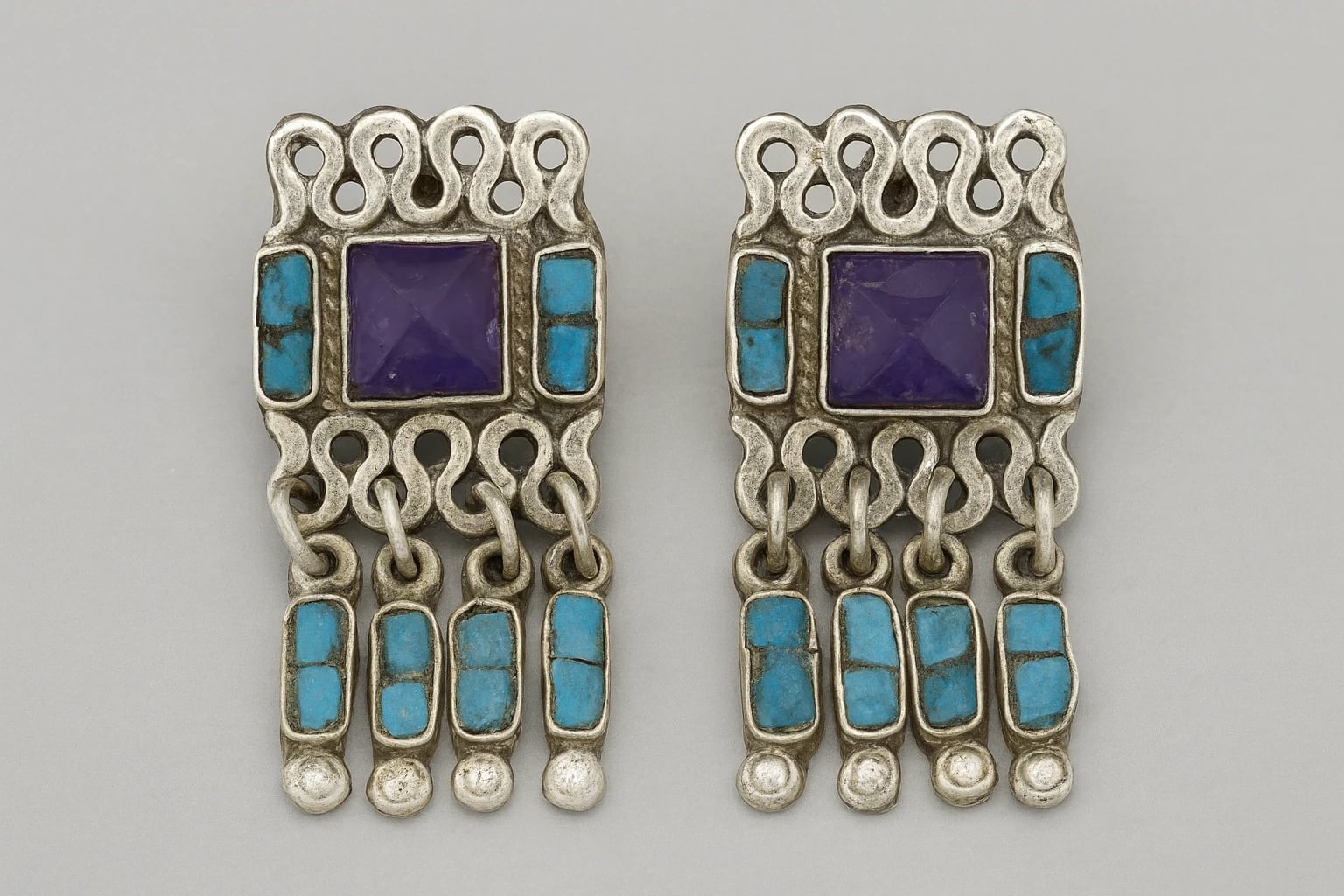
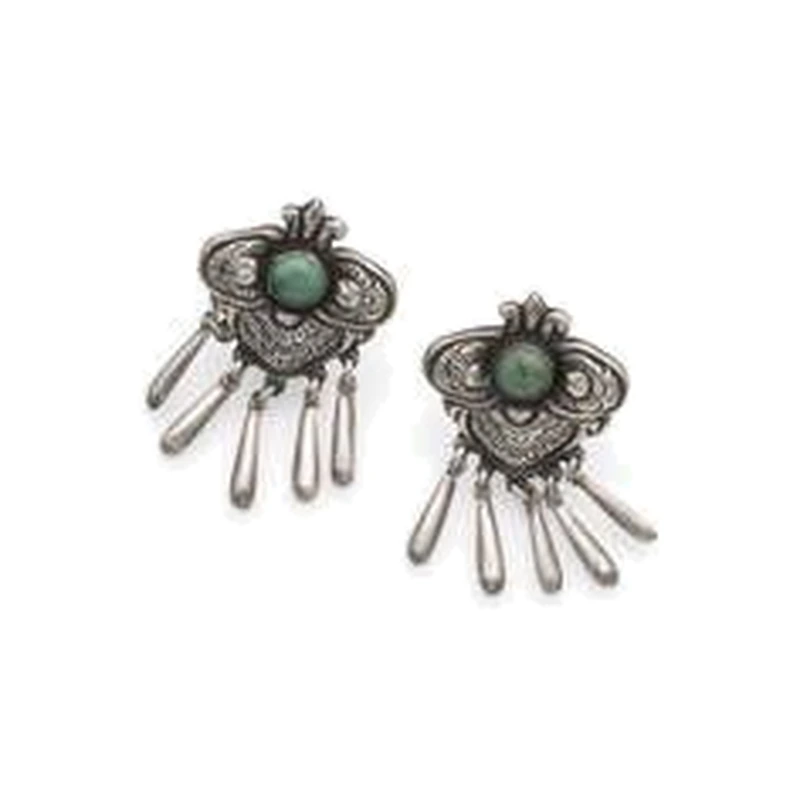
A dense cascade of turquoise and coral, suspended in silver scrollwork, gives these fringe earrings their character. The design gathers small stones into a hanging fringe rather than setting a single central cabochon, so that color moves as the earring moves. Turquoise supplies the dominant blue-green, with coral introducing warm red accents that interrupt the cooler field. This is the ornamental vocabulary most closely associated with the MATL workshop: a profusion of small stones, silver worked into dense curvilinear settings, and a decorative logic drawn from Mexican folk and colonial sources rather than from the austere geometry favored elsewhere in Taxco.
The fringe format organizes the composition around repetition and suspension. Individual stone-set elements hang from a supporting upper structure, and the pendant units catch light and shift with the wearer's movement. Coral and turquoise are used for their opacity and saturated color, not for transparency or faceted brilliance. The contrast between the two materials, blue-green against red, is integral to the design rather than incidental, and the silver scrollwork frames and binds the stones into a unified mass while remaining visible as ornament in its own right. This approach favors abundance and surface richness over the reduction and open negative space that define other currents of the period.
Matilde Poulat trained as a painter and designer at the San Carlos Academy of Art before opening her workshop in 1934, and her jewelry retains a designer's sensibility for composition and color. She registered the trademark "Matl," a variation of an Aztec word for water, under number 142093, and that mark in its several forms identifies the workshop's output. The MATL style stands somewhat apart within the broader Mexican silver renaissance. Where the Spratling lineage often pursued pre-Columbian geometry or modernist mass, Poulat drew on Mexican folk art and colonial devotion, producing an ornate, densely stone-set idiom that became instantly recognizable. Her nephew Ricardo Salas worked alongside her throughout her career and continued the Matl designs after her death in 1960, supervising a workshop of several dozen silversmiths at peak production.
The continuity of the Matl style across decades complicates dating any single example, since Salas and later hands produced established designs long after Poulat conceived them, and the museum record here does not fix this pair to a specific fabrication period within that long production. What the earrings document clearly is the workshop's characteristic marriage of color and silver: turquoise and coral massed into a fringe, held in scrolling settings that treat ornament as the primary subject. Within a collection of Mexican silver, such a piece registers the MATL contribution as a distinct alternative to the modernist mainstream, a folk-derived decorative language that found its own sustained audience.
Museum of Mexican Silver. “Fringe Earrings with Turquoise.” Catalog no. MoMS-002259. https://museumofmexicansilver.com/pieces/matl-fringe-earrings-with-turquoise
See something wrong with this record? Suggest a correction and the piece details fill in automatically.
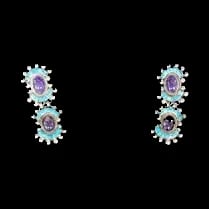
MATL (Matilde Poulat)
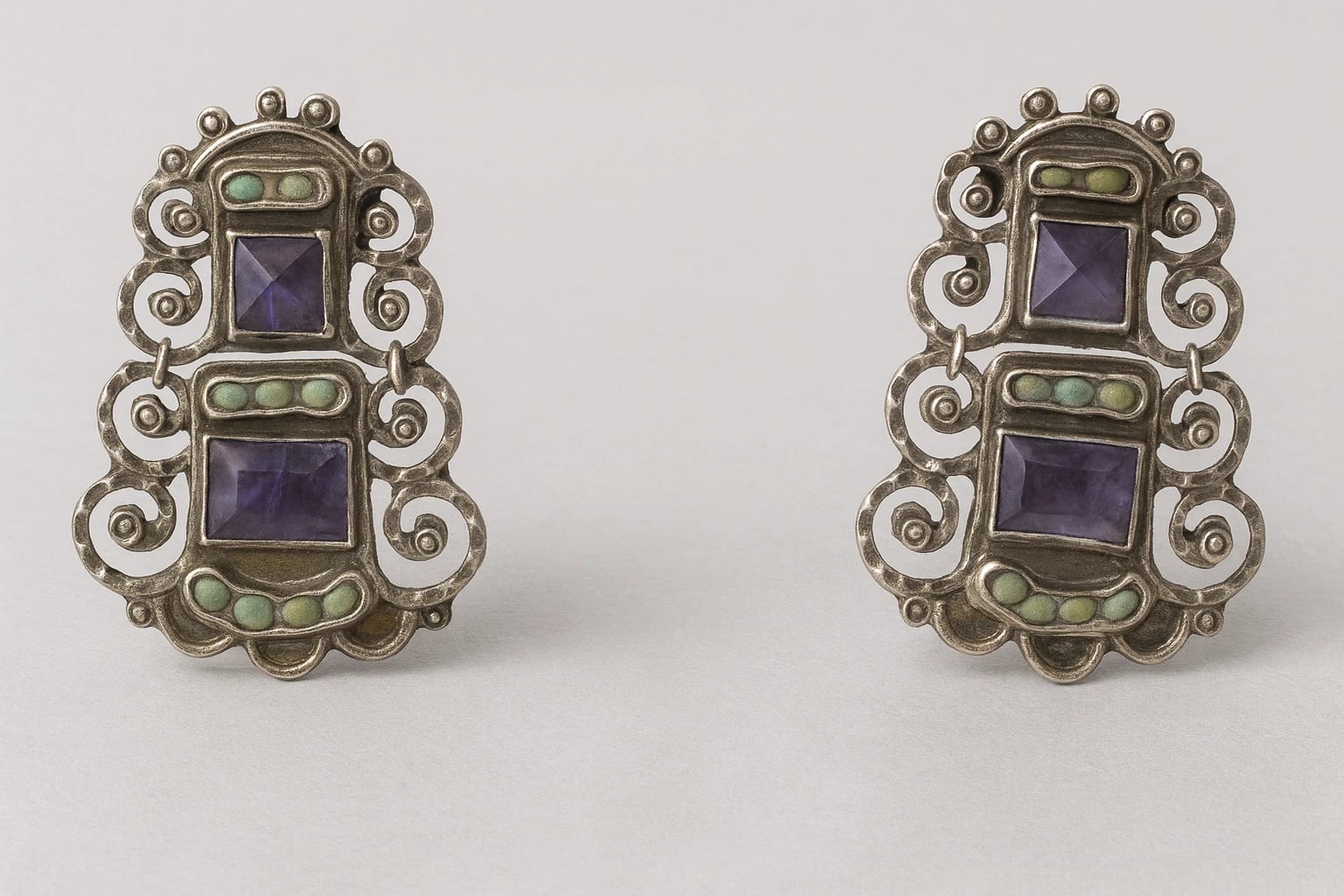
Cluster Drop Earrings with Turquoise and Amethyst
Sterling silver