Saves instantly, no account needed. Already a member? Sign in.
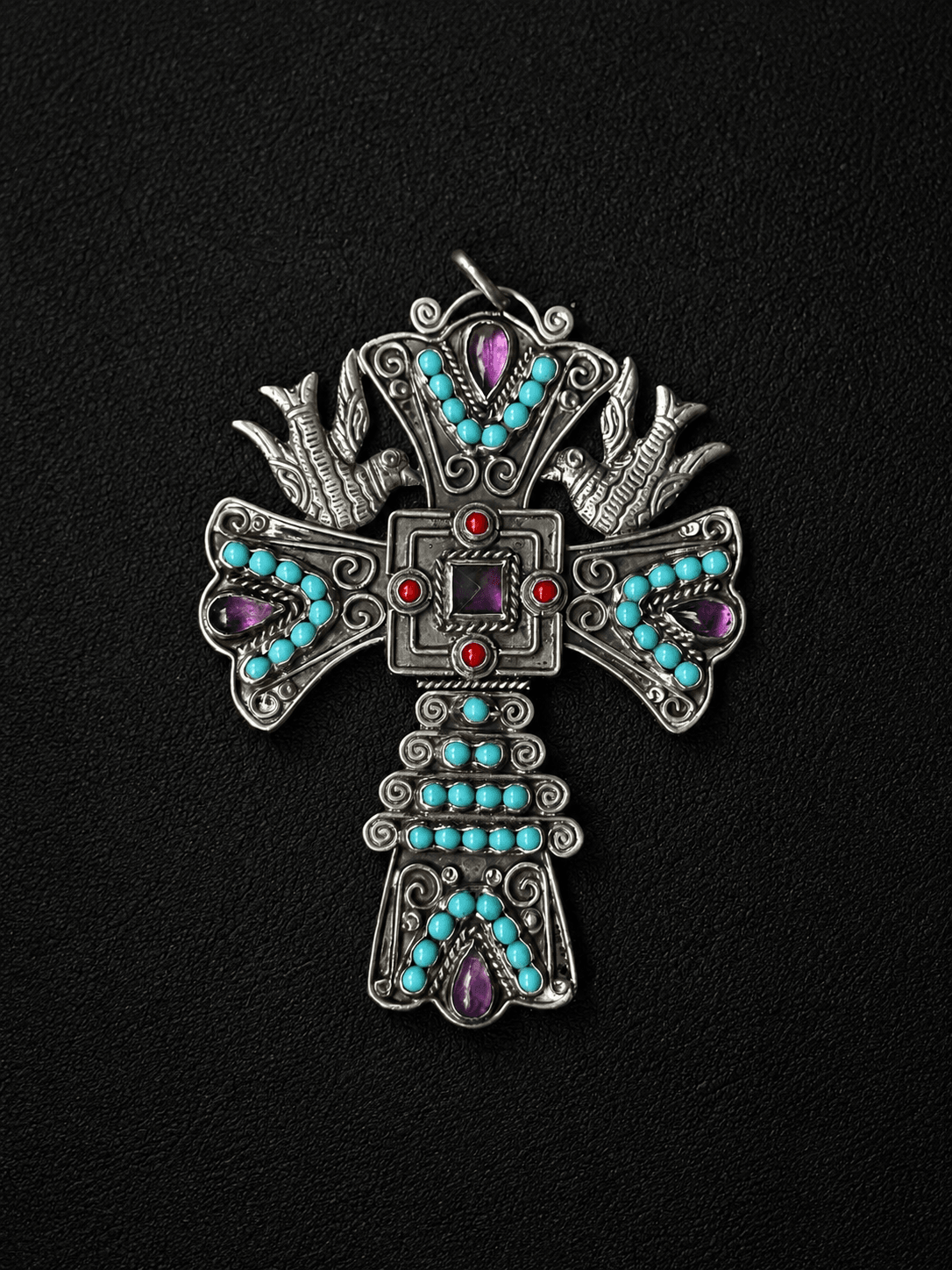
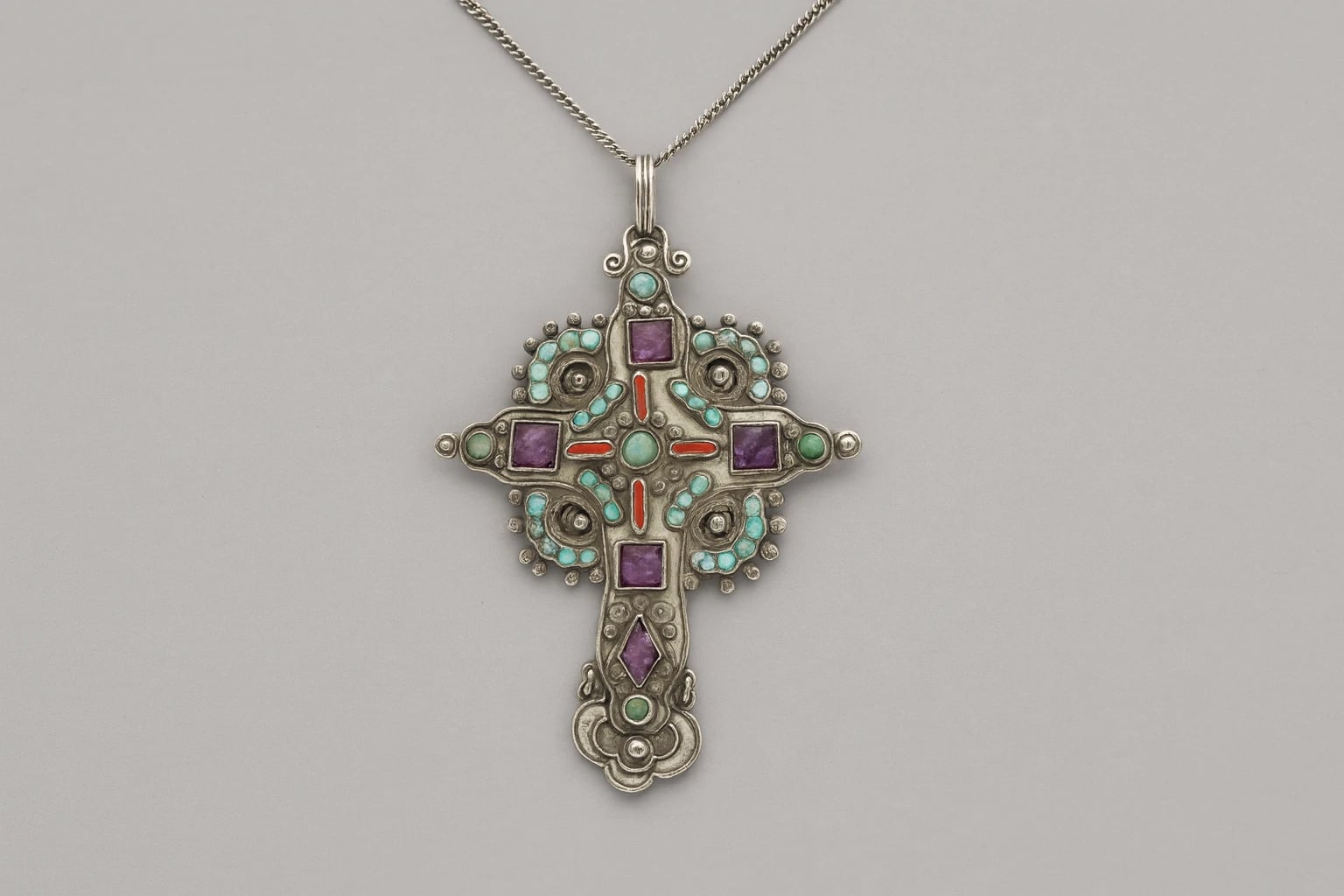
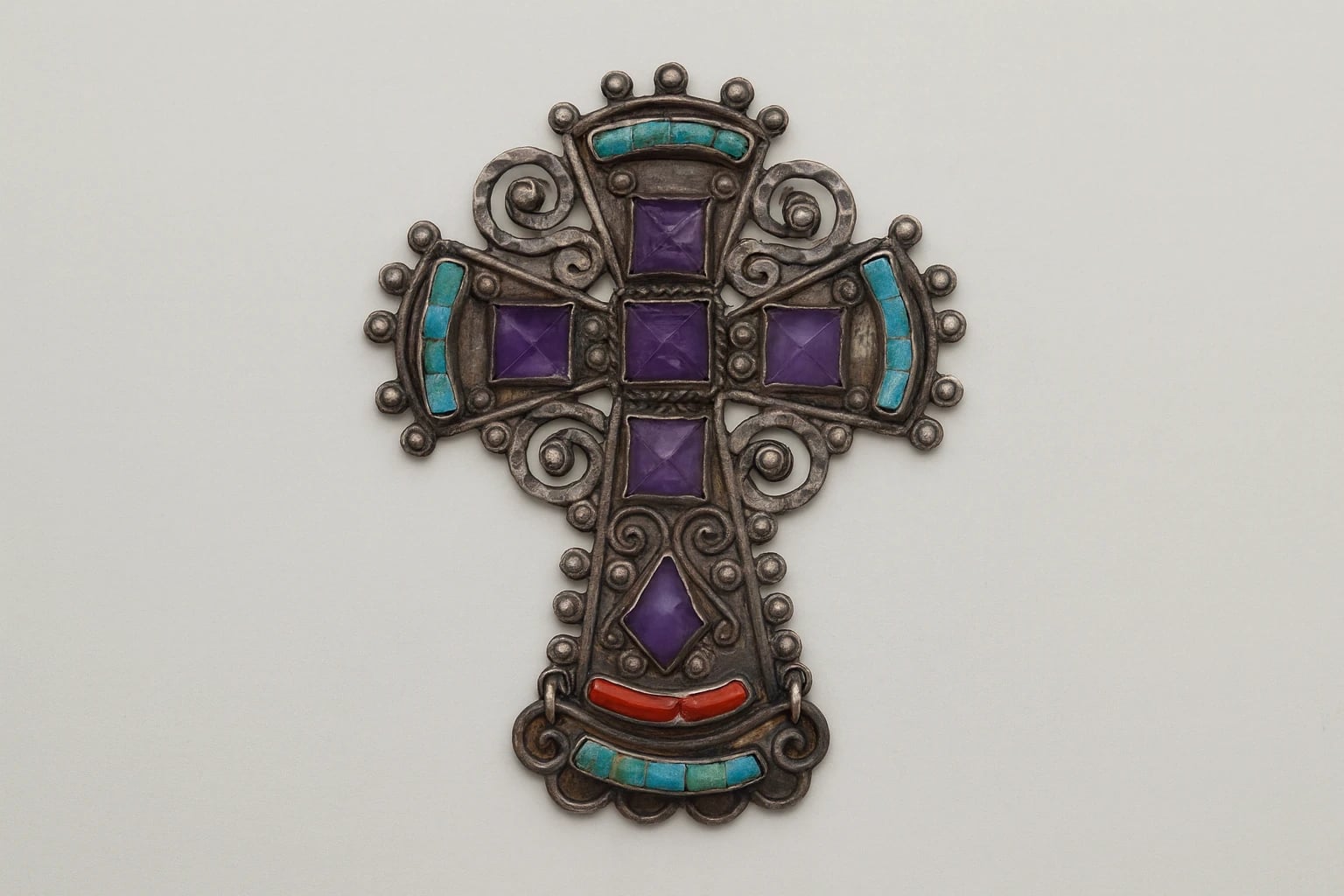
A rounded Latin cross carries a central turquoise cabochon at its crossing, with an amethyst set into the lower shaft, the two stones held within a dense weave of silver scrollwork, beading, and small blossoms. The design belongs to the devotional folk vocabulary that Matilde Poulat developed under the MATL mark, in which a Christian cross becomes an armature for exuberant Mexican ornament. What distinguishes the type is its refusal of austerity: rather than paring the cross to a plain geometric form, Poulat filled and framed it with curling wire and clustered detail, so that the sacred shape reads as a garden of silver holding two points of color.
The composition is organized around the contrast between the stones and the metal that surrounds them. Turquoise, opaque and cool, anchors the crossing where the eye naturally settles, while the amethyst introduces a warmer, translucent violet lower on the shaft. Poulat framed both with tight coils and raised beadwork, a granulated density that catches light unevenly and keeps the surface active. The rounded terminals of the arms soften the cross and give the scrollwork room to curl back on itself. This is ornament that fills rather than accents, and the color functions less as a jewel to be displayed than as a fixed center around which the silver turns.
Poulat trained as a painter and designer at the San Carlos Academy before opening her shop in Mexico City in 1934, and her jewelry stands somewhat apart from the Taxco workshops to the south. She registered the MATL trademark, a name drawn from an Aztec word associated with water, under number 142093, and her folk designs drew on colonial religious silver and Mexican popular art rather than on the severe modernism of Spratling's Las Delicias. The cross, the flower, the bird, and the dense scrolled ground became recurring motifs of the MATL style. Her marks span several fineness forms, from an early 0.900 stamp to the later 925 and 950 script marks, and the registration number continued to identify the work after her death in 1960, when her nephew Ricardo Salas carried the designs forward.
Because Salas continued producing MATL designs for decades after 1960, and Salas-era pieces after 1980 carry both the MATL mark and his own MS-12 registration, the fineness stamp and any registration marks on a given cross matter for placing it in the workshop's long chronology. The design itself was conceived within Poulat's lifetime, but examples were fabricated across a much longer span. Within a collection, a MATL cross of this kind documents a strand of the Mexican silver renaissance that stayed close to devotional and folk sources while the Taxco School moved toward geometric abstraction, a reminder that the renaissance held more than one idea of what modern Mexican silver could be.
Museum of Mexican Silver. “Rounded Cross Pendant with Turquoise and Amethyst.” Catalog no. MoMS-002221. https://museumofmexicansilver.com/pieces/matl-rounded-cross-pendant-with-turquoise-and-amethyst
See something wrong with this record? Suggest a correction and the piece details fill in automatically.
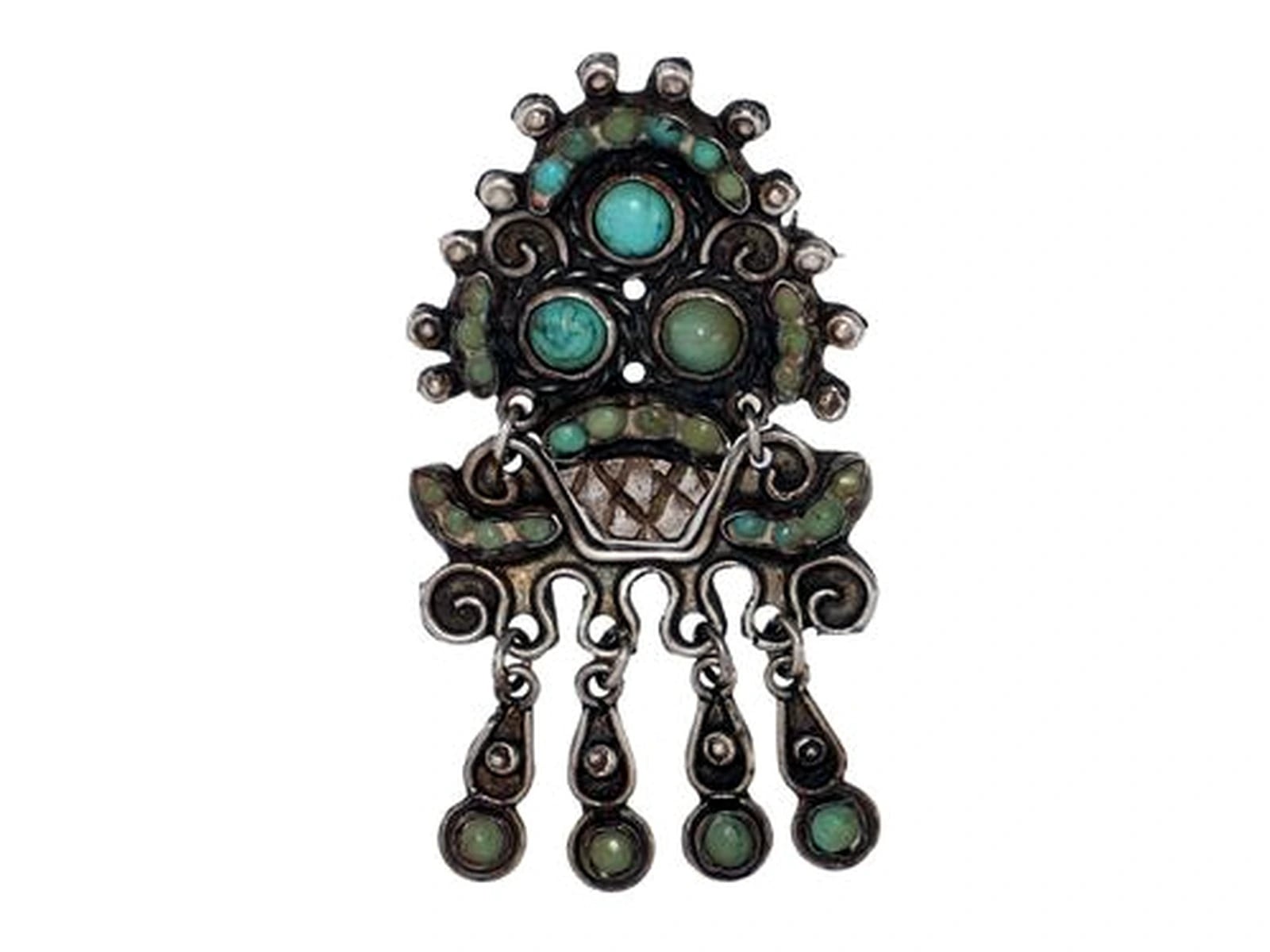
MATL (Matilde Poulat)
Mask Pendant
1934 or later
Turquoise