Saves instantly, no account needed. Already a member? Sign in.
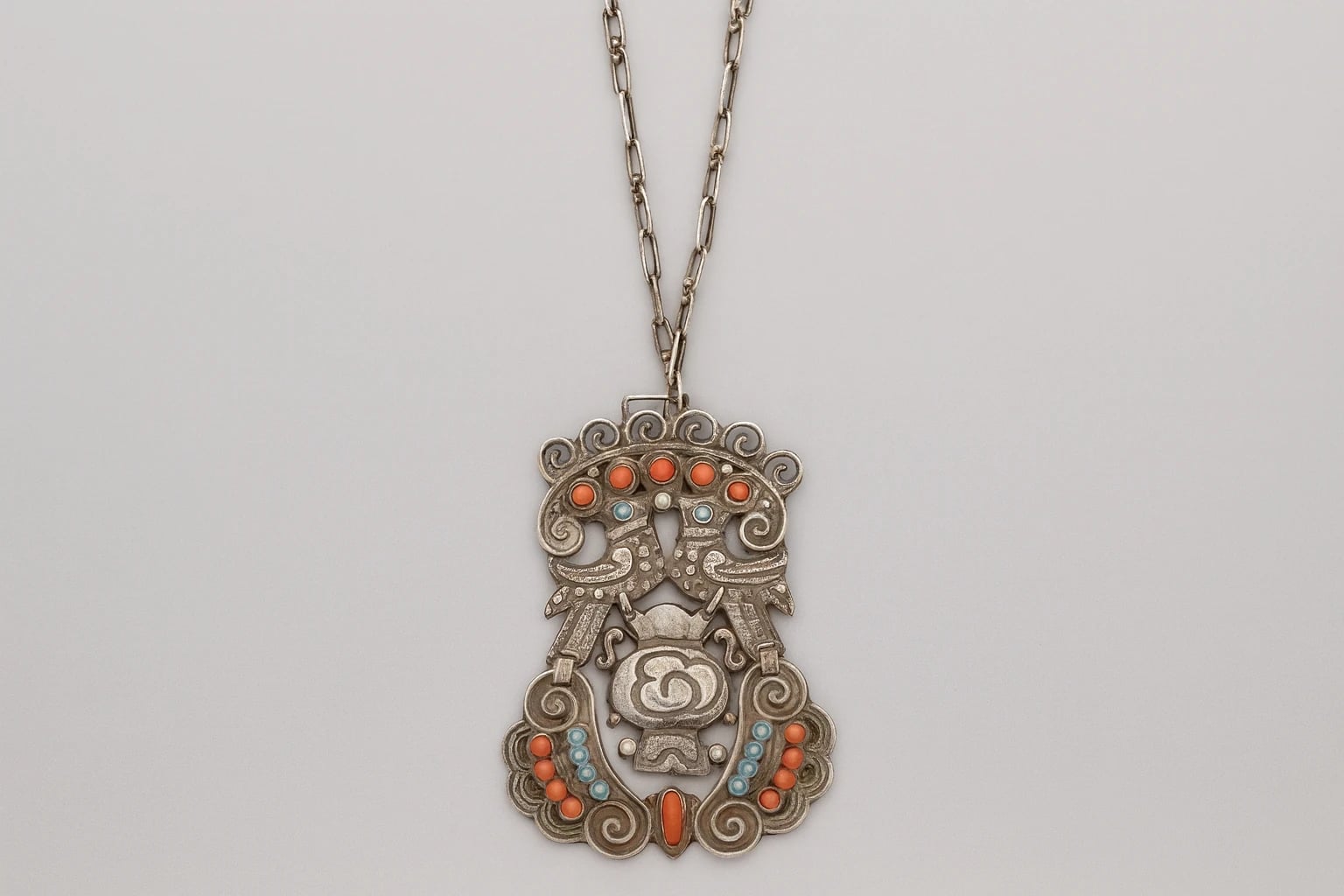
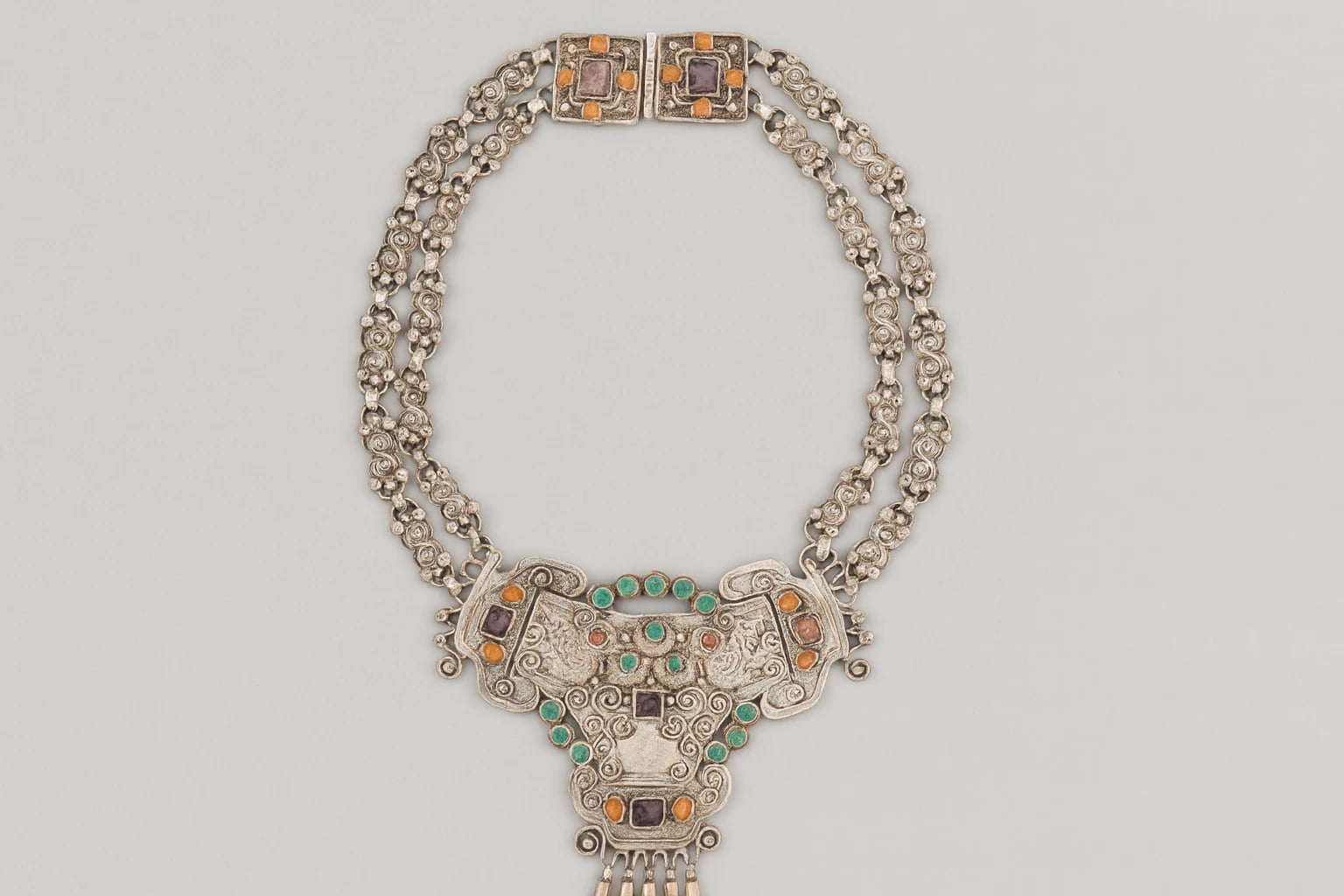
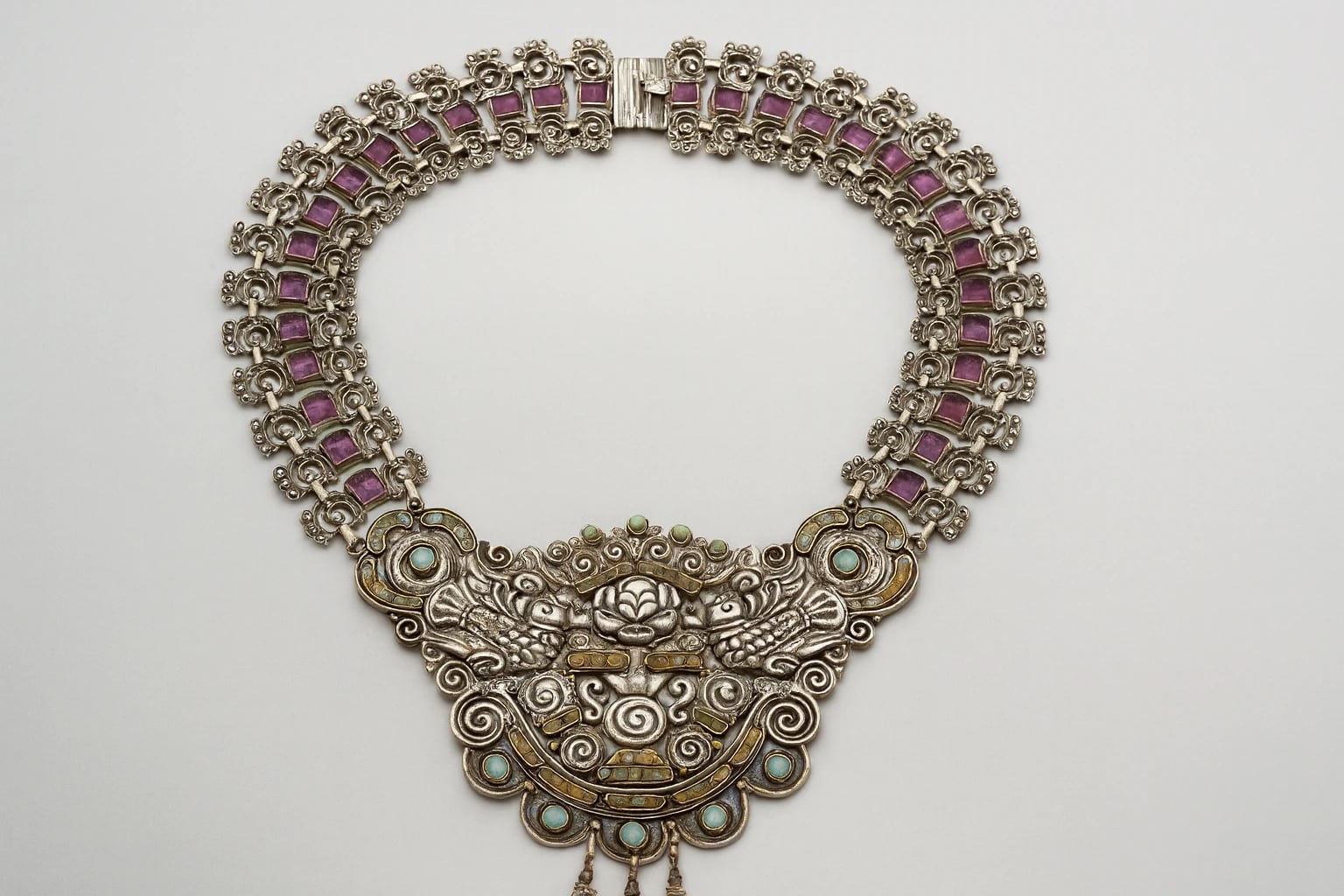
A butterfly holds the center of this necklace, its wings spread across a field of turquoise and coral in the dense, jewel-encrusted manner that made Matilde Poulat's workshop recognizable at a glance. The insect is not treated as a naturalistic study but as a symmetrical ornament, its body a vertical axis and its wings paired mirror images filled edge to edge with cut stones. The design belongs to a Mexican decorative sensibility that prized saturated color and horror vacui, the deliberate filling of every surface, rather than the spare metal geometry associated with the Taxco School to the south. It is a useful reminder that the twentieth-century silver renaissance ran along more than one aesthetic track.
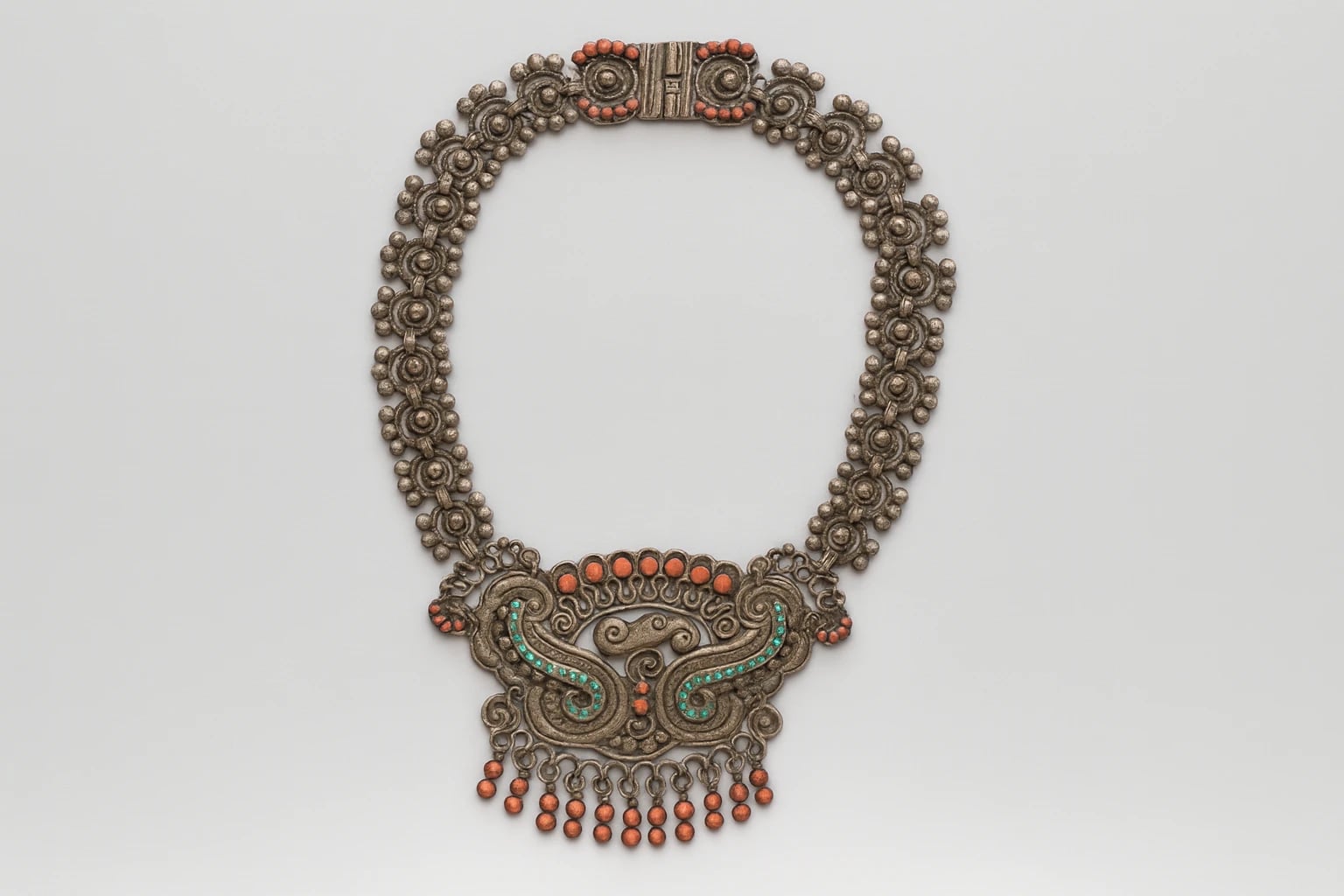
The color relationship carries the piece. Turquoise supplies a cool, opaque blue-green ground, and coral interrupts it with warm red accents, the two stones set close so that their contrast reads even at a distance. Poulat trained as a painter at the San Carlos Academy, and the handling of color here is closer to a painter's than a jeweler's habit of isolating a single showpiece stone. The stones sit in silver bezels that double as drawing, outlining each wing segment and lending the composition the cloisonné-like divisions of an enamel. MATL designs typically combine these stones with small silver beadwork and scrollwork that frame the color and keep the whole from dissolving into pattern, and the butterfly's symmetry gives the eye a stable center around which the necklace can be read.
Matilde Poulat opened her Mexico City shop in 1934 and registered the trademark "MATL," taken from a word for water, under number 142093. Her production drew on Mexican popular and folk imagery, including birds, flowers, hearts, and insects, rendered in a manner that owed little to European modernism and much to colonial religious silver and native craft color traditions. The butterfly sits comfortably within that vocabulary. After Poulat's death in 1960, her nephew Ricardo Salas continued the MATL designs, and the workshop marks record this long life: script and block "MATL" stamps with fineness figures in the earlier decades, later marks adding the M. Regis 142093 registration and, under Salas after 1980, the MS-12 designation. Because the design language persisted across these hands, a MATL butterfly of this type must be dated by its mark and construction rather than assumed to date from Poulat's own lifetime.
Within a collection, the necklace documents a strand of the Mexican silver renaissance that developed in the capital rather than in Taxco and that answered modern taste with color and dense ornament instead of reductive form. It shows how a painter's eye reshaped the jeweler's craft, and how a workshop identity strong enough to outlive its founder was built on a repeatable, immediately legible design vocabulary. The butterfly is one of the recurring motifs through which that vocabulary was expressed.
Museum of Mexican Silver. “Butterfly Necklace with Turquoise and Coral.” Catalog no. MoMS-001521. https://museumofmexicansilver.com/pieces/matl-turquoise-coral-butterfly-necklace
See something wrong with this record? Suggest a correction and the piece details fill in automatically.
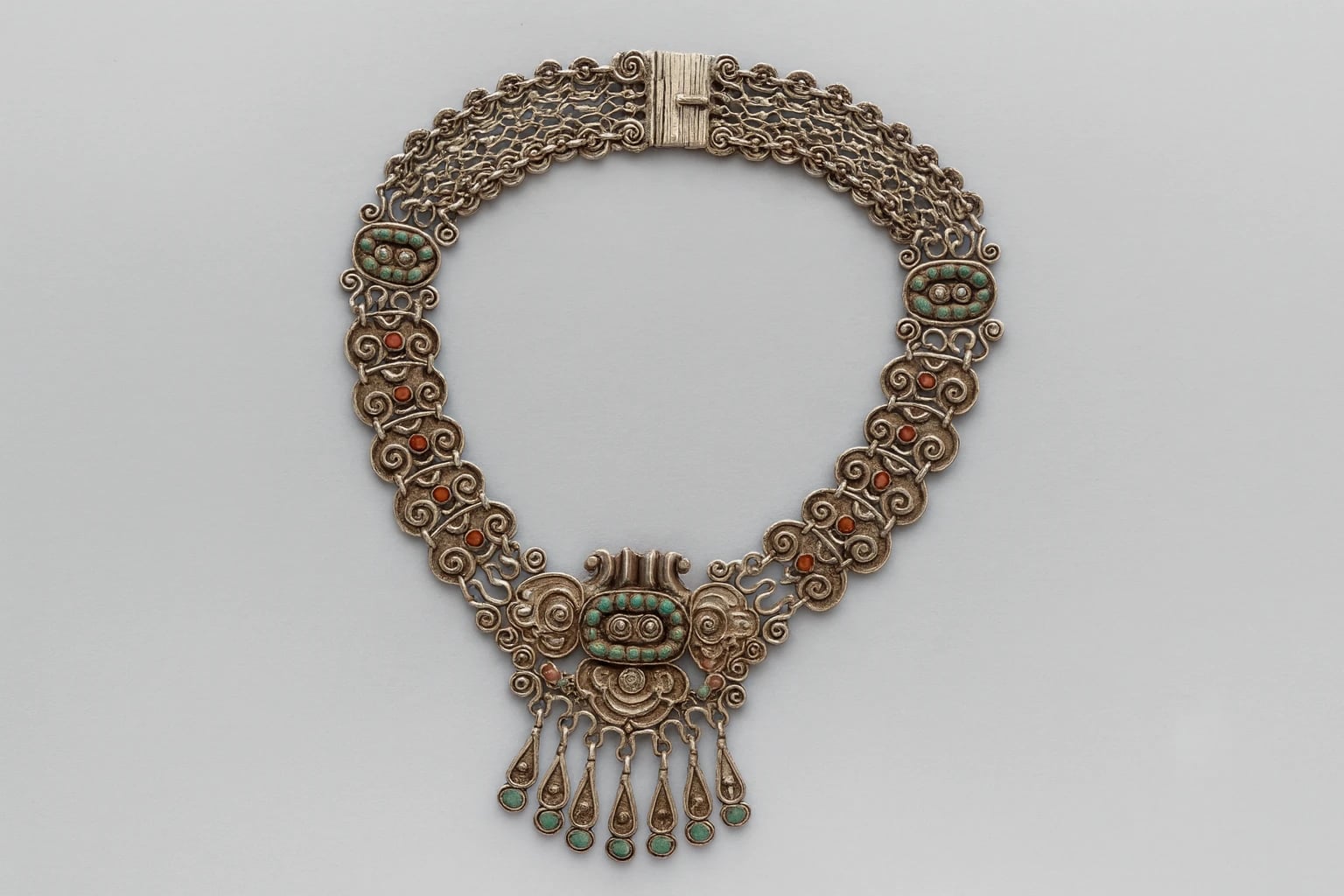
MATL (Matilde Poulat)
Scrollwork Fringe Necklace with Turquoise and Coral
1934-1948
Turquoise