Saves instantly, no account needed. Already a member? Sign in.
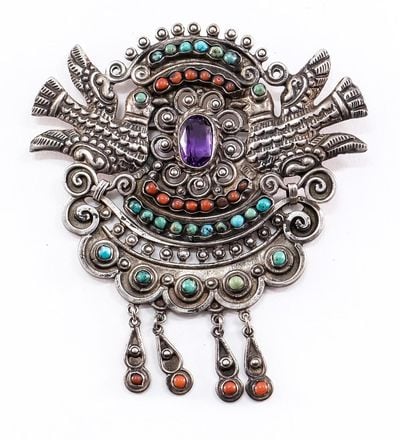
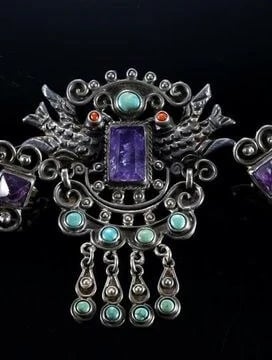
A dense cluster of turquoise and a central amethyst, framed by scrolling silverwork and paired wings, this brooch shows the MATL workshop translating colonial and folk devotional imagery into a portable modern ornament. Matilde Poulat built her jewelry around color and symmetry rather than the planar geometry that governed much Taxco design of the same decades. Where a Spratling brooch might resolve into a single silhouette, this piece organizes itself around a vertical axis, letting the amethyst anchor the composition while turquoise fills the surrounding silver with saturated blue. The result is ornament conceived by a painter, a maker who thought first in color and pattern.
The winged form places the brooch within a specific iconographic tradition. Poulat drew repeatedly on the vocabulary of Mexican religious silver and popular art: doves, hearts, flowers, and the winged and haloed motifs that recur across colonial retablos and ex-votos. Here the paired wings spread symmetrically from the central stone, a device that reads at once as a bird and as the winged frame of devotional imagery. The turquoise is set in massed clusters rather than isolated points, so that color operates as a field. The amethyst, cooler and translucent against the opaque blue, marks the center and gives the eye a single point of focus. Silver functions less as structure than as the drawn line that organizes and separates the stones, closer to the scrolling metalwork of colonial altar pieces than to the reductive forms of her Taxco contemporaries.
Poulat trained as a painter and designer at the San Carlos Academy, where Diego Rivera was a fellow student, and she opened her own shop in Mexico City in 1934. The name MATL, registered as trademark number 142093, derives from a Nahuatl root for water. Her aesthetic stood deliberately apart from the Taxco School: rather than distilling ancient Mexican sources into severe abstraction, she gathered colonial, folk, and devotional motifs into dense, colorful, frankly ornamental compositions. That approach proved durable. After her death in 1960, her nephew Ricardo Salas continued the MATL designs, at times supervising several dozen silversmiths, and the workshop carried the mark forward for decades. Because the recognizable MATL style persisted across this long production, the specific mark on any given example matters for dating: the script MATL fineness stamps belong to the earlier decades, while the registration mark M. Reg 142093 and the later MS-12 signal Salas-era production.
The brooch documents an alternative current within the Mexican silver renaissance, one grounded in Mexico City rather than Taxco and in painterly color rather than modernist geometry. It shows how the postrevolutionary interest in Mexican popular and colonial art could yield jewelry that embraced ornament and devotional imagery instead of rejecting them. For a collection tracing the full range of the renaissance, a MATL winged brooch establishes the counterweight to the reductive Taxco line, and clarifies that the movement contained more than one idea of what modern Mexican silver could look like.
Museum of Mexican Silver. “Winged Amethyst Brooch with Turquoise.” Catalog no. MoMS-002256. https://museumofmexicansilver.com/pieces/matl-winged-amethyst-brooch-with-turquoise
See something wrong with this record? Suggest a correction and the piece details fill in automatically.