Saves instantly, no account needed. Already a member? Sign in.
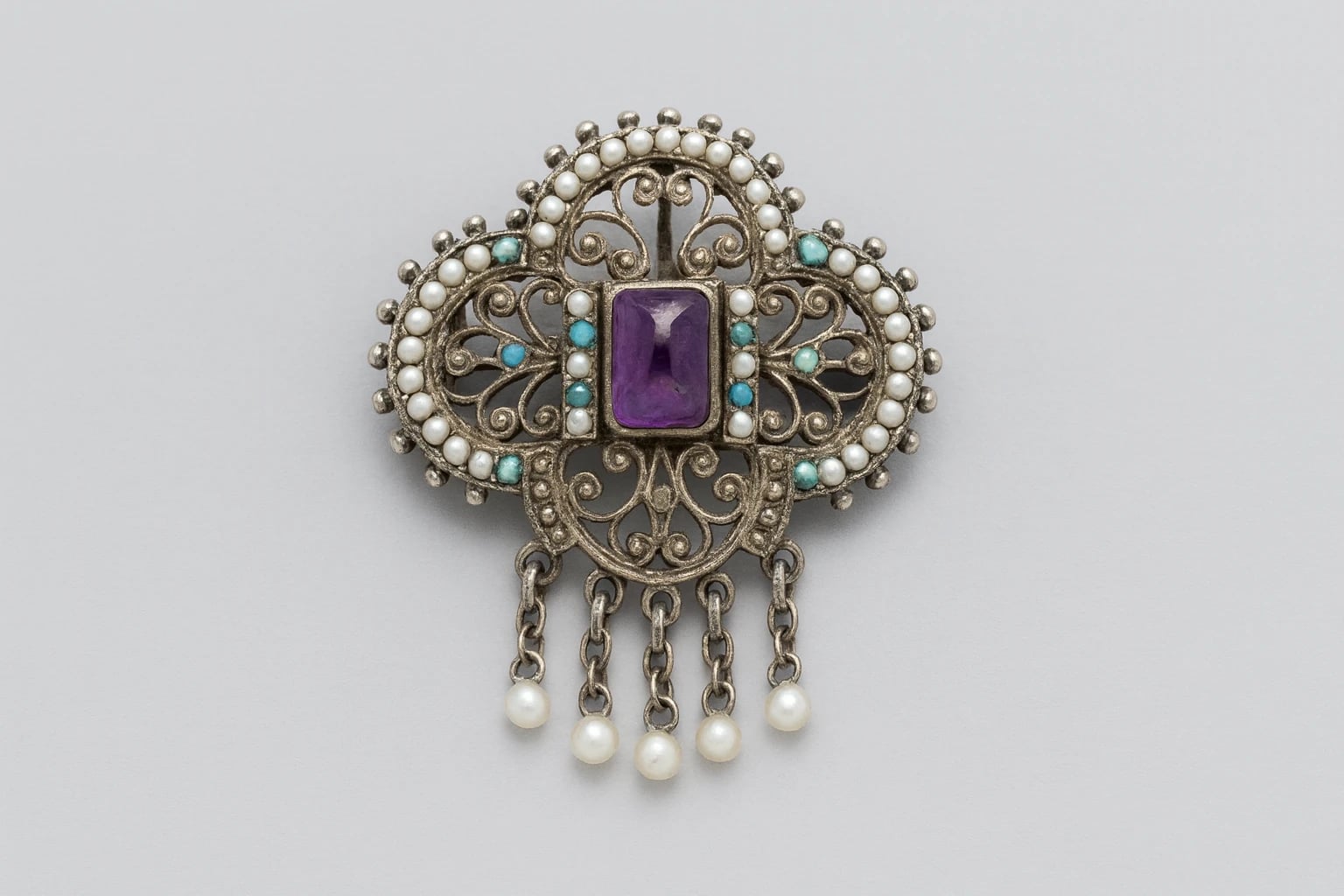
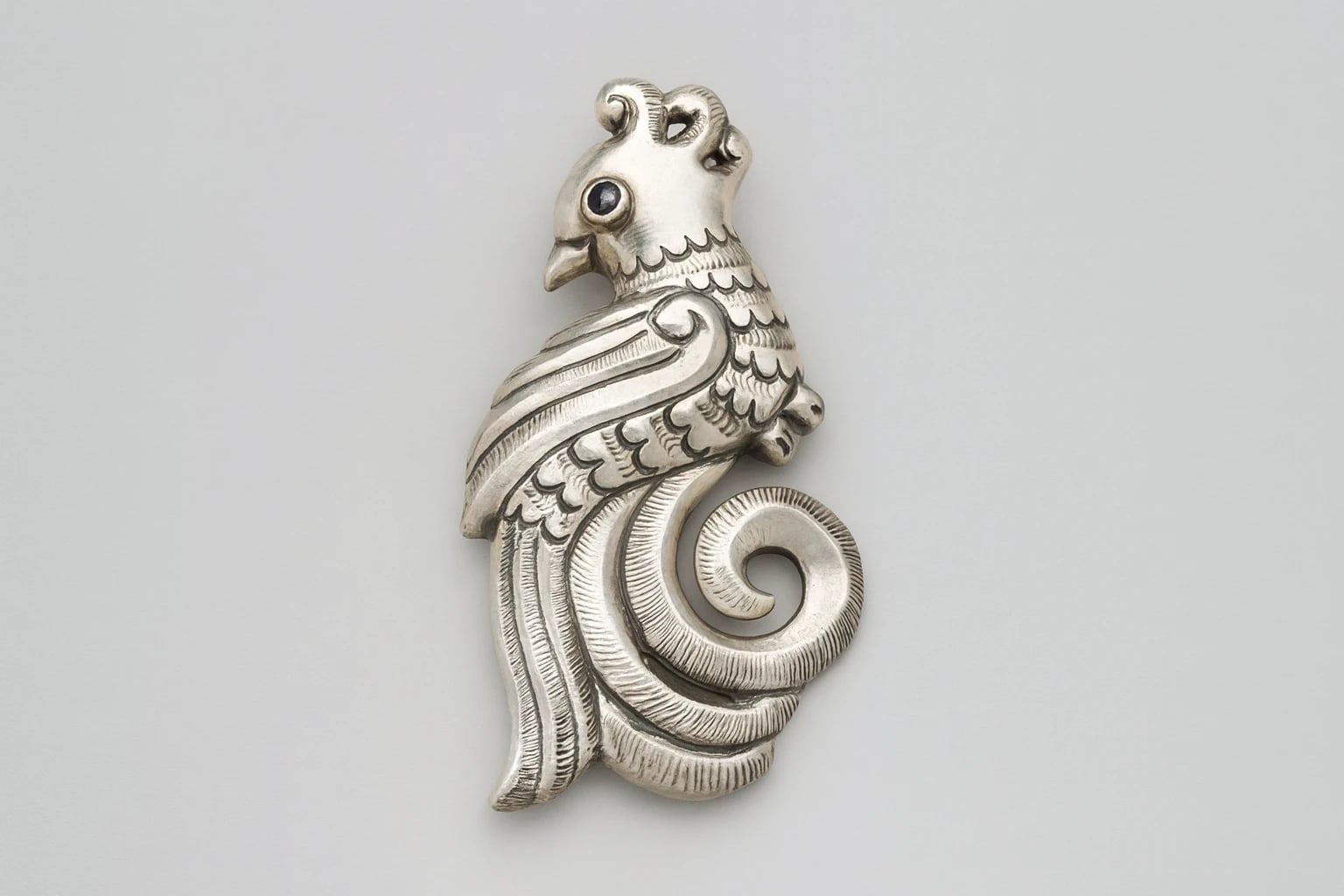
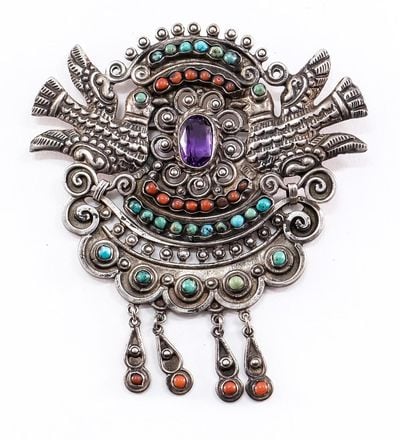
A dove with spread wings carries the entire composition here, its body and pinions built up in silver and set with turquoise so that the bird reads first as color and only afterward as line. Around it, Matilde Poulat organizes a dense field of scrolls, beading, and small blossoms, punctuating the design with amethyst that shifts the palette from the cool blue-green of the turquoise toward violet. The result is a brooch that treats the medallion format as a small altar to a single emblem, a compositional habit that distinguishes MATL work from the more austere geometry favored elsewhere in Mexican silver of the period.
The construction favors accumulation over reduction. Poulat fills the ground with tightly coiled wirework and granulated dots, so that almost no surface is left plain, and the eye moves through ornament rather than across open metal. Turquoise, set in irregular pieces, does much of the modeling of the wings, while the amethyst functions as accent and weight, drawing the composition inward toward its centered stones. This is jewelry organized around bilateral symmetry and a strong vertical axis, with the dove as the fixed point from which the scrolls radiate. The opacity of the turquoise matters to the effect: it holds color flatly against the silver rather than transmitting light, which keeps the bird legible as a solid shape even within a crowded field.
The dove, scrollwork, and floral density connect MATL to Mexican colonial and popular religious silver rather than to the machine-age vocabulary that shaped much Taxco design. Matilde Eugenia Poulat trained as a painter and designer at the San Carlos Academy and opened her shop in 1934, registering the name Matl, a variation of an Aztec word for water, as trademark number 142093. Her work stands somewhat apart from the workshop lineage that ran through Spratling's Las Delicias, drawing instead on ex-voto imagery, devotional ornament, and folk motifs recast in silver and semiprecious stone. That distinctive idiom proved durable enough to outlive her. After her death in 1960, her nephew Ricardo Salas continued producing the MATL designs and, at peak, supervised several dozen silversmiths, so that the style became a sustained workshop practice rather than a single hand's output.
Dating a MATL piece requires attention to its mark, since the design vocabulary changed little over decades. The museum's hallmark reference, rebuilt from Hougart, records seven distinct MATL stamps, from the early block-letter fineness marks through the etched-script forms that carry the registration number 142093, and later still the MS-12 marks that Salas used from 1980 onward. A brooch in this style therefore belongs to a design conceived under Poulat but may have been fabricated across a long span, and the specific mark on any given example is the surest guide to when it was made. For a collection tracing the Mexican silver renaissance, the piece documents a devotional and folk-art current that ran alongside, and independent of, the modernist mainstream, and it shows how a painter's sensibility for dense, centered composition translated into worked metal and colored stone.
Museum of Mexican Silver. “Spread-Wing Dove Medallion Brooch with Turquoise and Amethyst.” Catalog no. MoMS-002216. https://museumofmexicansilver.com/pieces/matl-winged-dove-medallion-brooch-with-turquoise-and-amethyst
See something wrong with this record? Suggest a correction and the piece details fill in automatically.
MATL (Matilde Poulat)
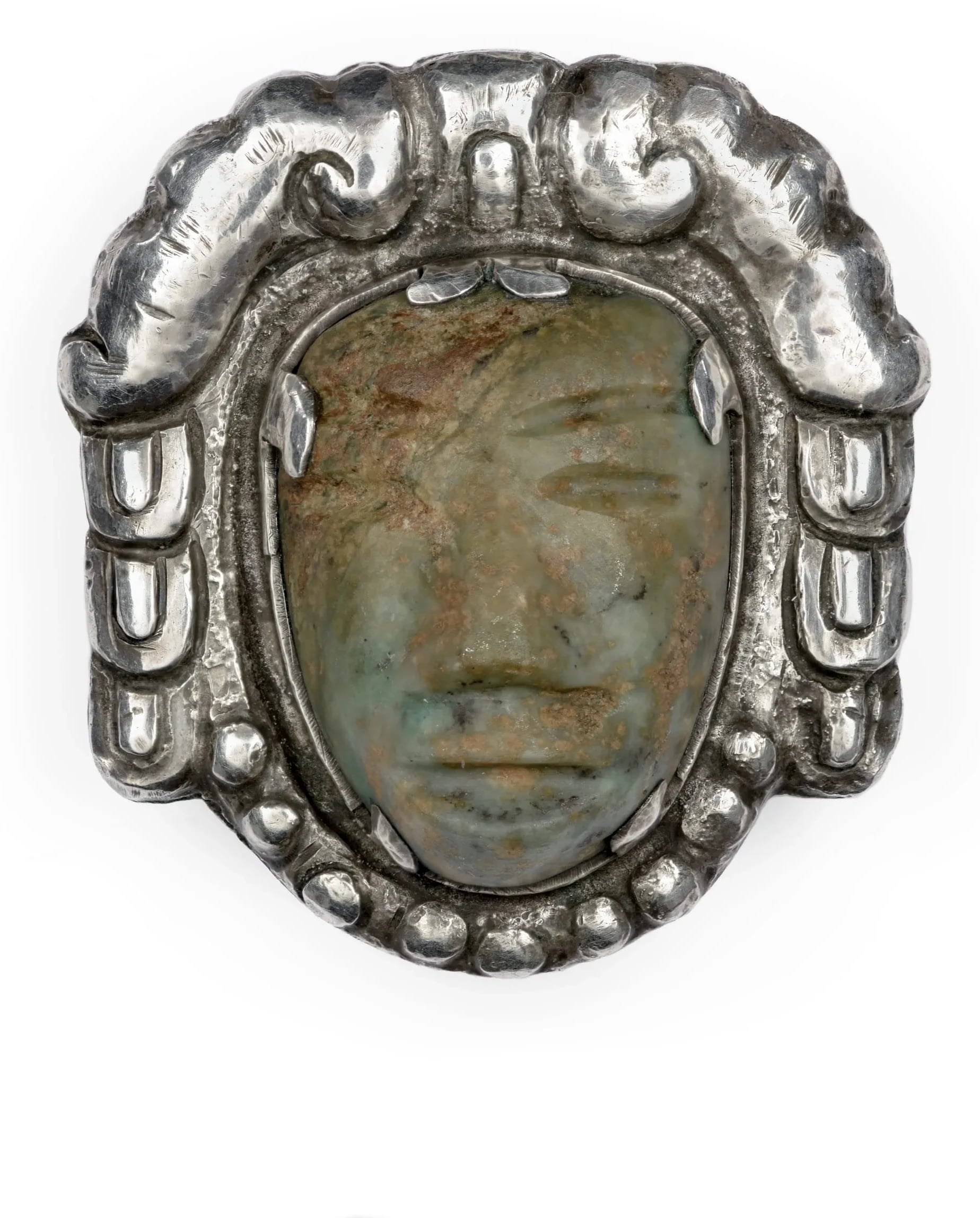
Carved Stone Face Brooch
1934-1940
Silver