Free account. We'll finish the save once you're in. Already a member? Sign in.
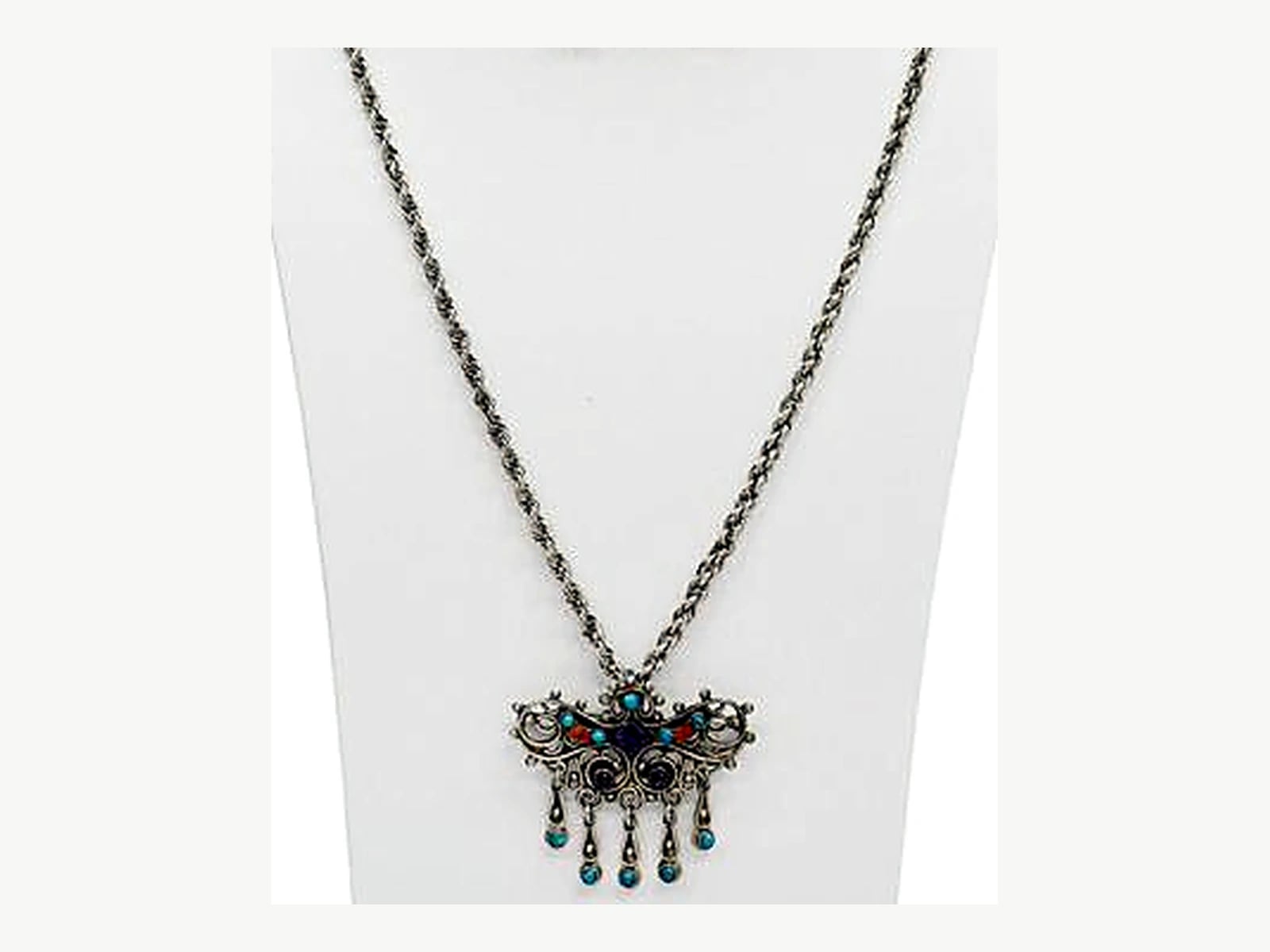
The pendant brooch by Morales belongs to the broad MATL school of Mexico City silver rather than to the MATL workshop itself. Its signature and registration mark, Morales, MC-102 Mexico 925, separate it from the marks of Matilde Poulat and Ricardo Salas, while its form clearly works within the visual language that made MATL jewelry so recognizable: small saturated stones, darkened silver, curling line, pendant drops, and a compact devotional scale adapted for bodily adornment. At 2 1/8 by 2 3/8 inches, the jewel is modest in size but dense in incident. The long sterling rope chain allows the pendant to sit low on the chest, where the horizontal crest of the brooch and the five turquoise drops read as a small suspended altar of color and movement.
The design is organized around a shallow crescent of silver scrollwork, with amethyst cabochons held in the center and smaller turquoise and red coral accents interrupting the surface. The five turquoise drops below give the piece its rhythm. They do not simply hang from the lower edge. They repeat the blue of the upper stones in a slower tempo, pulling the eye downward and allowing the object to shift slightly with the wearer. The contrast of purple, blue, and red is essential to the effect. MATL jewelry made color part of structure, not an addition to it, and Morales follows that lesson closely. The stones punctuate the silver like enamel in a colonial church interior or like inlaid color in a small popular devotional object, yet the symmetry and compressed geometry keep the brooch within a twentieth century design vocabulary.
Matilde Poulat’s work, introduced under the MATL name in 1934, emerged from Mexico City rather than Taxco, although it became inseparable from the larger Mexican silver renaissance. Morrill and Berk describe her jewelry as drawing on postrevolutionary efforts to define a Mexican aesthetic through ancient sources, pueblo art, religious imagery, and folk forms, especially after the 1932 discovery of Mixtec gold jewelry at Monte Albán. They also note the MATL workshop’s characteristic use of coral, turquoise, and amethyst quartz, together with elaborate silver surfaces. Morales adapts that inheritance without claiming the MATL name. The result is not a copy of a known Poulat or Salas object, but a Mexico City MATL-school jewel: one that absorbs the workshop’s color, surface, and suspended movement into a more anonymous but still carefully composed production.
That distinction matters. The Mexican silver renaissance was never limited to a short list of canonical names, and the MATL school was not confined to objects signed MATL. Designs like this pendant brooch show how a powerful workshop language moved outward into adjacent makers and registrations, carrying with it a recognizable idea of Mexican ornament as layered, colored, and tactile. Morales remains documented chiefly through the MC-102 mark, but the object itself gives that sparse record substance. It preserves the diffusion of MATL’s visual vocabulary into Mexico City silver production and helps trace the broader field in which twentieth century Mexican jewelry transformed small scale adornment into a serious vehicle for modern design.
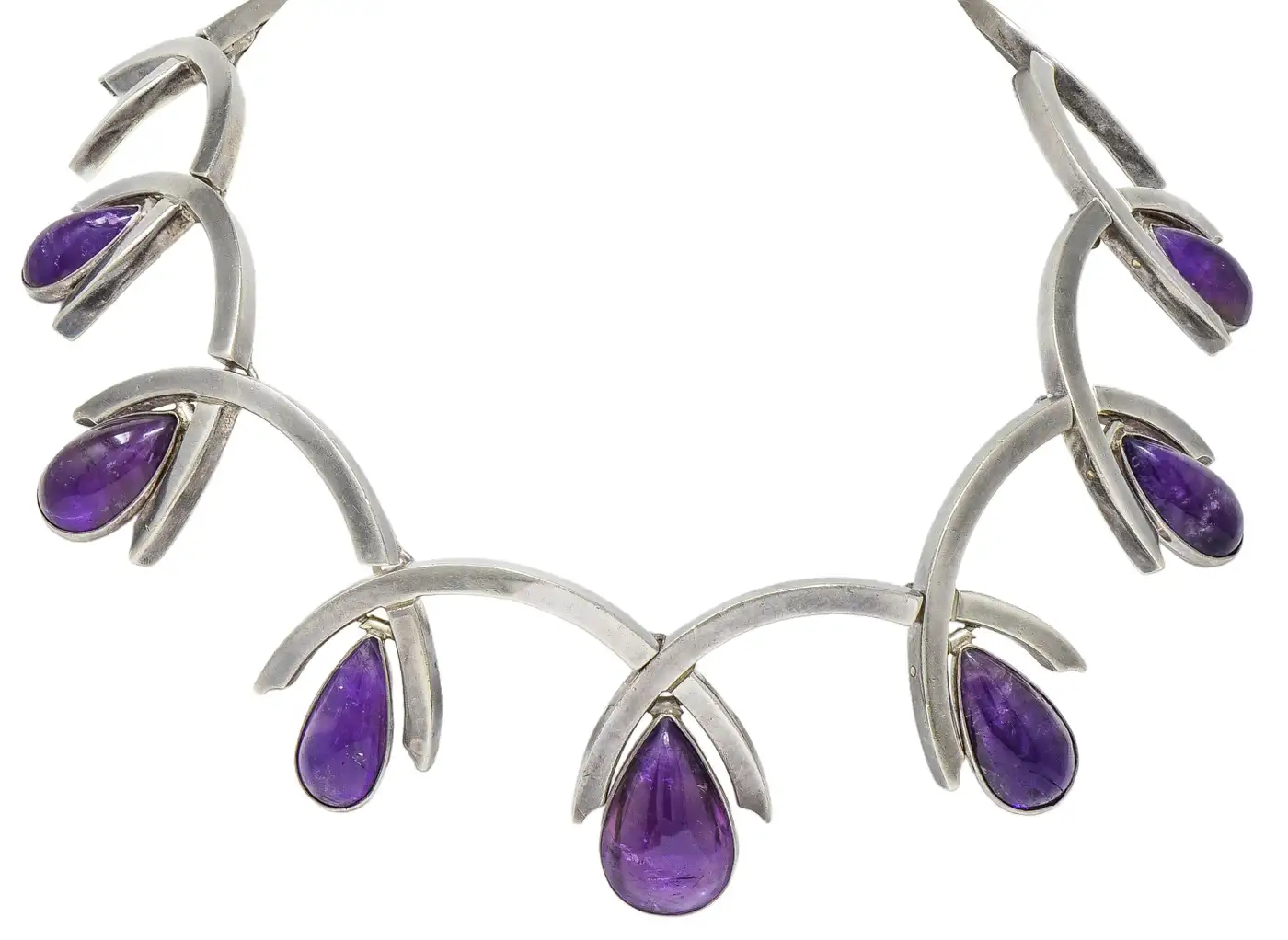
Sold Austin Auction Gallery 2021 in a lot of two necklaces described as 'in the style of Matilde Poulat', with the hardstone link choker in this collection (matl-two-hardstone-necklaces). Signed Morales, marked MC-102 Mexico 925.
Museum of Mexican Silver. “Hardstone Pendant Necklace.” Catalog no. MoMS-002202. https://museumofmexicansilver.com/pieces/morales-hardstone-pendant-necklace
See something wrong with this record? Suggest a correction and the piece details fill in automatically.
Modernist Silver and Azurmalachite Collar Necklace
Sterling silver