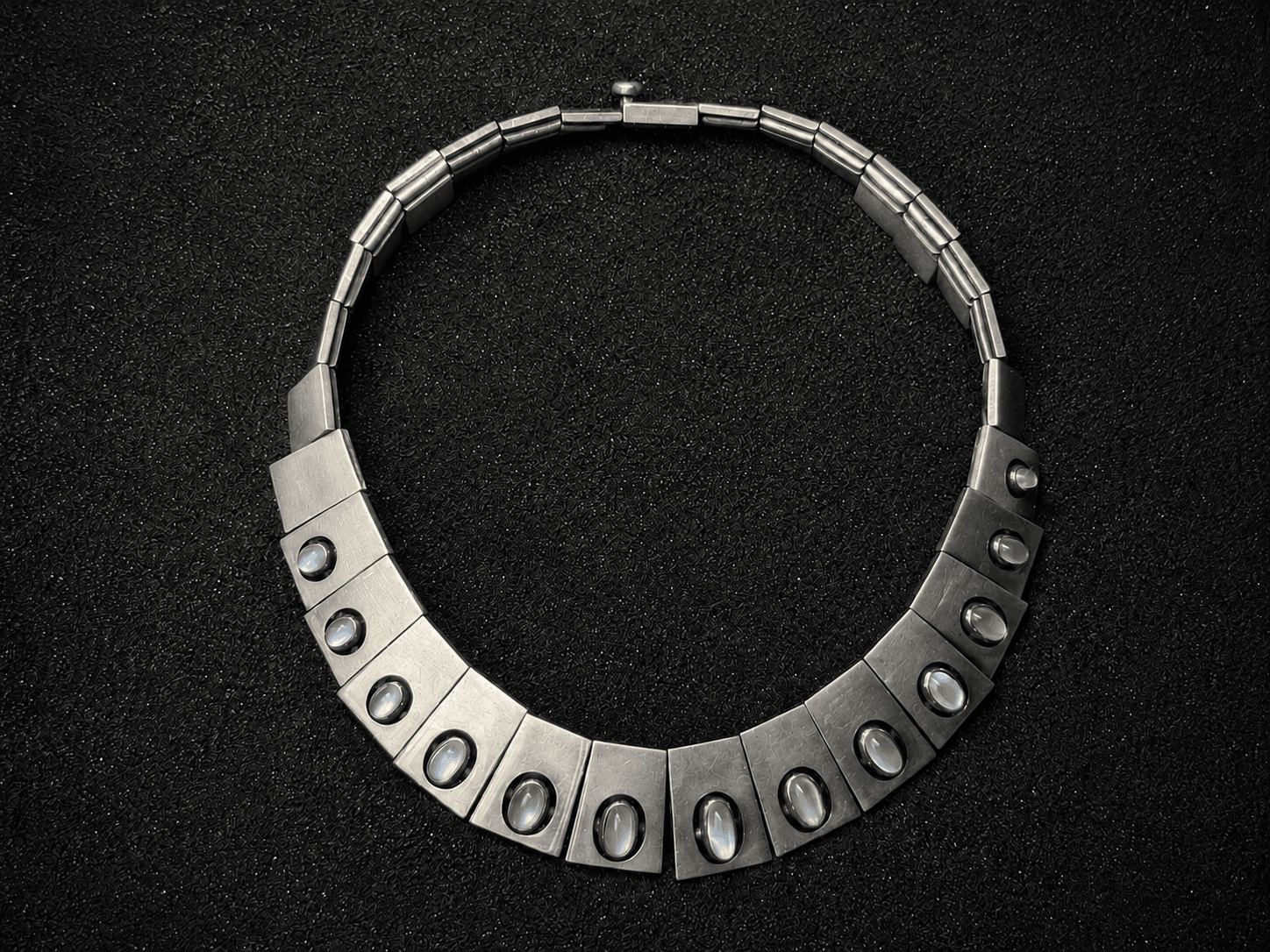
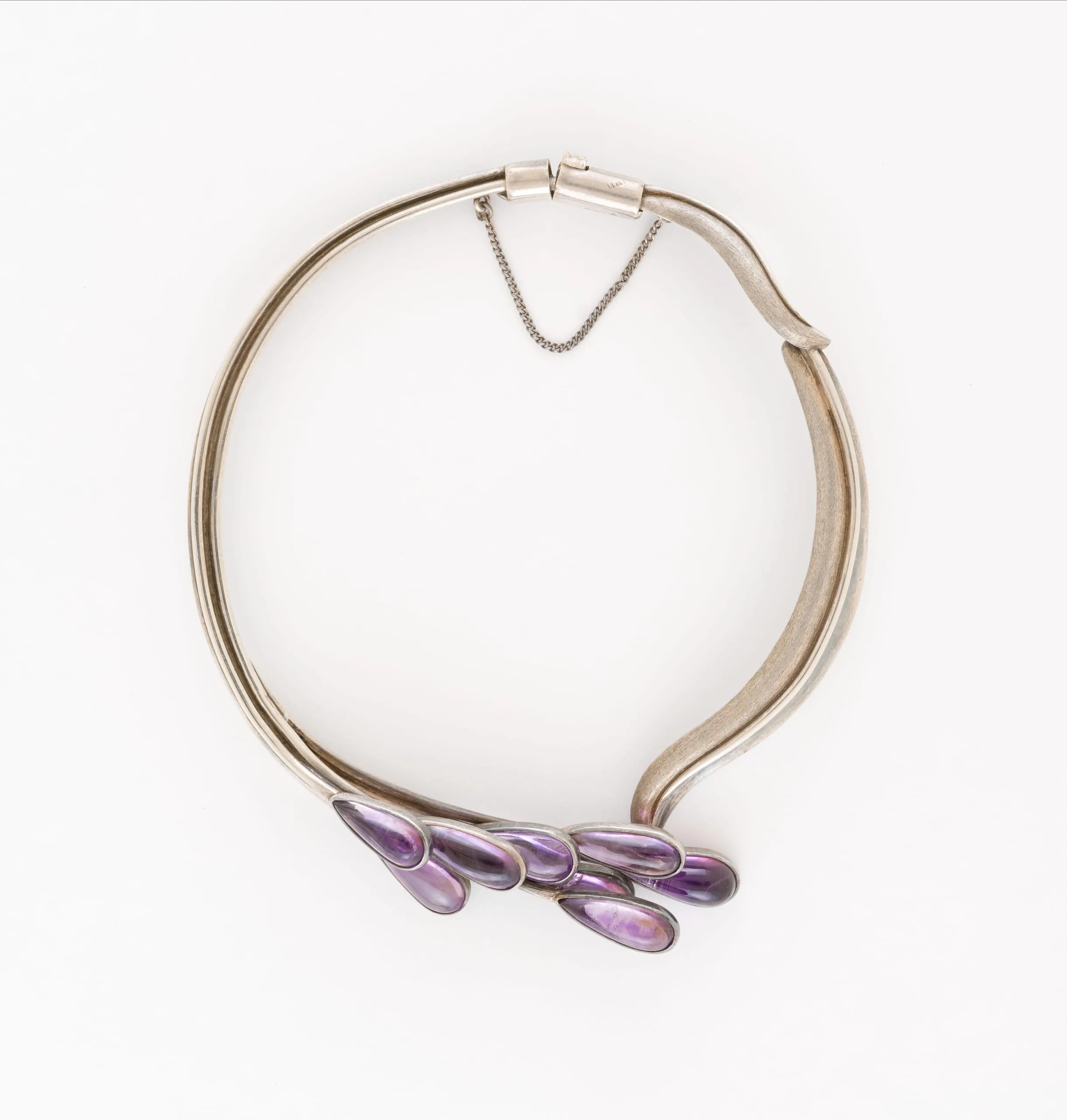
Trapezoid-Panel Moonstone Necklace (Stromberg fig. 227a)
Saves instantly, no account needed. Already a member? Sign in.
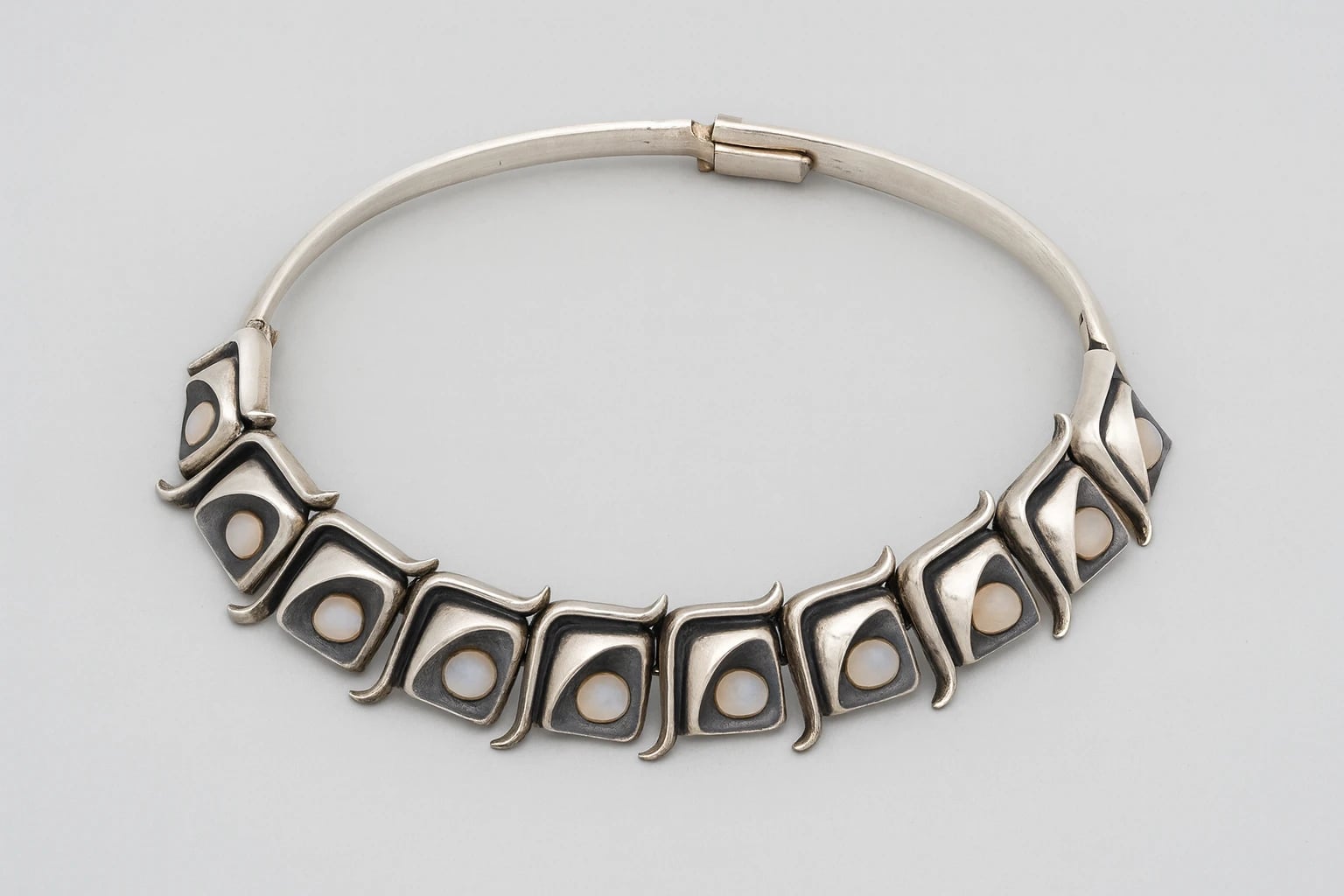
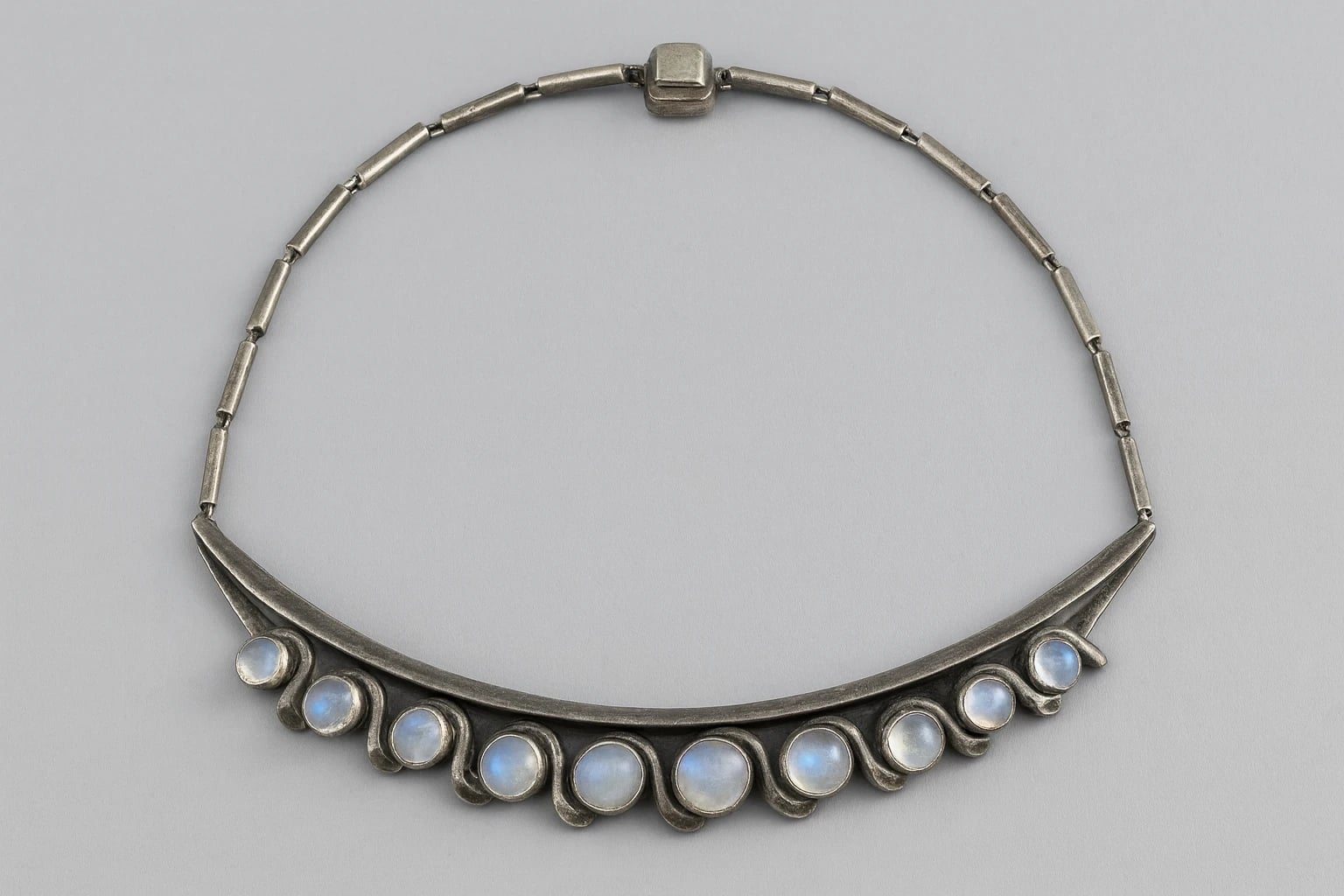
A rigid silver collar curves to a broad, tapering bib at the front, its lower edge lined with bezel-set oval moonstone cabochons that catch and soften the light against the sweep of polished metal. The body of the collar reads as a single sculptural plane, while the sides resolve into an articulated band of small beaded segments that lets the piece sit close around the neck. It is a design that treats the silver itself as the principal material, with the moonstones set as measured, recurring accents rather than as a scattered display of stones, the whole thing built to be worn as one bold architectural form.
The vocabulary is unmistakably Antonio Pineda's. From his Taxco workshop, established on the zócalo in 1941, Pineda forged a body of jewelry that Gobi Stromberg describes as known for its boldness and superb craftsmanship (Stromberg 2008, p. 17), and the pairing of moonstone with sterling recurs across his output, as in the Moonstone Necklace recorded by Penny C. Morrill in 970 silver under the Antonio crown mark (Morrill 1996, p. 181). The articulated beaded band and the strong, continuous front plate also belong to a line of Pineda work in which linked bands of beading carry forms with a Pre-Columbian feel, reworked, as Morrill notes of his early necklaces and bracelets, with added texture and dimension into a sophisticated twentieth-century interpretation (Morrill 1996, p. 178).
Worn, the collar reads as modern sculpture for the body rather than ornament applied to it, the cool translucence of the moonstones playing against silver shaped into a single confident curve. This collar carries the qualities, weight of metal, disciplined stone-setting, and architectural form, that define his contribution to the Taxco school.
Record data: Stromberg, Silver Seduction: The Art of Mexican Modernist Antonio Pineda, p. 159, fig. 227a, documents this necklace and supplies the 970 silver standard, the Antonio crown mark, a date of 1953 or later, and a diameter of 15.5 cm. All are now entered as structured fields and the reference is listed under References. The title has been tightened from "Trapezoid and Moonstone Collar Necklace" to Trapezoid-Panel Moonstone Necklace, which describes the construction rather than listing components.
Museum of Mexican Silver. “Trapezoid-Panel Moonstone Necklace (Stromberg fig. 227a).” Catalog no. MoMS-001934. https://museumofmexicansilver.com/pieces/pineda-silver-and-moonstone-collar-necklace
See something wrong with this record? Suggest a correction and the piece details fill in automatically.
Antonio Pineda
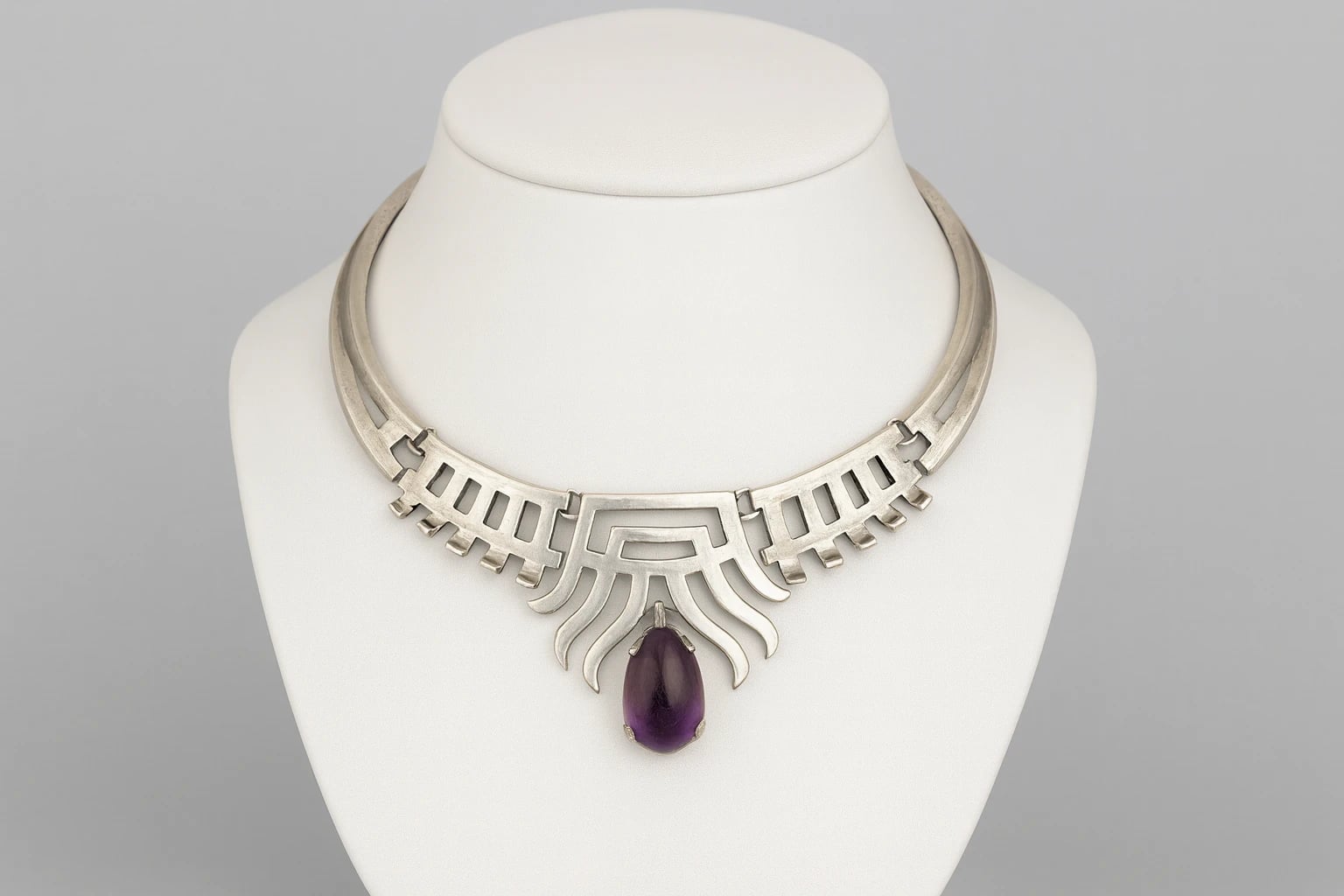
Teardrop Necklace
c. 1953
Sterling silver