Saves instantly, no account needed. Already a member? Sign in.
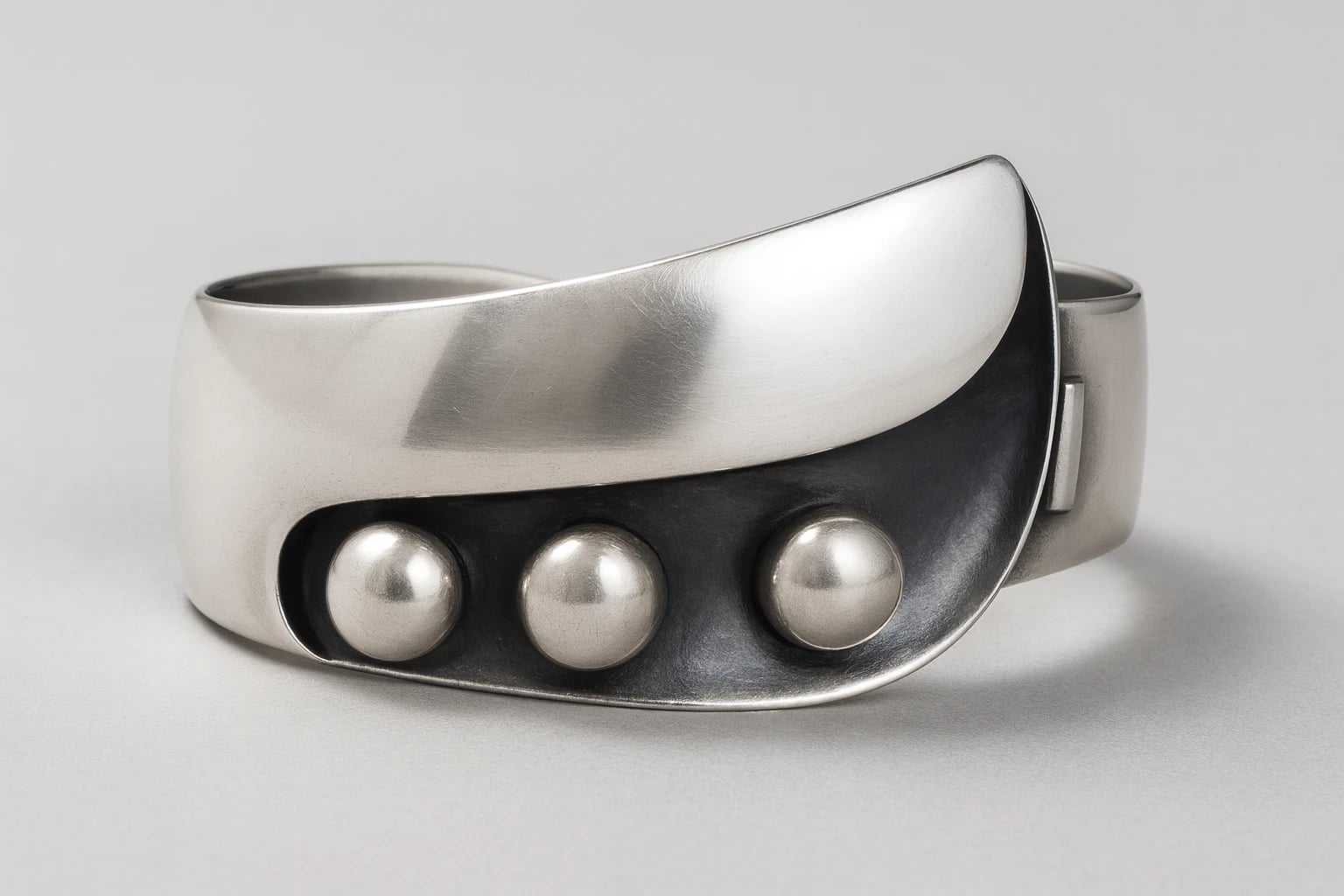
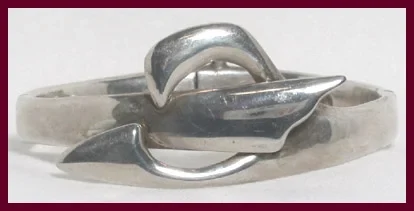
The bracelet is organized around a compact interlock at the front: two polished silver forms pass across and through one another, creating a small architecture of overlap, shadow, and open space. Its band is narrow in relation to the central motif, one inch high at the front and seven inches around the inside, so the design concentrates attention at the wrist’s upper surface rather than distributing ornament evenly around the arm. The two side hinges are important to that effect. They allow the bracelet to open and close cleanly while preserving the visual continuity of a rigid bangle.
The central construction has the clarity associated with Sigi Pineda’s mature modernist work. A pointed, swept form crosses a rounded element below it, while a second raised curve frames the top. The bracelet does not rely on stone color, engraving, or applied decoration. Its interest comes from the way silver changes as it turns: broad highlights gather on the convex surfaces, darker reflections settle into the recesses, and the open passages prevent the front from becoming a single heavy mass. The interlocking design is therefore both motif and mechanism of seeing. It gives the bracelet depth without enlarging its footprint.
Marked with the old Sigi Tasco mark, eagle 36, and a design number read as 19 or 61, the bracelet belongs to the period in which Sigfrido “Sigi” Pineda was establishing an independent language after work in major Taxco settings. Published scholarship records his presence among the silversmiths who followed Margot van Voorhies into Margot de Taxco, where he oversaw the enamelers for four years before opening his own shop in the mid 1950s. Other specialist accounts place him earlier at Los Castillo and note that his shop Plateros, opened in 1952, was later renamed Sigi. That background matters here not as biography alone, but because this bracelet leaves enamel and pictorial ornament behind in favor of abstract form, controlled volume, and disciplined surface.
Within the Mexican silver renaissance, the bracelet represents a restrained branch of Taxco modernism. It is not a translation of ancient motif, nor an ornamental souvenir of place. Its Mexican modernity lies in the taller system that formed it, in the Taxco practice of making design inseparable from bodily use, and in the confidence with which sterling silver becomes structure, image, and reflected light at once. The old Sigi mark and eagle 36 situate the piece within the historical marking system of mid century Mexican silver, while the low design number suggests an early place within the workshop’s numbered production. As an object for the Museum, it records Sigi Pineda’s ability to make a small hinged bracelet carry the spatial intelligence of sculpture without losing the scale and precision of jewelry.
Museum of Mexican Silver. “Interlocking Leaf Hinged Bracelet.” Catalog no. MoMS-002330. https://museumofmexicansilver.com/pieces/sigi-pineda-modernist-hinged-bracelet-3
See something wrong with this record? Suggest a correction and the piece details fill in automatically.
Sigi Pineda
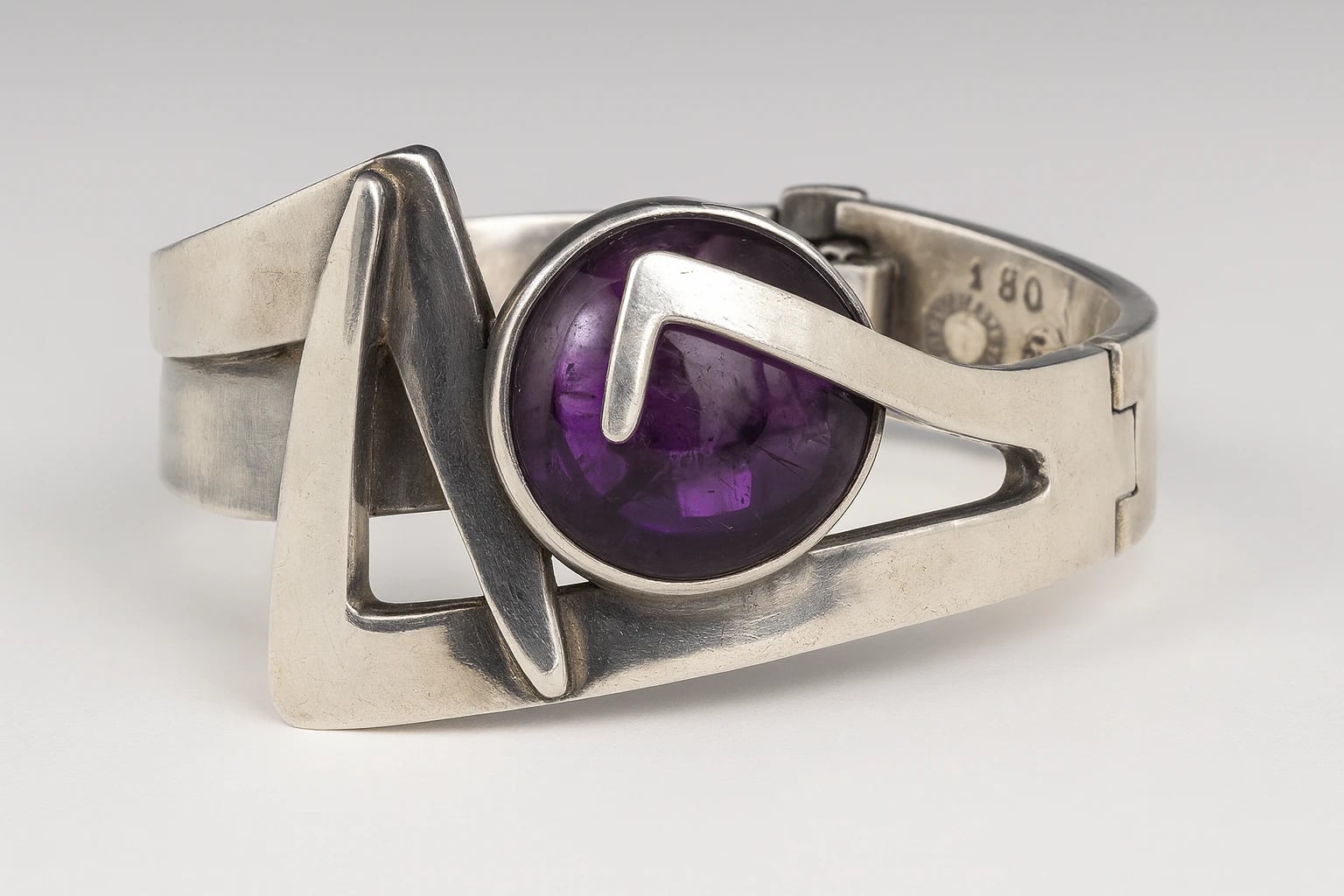
Modernist Hinged Bracelet with Amethyst and Niello
Amethyst