Saves instantly, no account needed. Already a member? Sign in.
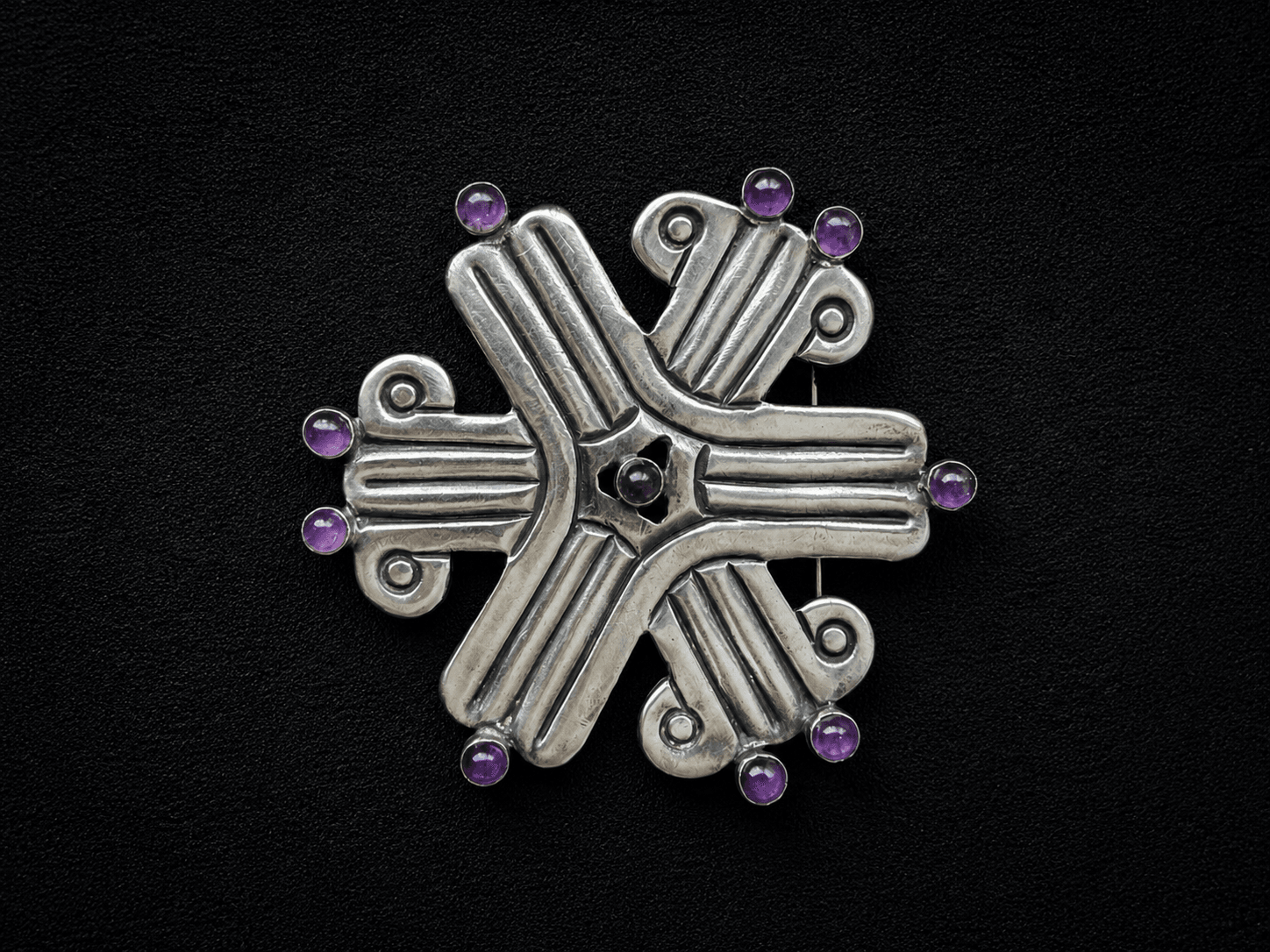
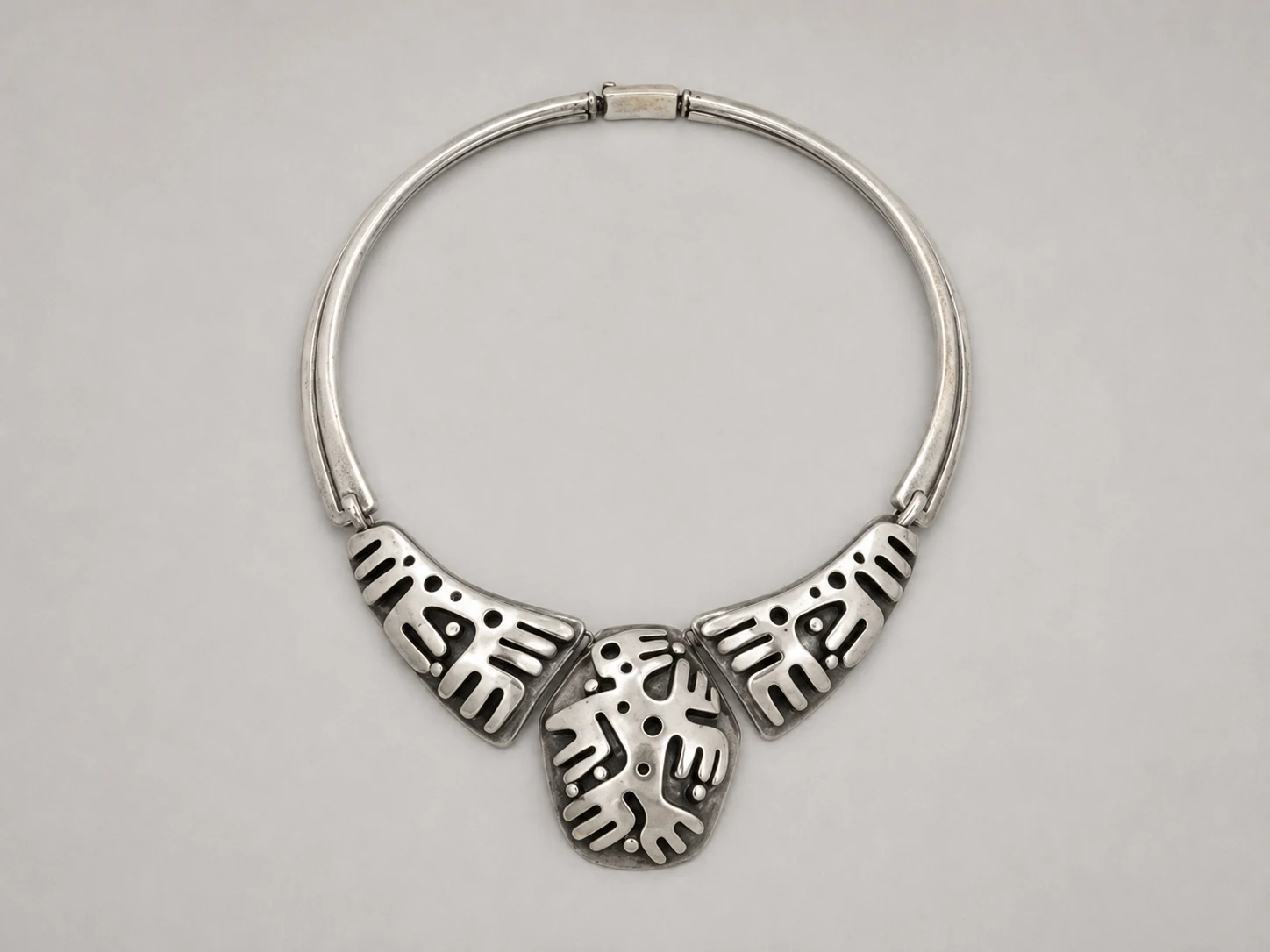
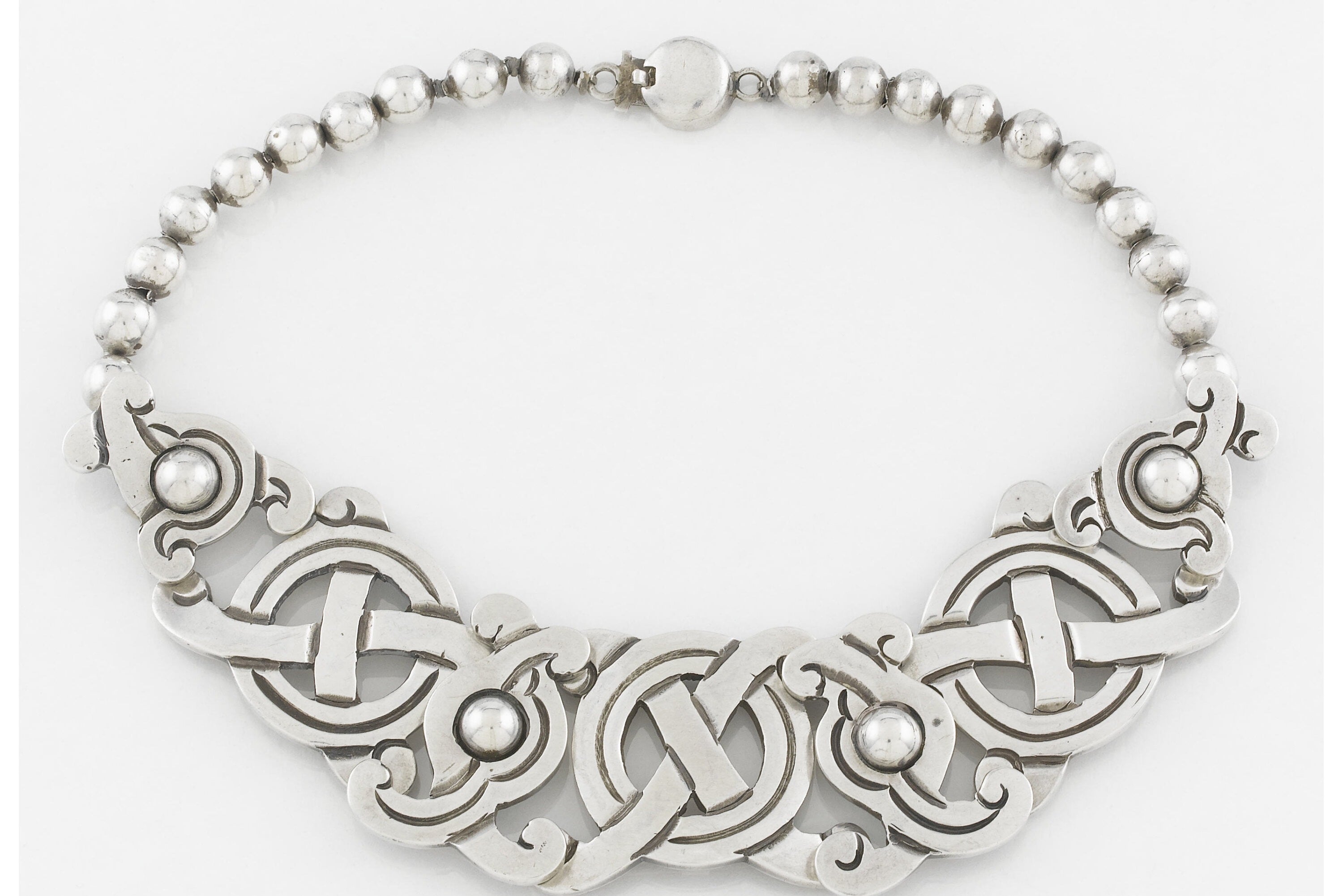
The interlaced bib that anchors this necklace exemplifies the design philosophy William Spratling built the Taxco silver revival around: a rigorous translation of pre-Columbian visual grammar into handwrought silver. Marked for 980 silver and set with native obsidian, it belongs to a documented program from his atelier dating to approximately 1944, when the workshop was producing collar-scale work of real formal ambition.
The bib panel is built from three interlocking plaited-cord motifs, a vocabulary rooted in Mesoamerican textile and architectural ornament. Obsidian cabochons punctuate the intersections where the silver strands converge, their dark volcanic glass set against the polished metal ground. Oxidation deepens the recesses between raised elements, sharpening the sculptural relief across the surface. A chain of graduated silver spheres connects the piece at the back, stepping down in scale toward the clasp and sustaining the collar's weight and symmetry without adding visual complexity.
Penny C. Morrill's scholarship on the Taxco school records a Spratling pre-Columbian necklace in 980 silver and obsidian from this same period, confirming that the pairing of these materials with interlace ornament was a deliberate and sustained workshop commitment rather than an isolated experiment. Spratling's consistent use of obsidian — volcanic glass indigenous to the Mexican highlands and inseparable from the ancient visual culture he drew on — carried purpose beyond material contrast: it placed the object in direct relationship with the civilization whose forms it honored.
The stamped WS mark alongside the 980 hallmark authenticate both maker and alloy at a glance, and the piece's scale — sixteen and a half inches overall with a bib nearly three inches across — speaks to the formal seriousness of the workshop at this moment.
Museum of Mexican Silver. “Carved Pre-Columbian Necklace.” Catalog no. MoMS-000117. https://museumofmexicansilver.com/pieces/spratling-1827
See something wrong with this record? Suggest a correction and the piece details fill in automatically.
William Spratling
Silson Cascabel Necklace
Silver Plate