Saves instantly, no account needed. Already a member? Sign in.
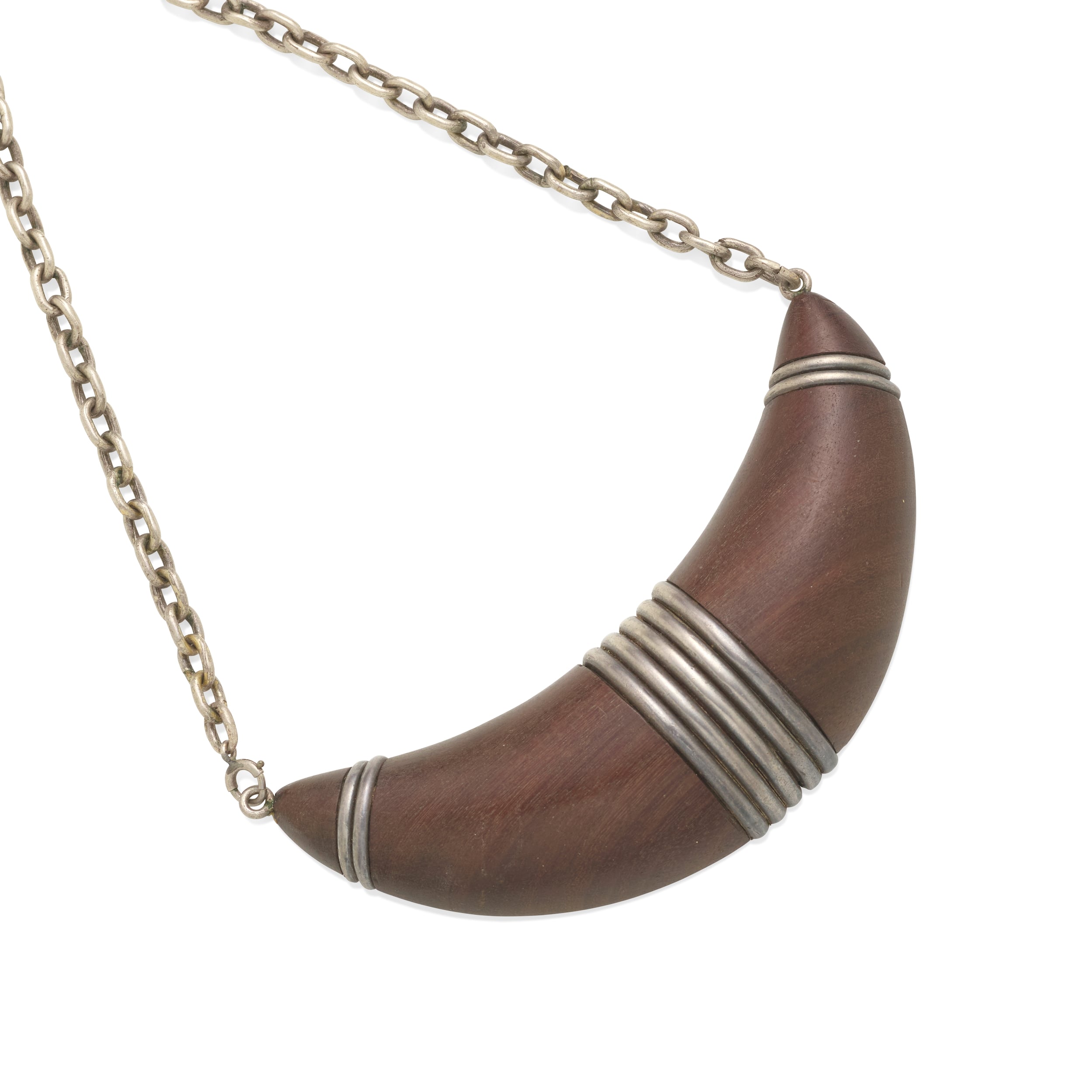
A single curve of rosewood, dark and dense, forms the whole body of this necklace, and silver wire does the rest. Spratling wrapped the crescent at its center and again near each tapering end, letting the pale metal read as bright bands against the wood. The design withholds nearly everything a silver necklace of the period might offer, no repoussé, no cast plaques, no stones, and asks the wood itself to carry the form. What remains is a study in contrast between two materials, one warm and opaque, the other reflective and linear.
The crescent is the governing shape. Its arc narrows toward each end so that the mass concentrates at the low center and thins where the silver link chain takes over, a distribution that lets the wood sit against the body rather than stand away from it. The wrapped wire at the middle marks the lowest point and visually anchors the curve, while the two pairs of wraps closer to the ends both secure the wood and divide its length into measured intervals. Silver here is structural and ornamental at once, binding the crescent and articulating it. The link chain continues the vocabulary of metal against wood, extending the necklace upward in a lighter register than the solid arc below.
The use of local hardwood belongs to Spratling's first design period, the years following his founding of the Taller de Las Delicias in 1931, when he was reorganizing production in Taxco and testing which materials could carry his ideas. Rosewood and other native woods entered his repertoire alongside silver, tortoiseshell, and regional stone, part of a deliberate turn toward Mexican materials that Gobi Stromberg has connected to the broader postrevolutionary interest in the country's indigenous heritage and craft traditions. Spratling was not alone in this pursuit. He stood among the generation of Taxco designers, including Antonio Pineda, Héctor Aguilar, and the Castillo brothers, who built a world-recognized school of silver design through the workshop system. In this necklace, though, the emphasis falls away from silver as the primary substance and toward silver as the element that frames and completes a wooden form.
The piece is recorded in Phyllis Goddard's field guide to Spratling's work and in the literature on the American School of Mexican silver, placing it within the documented body of his early production. Its interest lies in restraint. Where much Taxco jewelry of the era demonstrates the taller's capacity for elaborate metalwork, this necklace shows Spratling reducing a design to a curve of wood and a few turns of wire, trusting the material relationship to hold. It records a moment in his development when the choice of a native hardwood was itself a design decision, and when the simplest binding of silver to wood could stand as a finished statement.
Museum of Mexican Silver. “Rosewood Crescent Necklace.” Catalog no. MoMS-000462. https://museumofmexicansilver.com/pieces/spratling-2387
See something wrong with this record? Suggest a correction and the piece details fill in automatically.
Carved Link Cascabel Necklace
First Design Period: 1931 - 1946
Silver