Saves instantly, no account needed. Already a member? Sign in.
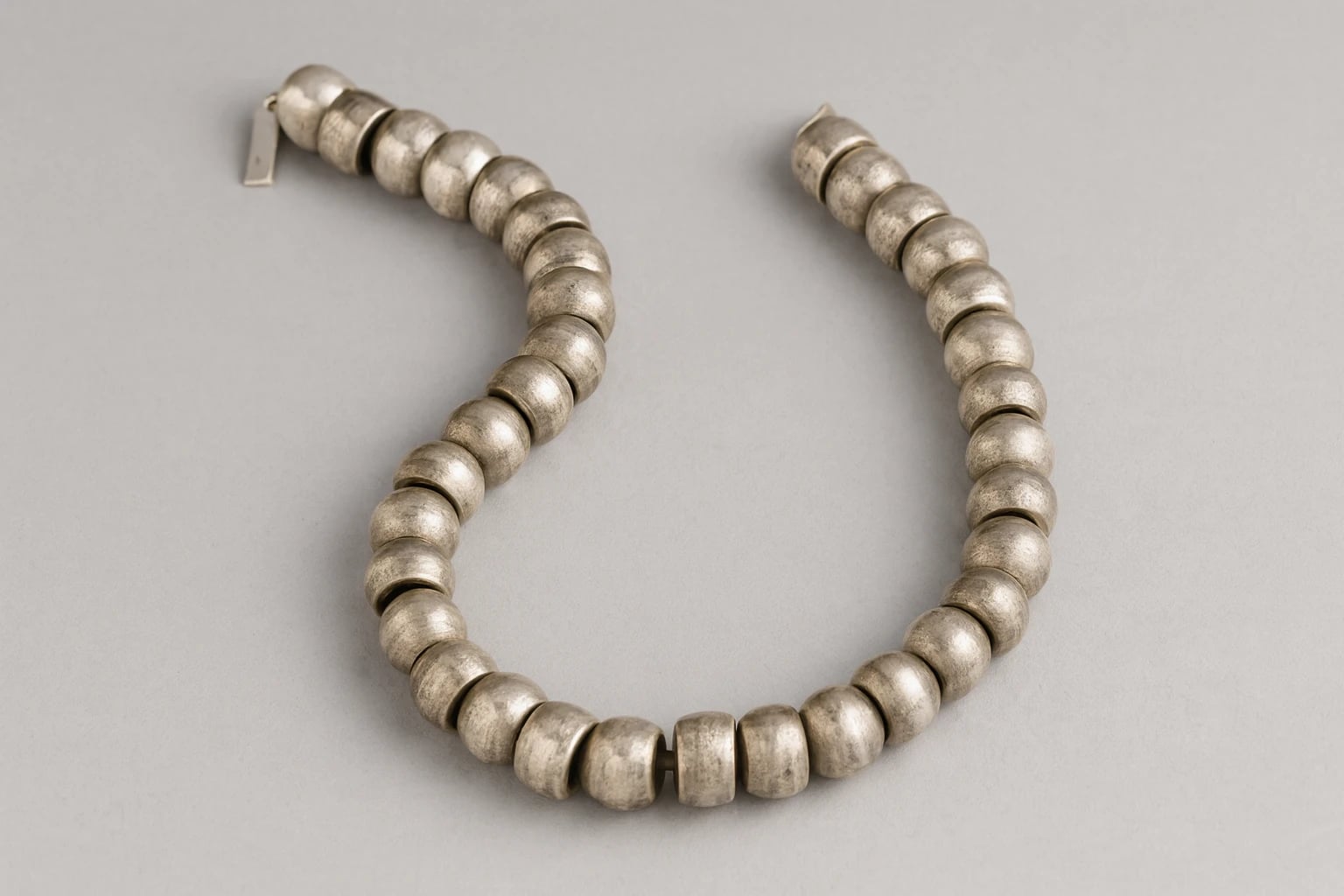
A necklace built from a single repeated element, the large hollow bead, turns weight into visual rhythm without becoming heavy on the body. Each bead joins the next through an internal fitting rather than a visible chain or clasp, so the strand reads as an unbroken sequence of rounded silver volumes. The design depends on the interval between beads and on the way light moves across their curved surfaces, catching a highlight on each and dropping into shadow where they meet. The result is a piece organized around mass and reflection rather than applied ornament.
The internal fitting is the governing idea. Because the beads connect from within, the strand has no competing hardware to interrupt the line, and the eye follows one bead into the next as a continuous curve around the neck. Hollow construction keeps the scale generous while allowing the necklace to drape and settle, so the large diameter of each bead becomes wearable rather than cumbersome. Silver here is treated as a plain, unbroken surface, its polish doing the work that a stone or an engraved pattern might do elsewhere. The restraint is deliberate: the material carries the design through volume, spacing, and the play of reflected light.
This necklace belongs to the third of William Spratling's design periods, the years from 1951 to 1967, when the Taller de Las Delicias he had founded in 1931 had long since helped catalyze Taxco's silver renaissance and a full generation of designers had established their own talleres. Spratling's late production came from a small workshop on his ranch, where, as Alberto Ulrich and the maestro Tomás Vega both recalled, the eagle stamp continued in use through 1967 and relatively few pieces were made. The taller system that Taxco developed allowed a designer to concentrate on form while master smiths handled execution, and a bead necklace of this kind reflects that division of labor: a clear formal idea realized in repeated, precisely fitted units. Spratling's late reduction of ornament to pure silver volume sits comfortably beside the broader Taxco School interest in innovation and experimentation that Stromberg and others have documented.
Within Spratling's work, a necklace of large plain beads represents his enduring preference for form stated through material rather than decoration. It shows how a workshop could take a simple, ancient jewelry type, the strung bead, and resolve it into a modern object through scale, interval, and concealed construction. For a collection tracing the Taxco renaissance, it records the quieter register of Spratling's late output, silver understood as sculptural volume, made in the small ranch workshop of his final years.
Museum of Mexican Silver. “Necklace of Large Silver Beads.” Catalog no. MoMS-000598. https://museumofmexicansilver.com/pieces/spratling-3039
See something wrong with this record? Suggest a correction and the piece details fill in automatically.
William Spratling
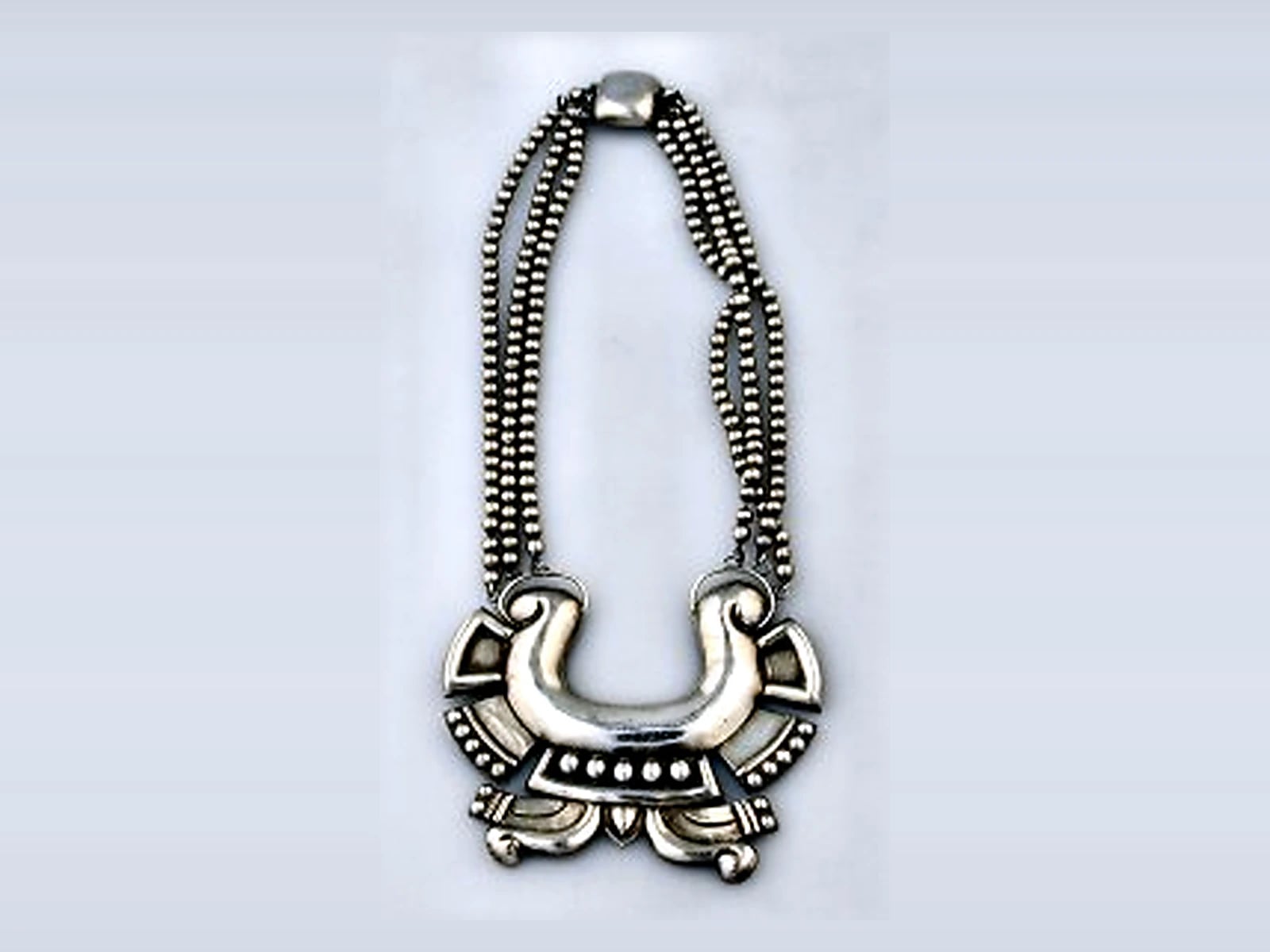
Chupamirto Azteca Necklace
First Design Period: 1931 - 1946
Silver