Saves instantly, no account needed. Already a member? Sign in.
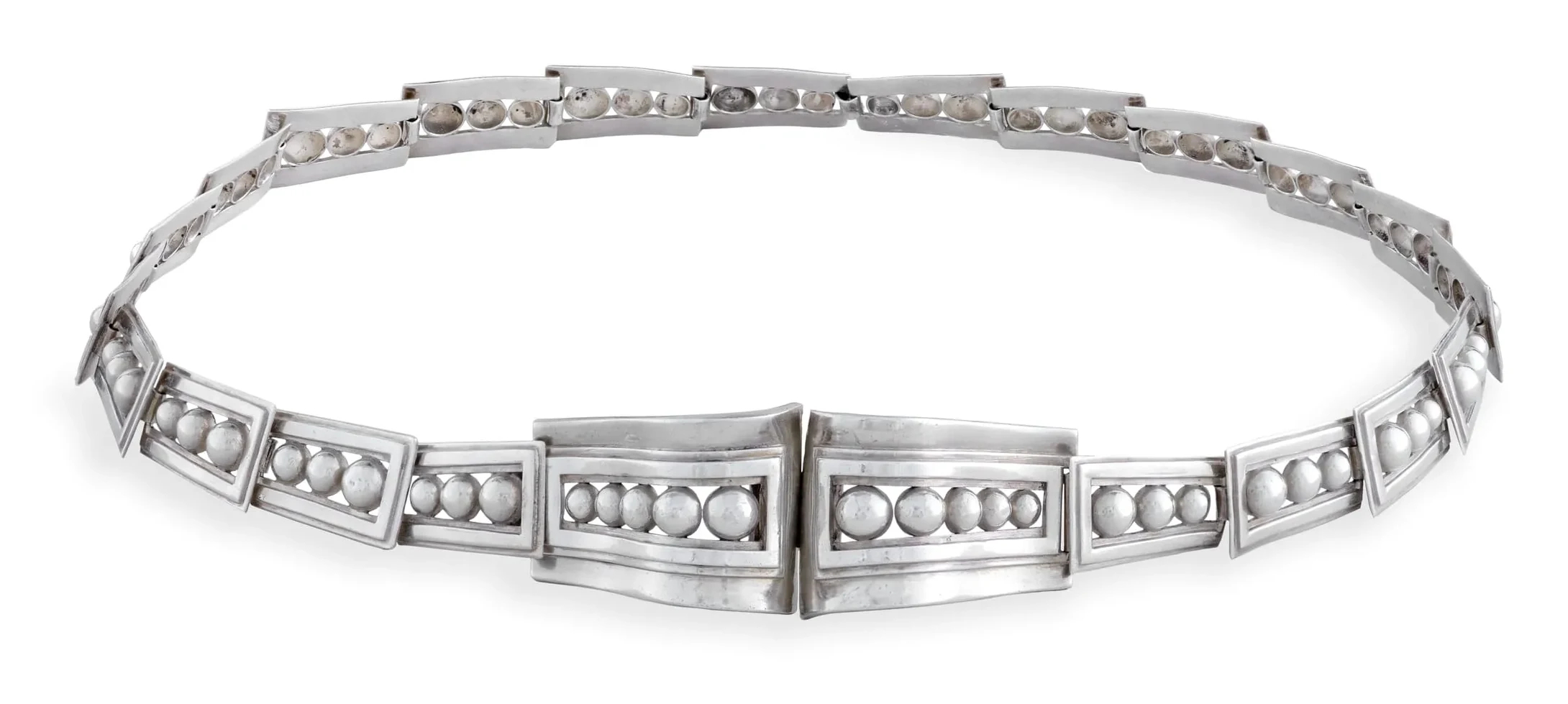
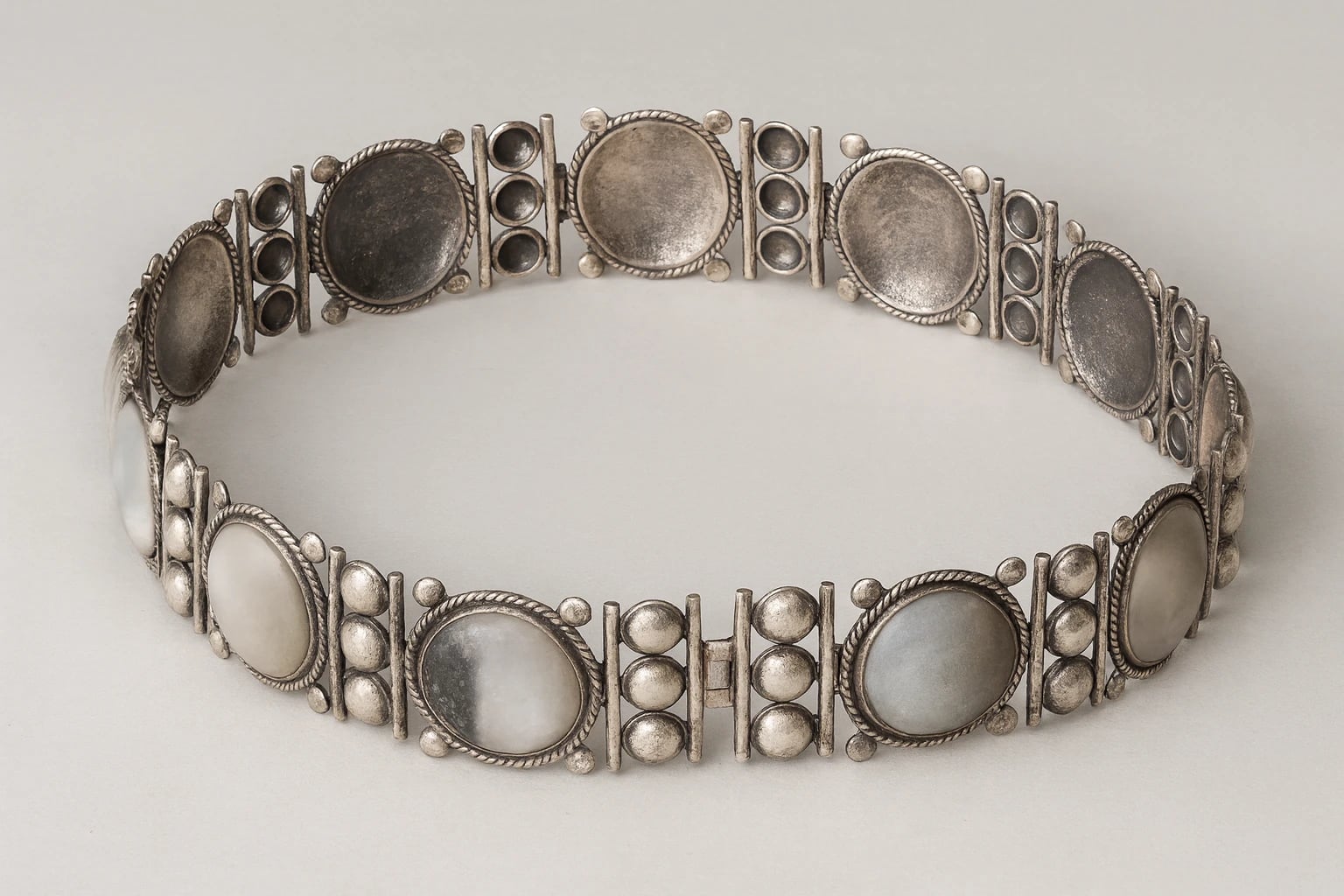
A belt assembled from round silver links, each joined to the next by pin hinges, this is Spratling at his most architectural, building a wearable band entirely out of repeated geometric units. The same link design was carried over into a bracelet, so the form scaled across two objects.
The modular construction reflects the workshop's hand methods. Each disc and hinge had to be hammered, cut, and fitted by hand, the early shop working without rolling mills and forming small components individually (Morrill, Mexican Silver, 1994, p. 36). A full belt of such links was a considerable undertaking.
Reusing one link design across a belt and a bracelet was typical of how Spratling treated a successful module, letting a single resolved unit do duty at different scales. The pin-hinge joinery gives the band its flexibility while keeping the silver reading as a continuous chain of discs.
The belt is recorded in Phyllis M. Goddard's Spratling Silver: A Field Guide. Silver belts are among the less common Spratling forms and come to market only occasionally, which makes a documented example like this useful to anyone tracing how his link vocabulary moved between body and waist.
Museum of Mexican Silver. “Round Link Silver Belt.” Catalog no. MoMS-000024. https://museumofmexicansilver.com/pieces/spratling-3102
See something wrong with this record? Suggest a correction and the piece details fill in automatically.
Hinged Book Picture Frame
First Design Period: 1931 - 1946
Silver