Saves instantly, no account needed. Already a member? Sign in.
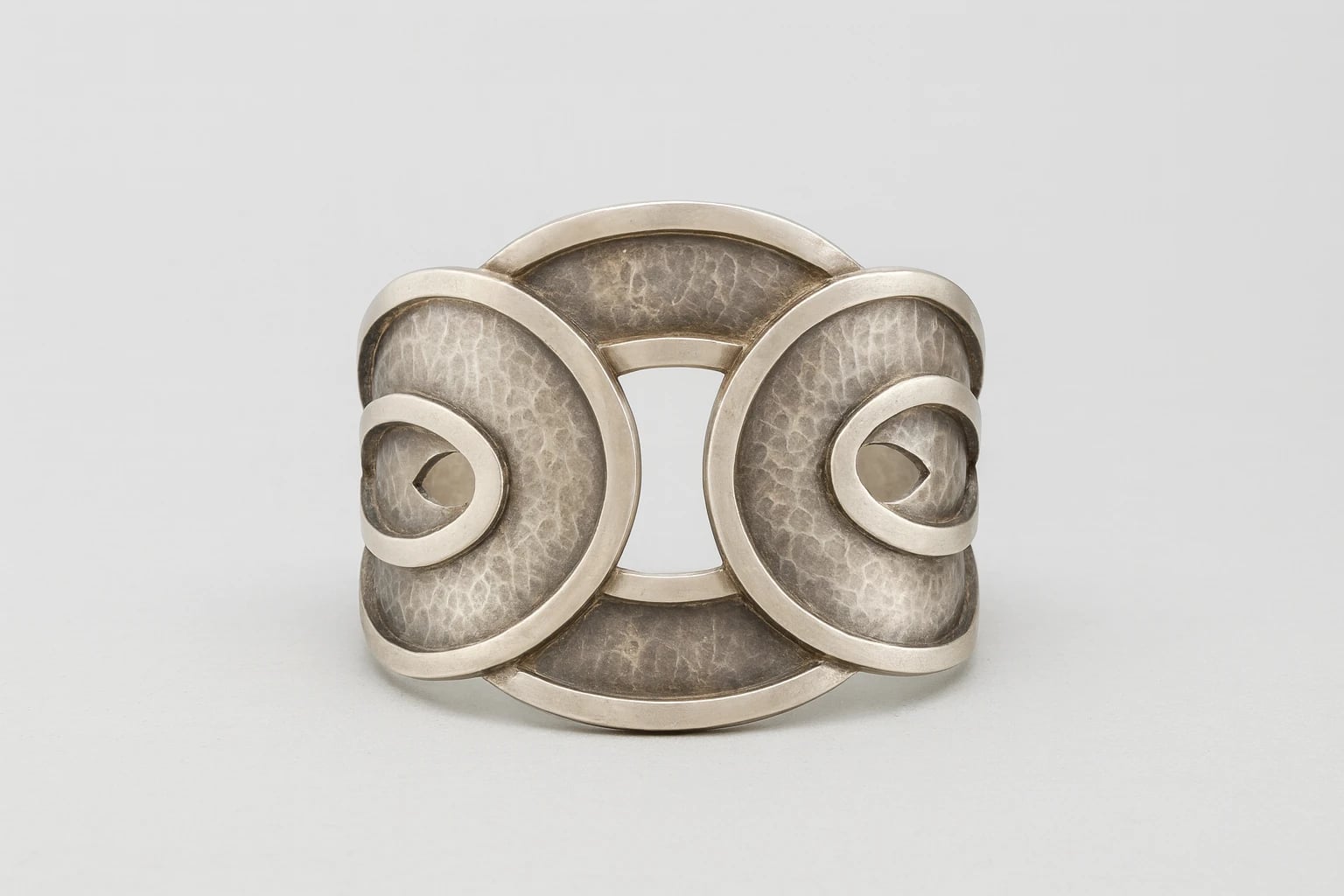
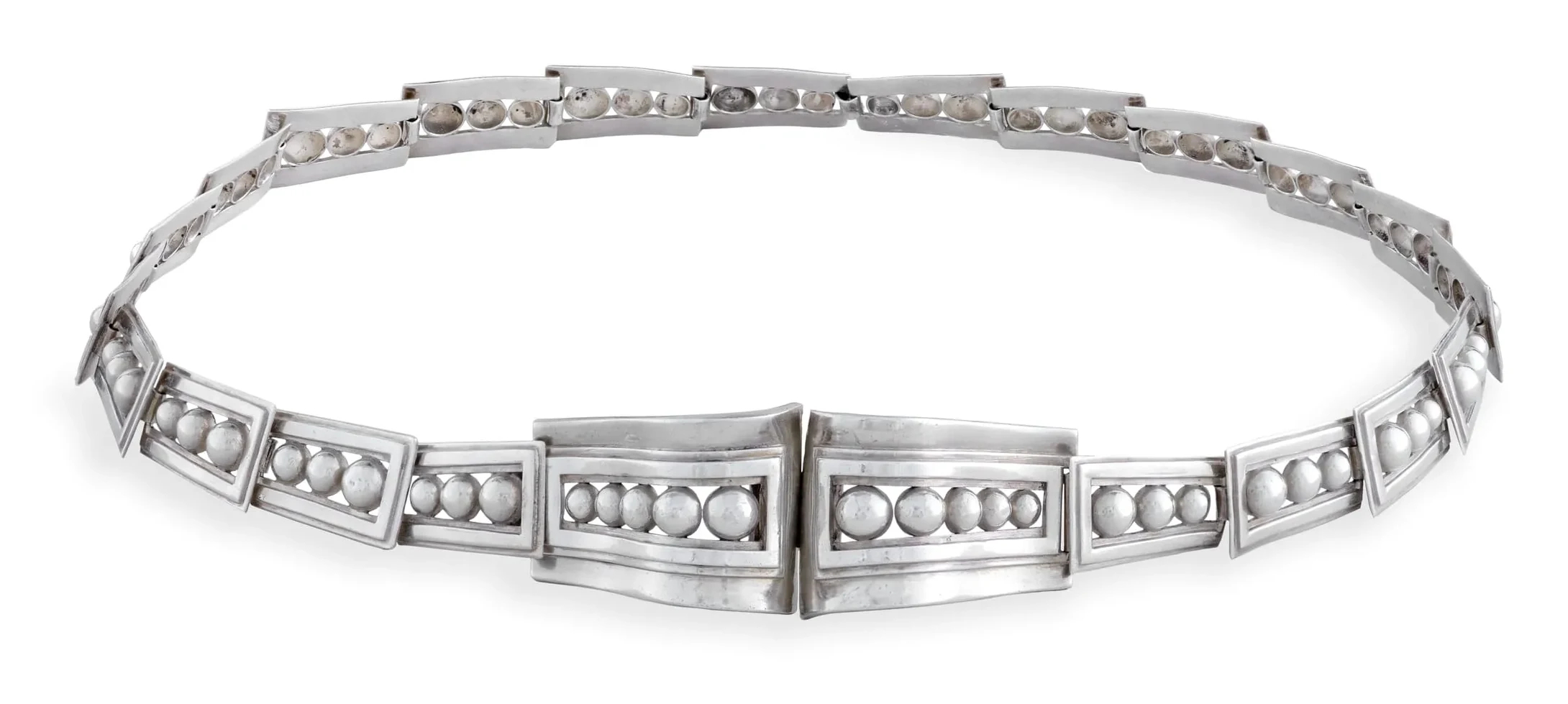
The belt is organized as a sequence of rectangular silver panels, each one a small architectural unit with a raised border, an open center, and a row of rounded relief forms held within the frame. Around the waist those units do not become a continuous strip. They remain distinct, tilting slightly at their joints so that the belt reads as both structure and ornament. The larger front panels establish a broad visual weight at the center, while the narrower linked sections carry the pattern around the body. The design depends on repetition, but it avoids monotony through changes of scale, shallow curvature, and the alternating shadows created by the openwork.
This is a silver object about articulation. Each rectangle frames a group of rounded forms, usually read as small domes or beads, and the surrounding metal throws those reliefs into sharper focus. The pattern is simple enough to be grasped at once, but the belt gains interest from the way each unit moves against the next. At the front, the paired central panels meet with a narrow vertical break, making the closure part of the composition rather than hiding it. The surface carries the marks of use and polishing, but the main effect remains clear: bright silver, recessed shadows, and a repeated geometry that turns the waist into a moving chain of framed reliefs.
Within Margot de Taxco’s work, the belt is especially useful because it shows how strong her silver design could be without enamel. Hougart records that Margot van Voorhies opened her own shop, Margot de Taxco, in 1947, after her years with Los Castillo, and that she became known above all for high quality champlevé enamel, whose production began in 1955 (Hougart, pp. 165 to 166). This belt belongs to the other side of that achievement: the disciplined silver line in which form, relief, and mechanical joining carry the design. Morrill and Berk emphasize that Margot designed everything her company produced and that her workshop practice was organized through drawings, technical instructions, molds, dies, assembly, and finishing. They also record that the silver designs ran from inventory number 5100 to 5790, with the actual silver pieces marked by design or inventory number (Morrill and Berk, p. 171). The reverse mark on this example is not fully legible in the available contact sheet, so the design number should not be inferred, but the stamped mark area is consistent with the workshop’s numbered system.
The belt also clarifies the collaborative intelligence of the Margot taller. Morrill and Berk describe silver jewelry formed from molds, pressed in the workshop, assembled according to Margot’s instructions, then finished and polished by the men in the taller (Morrill and Berk, p. 169). That account matters here because the object’s refinement lies not in a single spectacular motif, but in the repeated accuracy of its modules and the way those modules behave on the body. A poorly resolved version of this idea would be stiff or merely decorative. This belt curves through its linked panels while preserving the crisp rectangular grammar of the design. It shows the Taxco School at a scale often overlooked in histories of modern design: not a brooch held in the hand or a necklace framed at the throat, but a silver structure that encircles the body and makes movement part of the pattern.
Museum of Mexican Silver. “Silver Panel Belt.” Catalog no. MoMS-002281. https://museumofmexicansilver.com/pieces/margot-silver-panel-belt
See something wrong with this record? Suggest a correction and the piece details fill in automatically.
As a museum object, the belt helps place Margot de Taxco beyond the more familiar category of enamel jewelry. It belongs to the broader Mexican silver renaissance in which designers treated jewelry, belts, buckles, and table objects as serious modern forms. Its vocabulary is restrained: rectangles, roundels, open centers, hinged repetition. Its ambition lies in proportion and construction. The object demonstrates how Margot’s workshop could translate a severe geometric idea into wearable silver without sacrificing bodily flexibility, and how Taxco modernism often reached its clearest expression through objects made to be handled, fastened, worn, and seen in motion.
Margot de Taxco
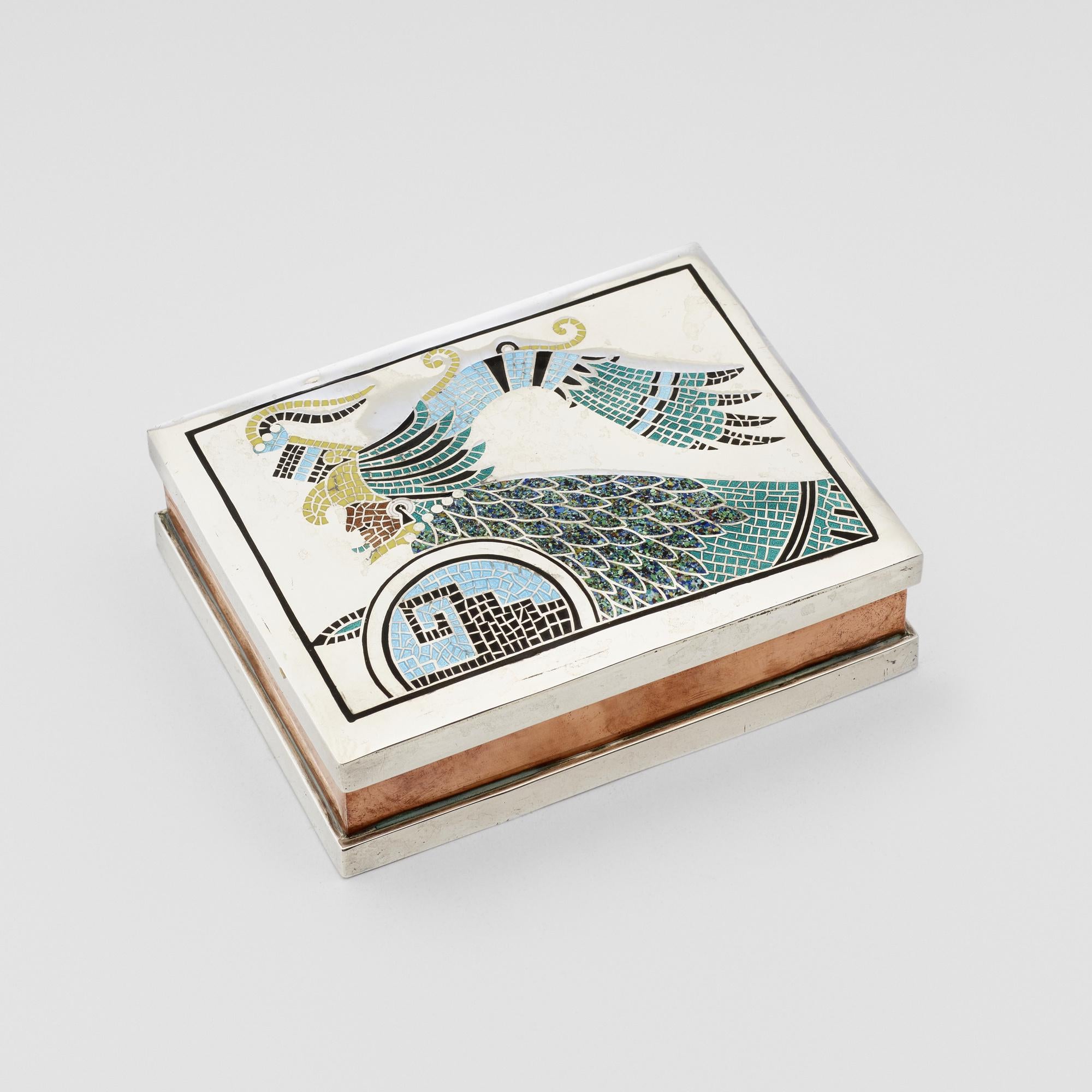
Eagle Knight Mosaic Box, Design No. 5560
Sterling silver