Saves instantly, no account needed. Already a member? Sign in.
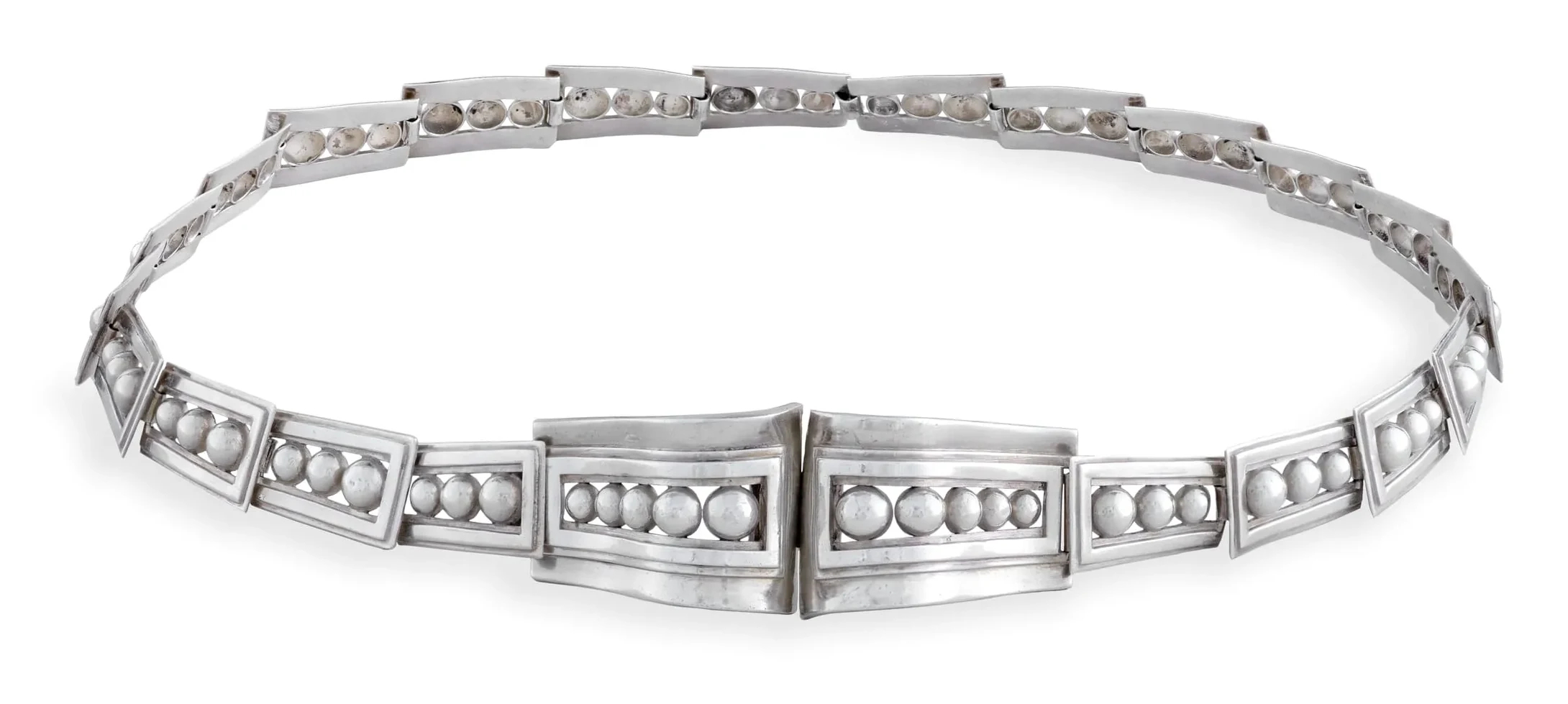
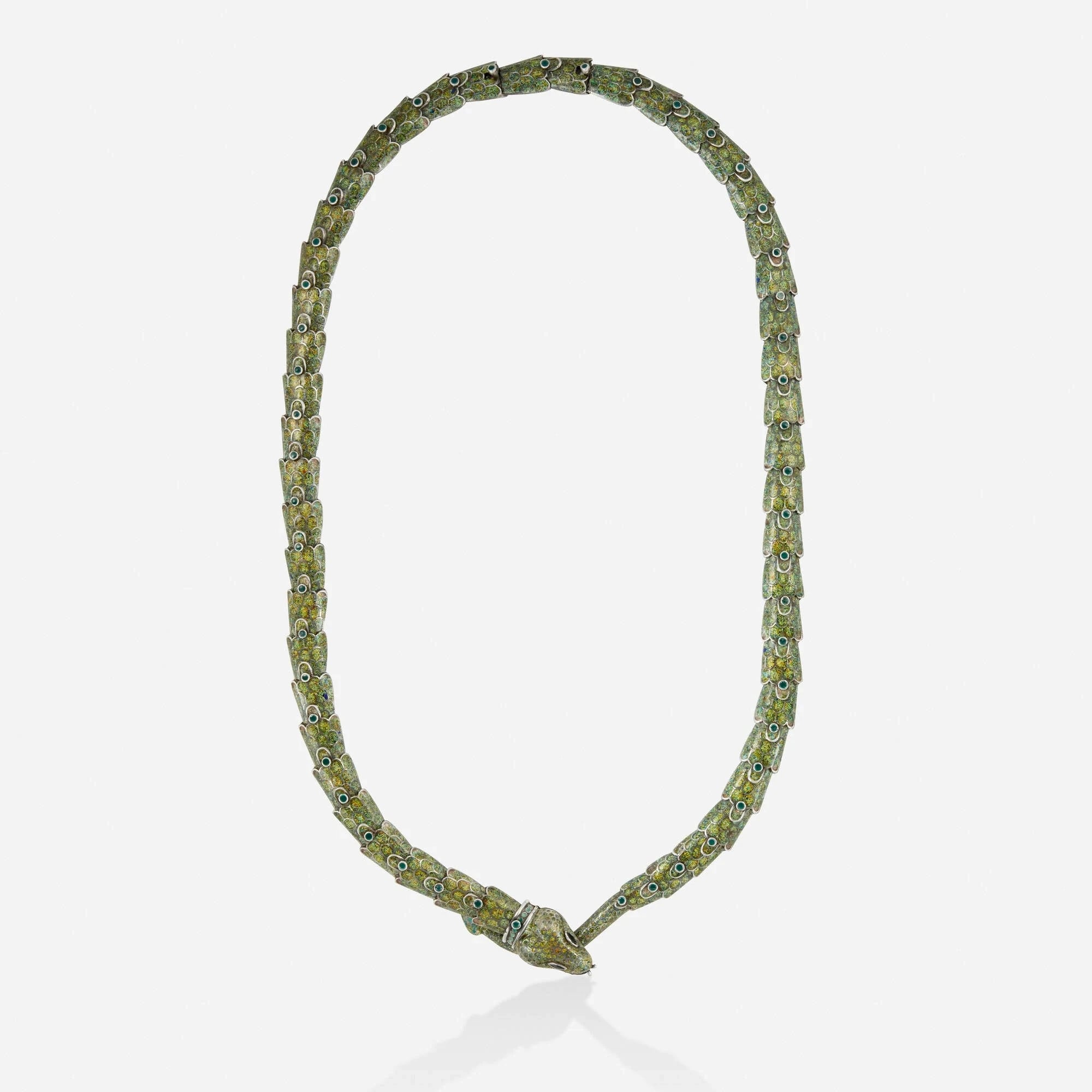
The rarest expression of Margot de Taxco's celebrated serpent vocabulary, this belt translates the sinuous form that made her snake necklace famous into an even more ambitious object worn at the waist. It belongs unmistakably to the same idiom as that better-known collar: the articulated serpent rendered in sterling silver and enamel, the ancient image of the feathered serpent recast as glamorous mid-century Mexican design. But where the necklace coils around the throat, this is a belt, a length of jointed silver that follows the curve of the body along a continuous line. Enamel belts are among the most ambitious pieces Margot produced, and this snake belt sits at the outer edge of her surviving output.
The form gives Margot a long, uninterrupted line to carry her color. Articulated silver links follow the serpent's body around the waist, terminating in a head that provides both the closure and the sculptural identity of the piece. The Heritage example, marked MARGOT DE TAXCO, 3354, HECHO EN MEXICO with the eagle-16 assay and dated circa 1950, measures thirty-two inches in yellow enamel, secured by a tongue and box clasp in the form of the snake's mouth. That belt was offered as part of a matching set with a pair of screw-back earrings and an expandable ring, suggesting the serpent motif was conceived across a coordinated suite rather than as a single jewel.
The color that animates the belt comes from Margot's mastery of champlevé enamel on silver, the technique she developed into one of her signature lines after it was first introduced at the Los Castillo workshop by Reveriano Castillo and Miguel Melendez (Morrill, p. 166). Her enamel pieces were prized as glittering displays of color, texture, and technical perfection, uniting elegance of line with sensuality of color (Morrill, p. 166). In this idiom the enamel is not surface decoration but color sealed into the architecture of the silver itself, producing the reptilian skin against the metal structure. Applied to a belt-length serpent, that technique becomes both more demanding to execute and more vulnerable to loss over time, which helps explain why so few examples endure.
No production total is documented. The Museum's dataset records only two linked auction appearances for the snake belt, far fewer than for the snake necklace, itself a scarce design. As a workshop design more than one was made, but a complete, period, well-preserved enamel belt is uncommon, and a full matching suite in excellent condition rarer still. For collectors of the Taxco School, the snake belt represents the serpent theme at its most extended and least frequently encountered.
Museum of Mexican Silver. “Snake Belt.” Catalog no. MoMS-001105. https://museumofmexicansilver.com/pieces/margot-belt-snake
See something wrong with this record? Suggest a correction and the piece details fill in automatically.
Margot de Taxco
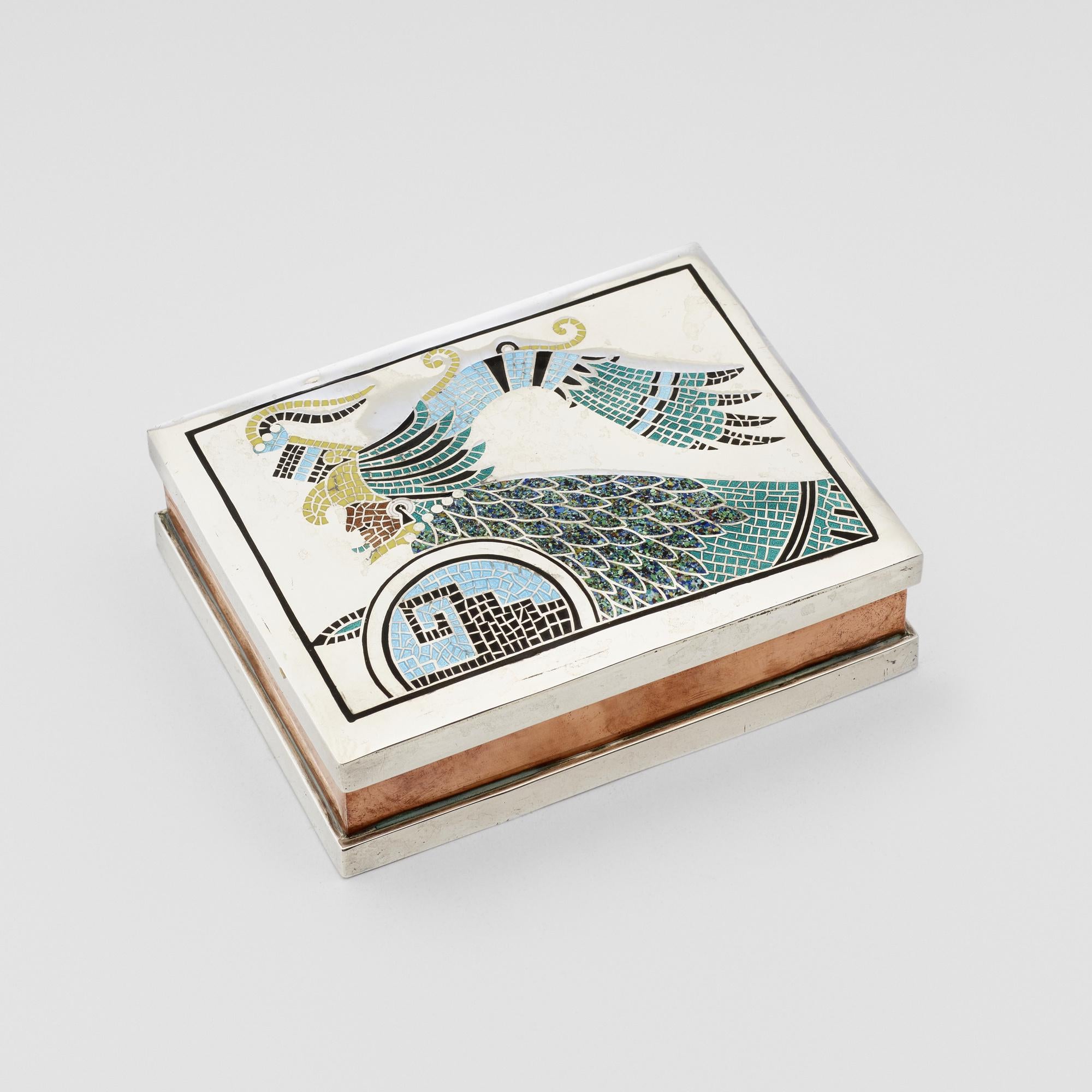
Eagle Knight Mosaic Box, Design No. 5560
Sterling silver