Saves instantly, no account needed. Already a member? Sign in.
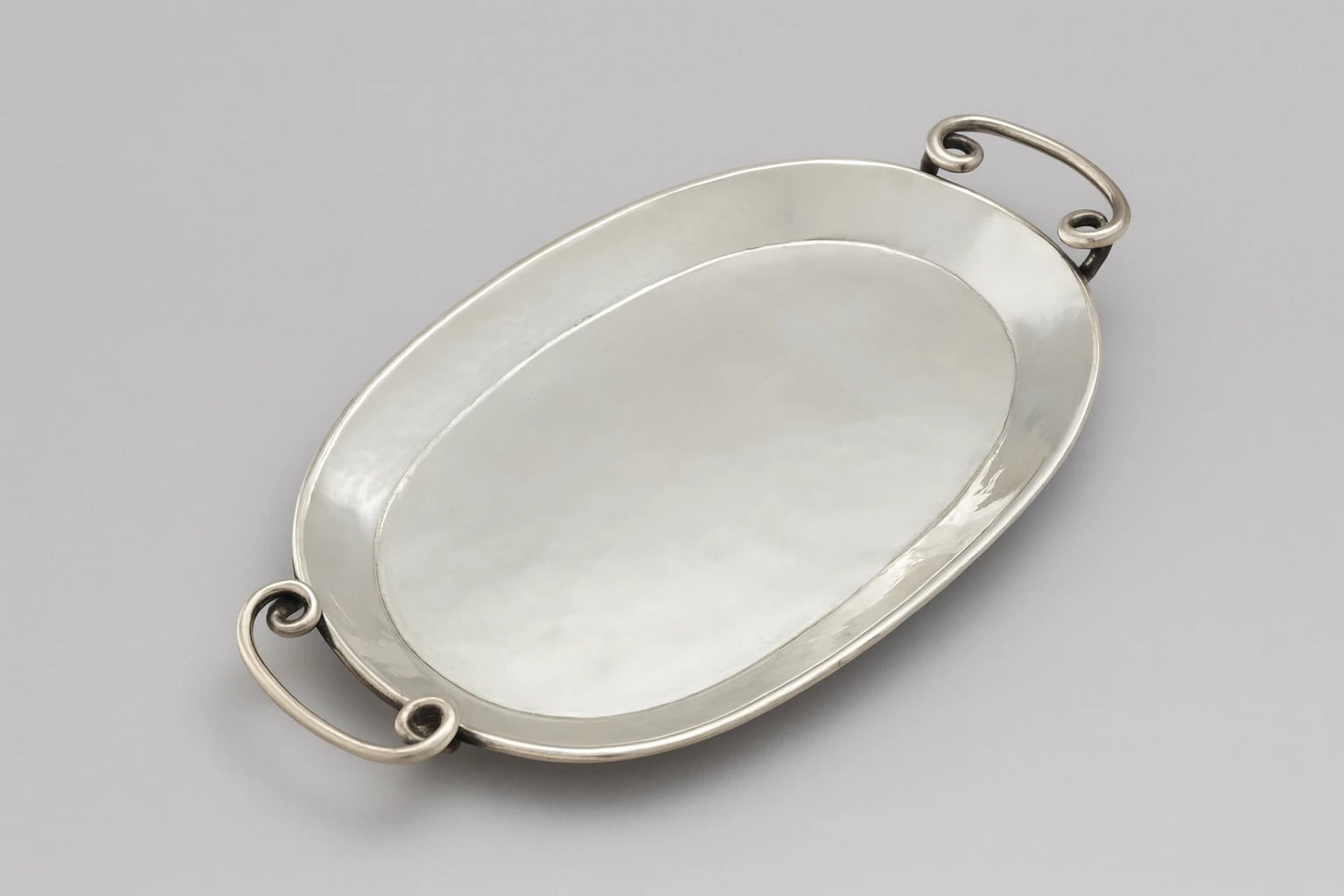
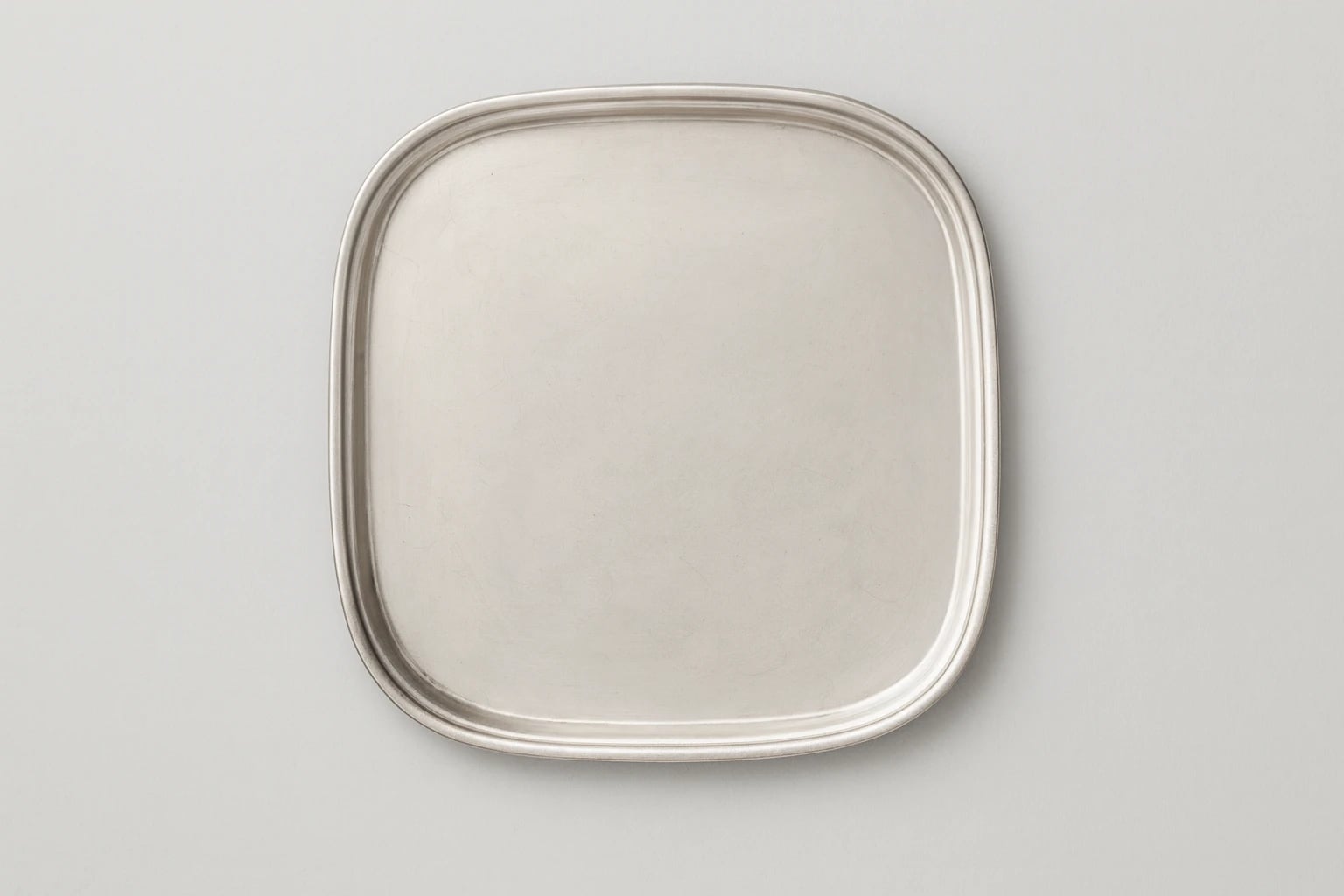
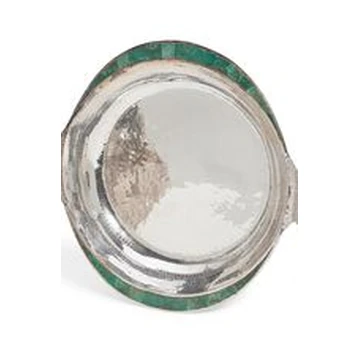
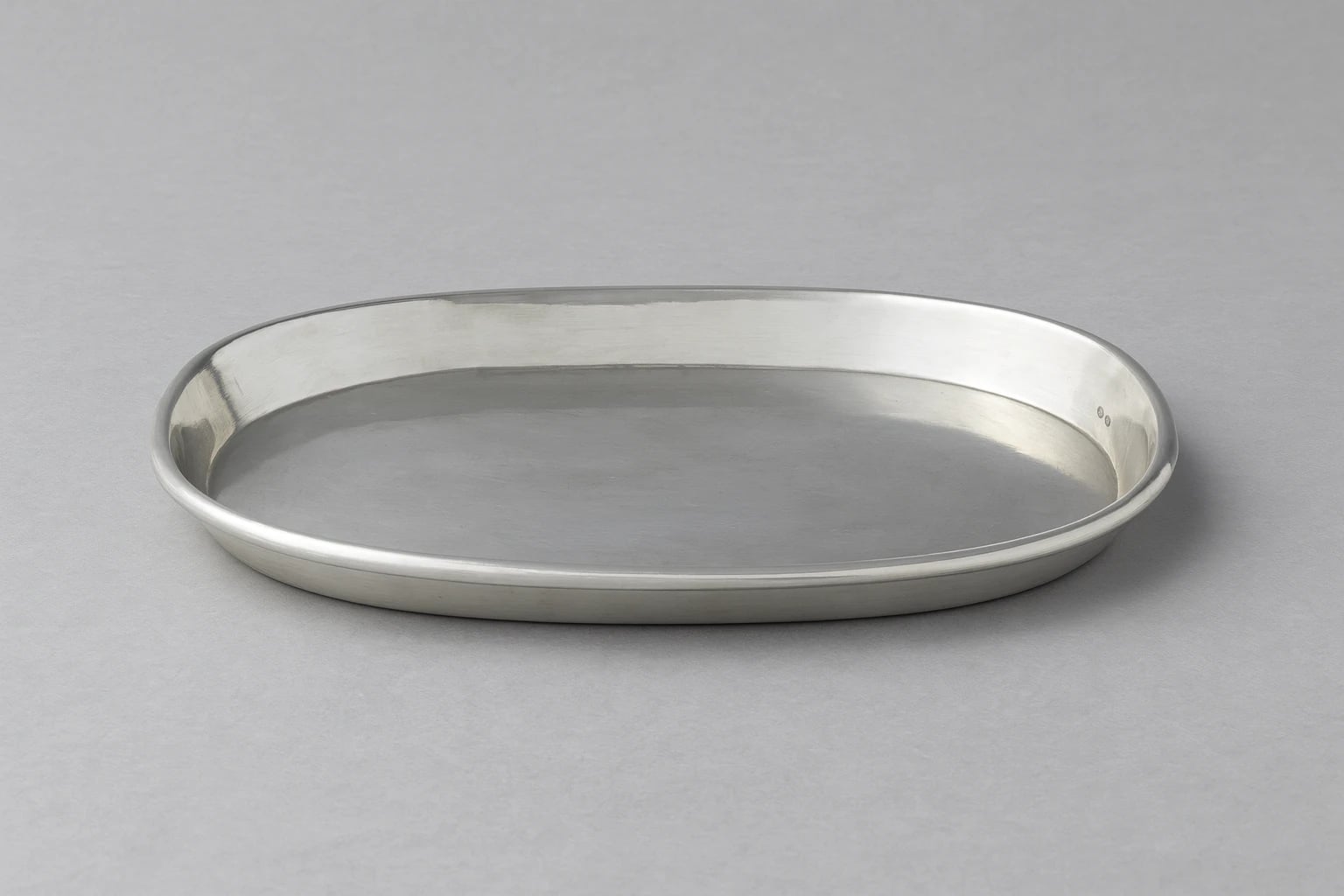
A rolled rim does most of the work in this tray. Spratling took a plain circular sheet of silver, left the field entirely undecorated, and turned the edge over into a smooth continuous roll. That single move gives the object its whole character: the polished field reflects light across an open expanse, and the rim reads as a thickened line drawn around it. The tray belongs to a body of Spratling hollowware in which restraint, rather than ornament, carries the design.
The form depends on proportion and finish. Without applied decoration, the eye registers the ratio between the flat interior and the width of the rolled edge, and it registers how cleanly that curve is turned. A rolled rim also does practical work, stiffening the perimeter of a broad shallow sheet and giving the hand a defined edge to lift. Spratling's wholesale and retail catalogues list the design in more than one size, at eight and a half inches and again at eight and three quarters, which indicates that it was produced as a repeatable workshop pattern rather than a one-off. The absence of chasing, piercing, or repoussé is the point of the design, and it places the entire burden of quality on the smoothness of the field and the evenness of the turned edge.
The tray comes from Spratling's third design period, the years from 1951 to 1967, when he had returned to production in Taxco and worked through a smaller operation on his ranch. By this stage the workshop system he had helped establish two decades earlier had trained a generation of designers and master smiths across Taxco, among them Antonio Pineda, the Castillo brothers, Enrique Ledesma, and Héctor Aguilar, who built their own talleres and formal languages. Against that expanding field of ambitious, often sculptural silver, an undecorated tray represents a different discipline: modernist plainness, in which the material and the geometry are left to speak without incident. Production in these later years was limited, and Alberto Ulrich, who bought the Taxco house and manufactory from Spratling, recalled that relatively few pieces were being made and stamped in that period.
This design was included in "The World of William Spratling," the 1965 exhibition that traveled to United States museums during the designer's lifetime, which places it among the works Spratling chose to present as representative of his practice. That selection is useful evidence of how he understood his own hollowware: a plain tray stood comfortably beside his more elaborate silver as an example of what the workshop made. For a collection, the object records the quiet end of the Spratling range, where design is a matter of proportion, reflection, and a single turned edge.
Museum of Mexican Silver. “Plain Silver Tray with Rolled Rim.” Catalog no. MoMS-000614. https://museumofmexicansilver.com/pieces/spratling-498
See something wrong with this record? Suggest a correction and the piece details fill in automatically.
William Spratling
Square Jaguar Service Tray
Third Design Period: 1951 - 1967
Silver