Saves instantly, no account needed. Already a member? Sign in.
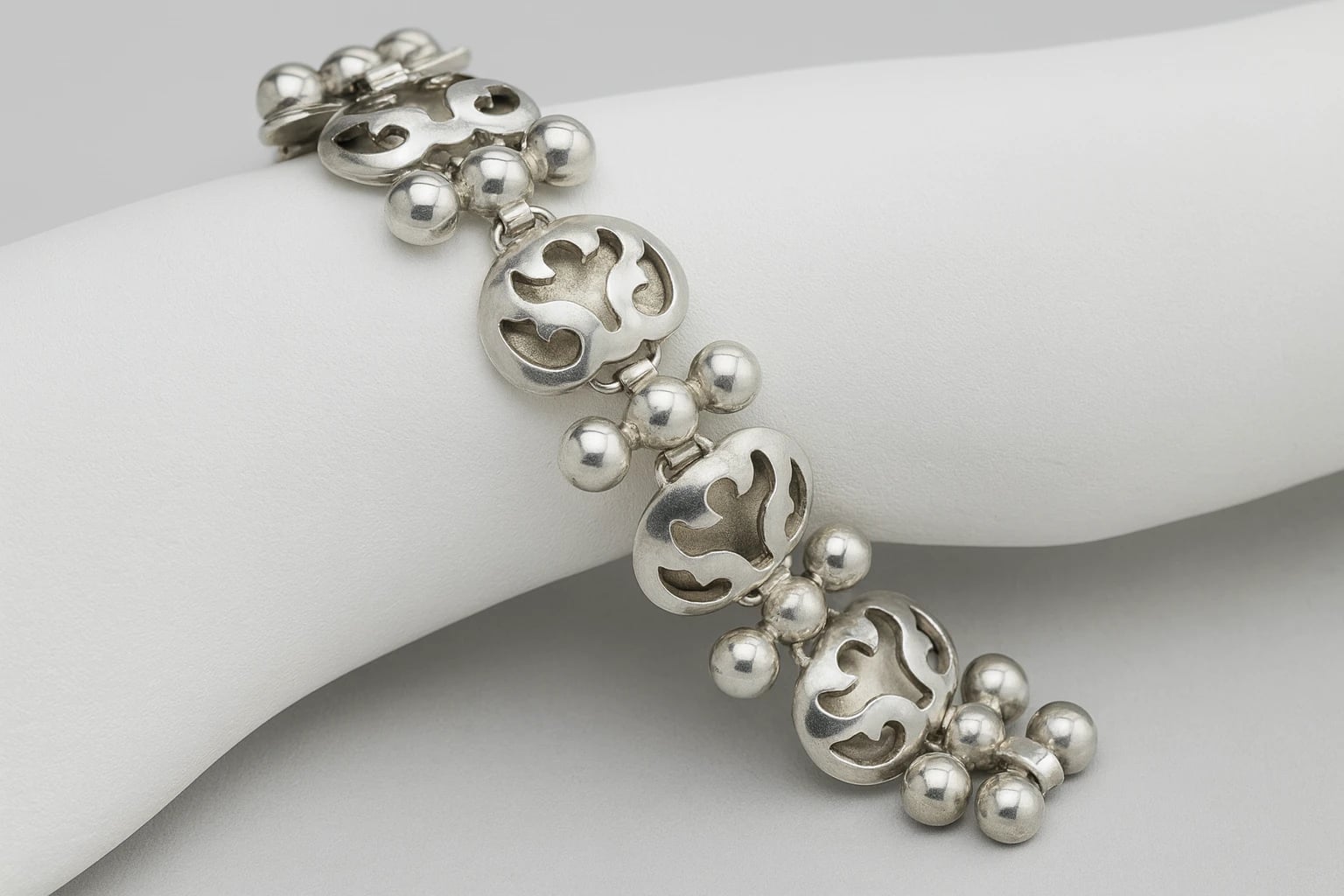
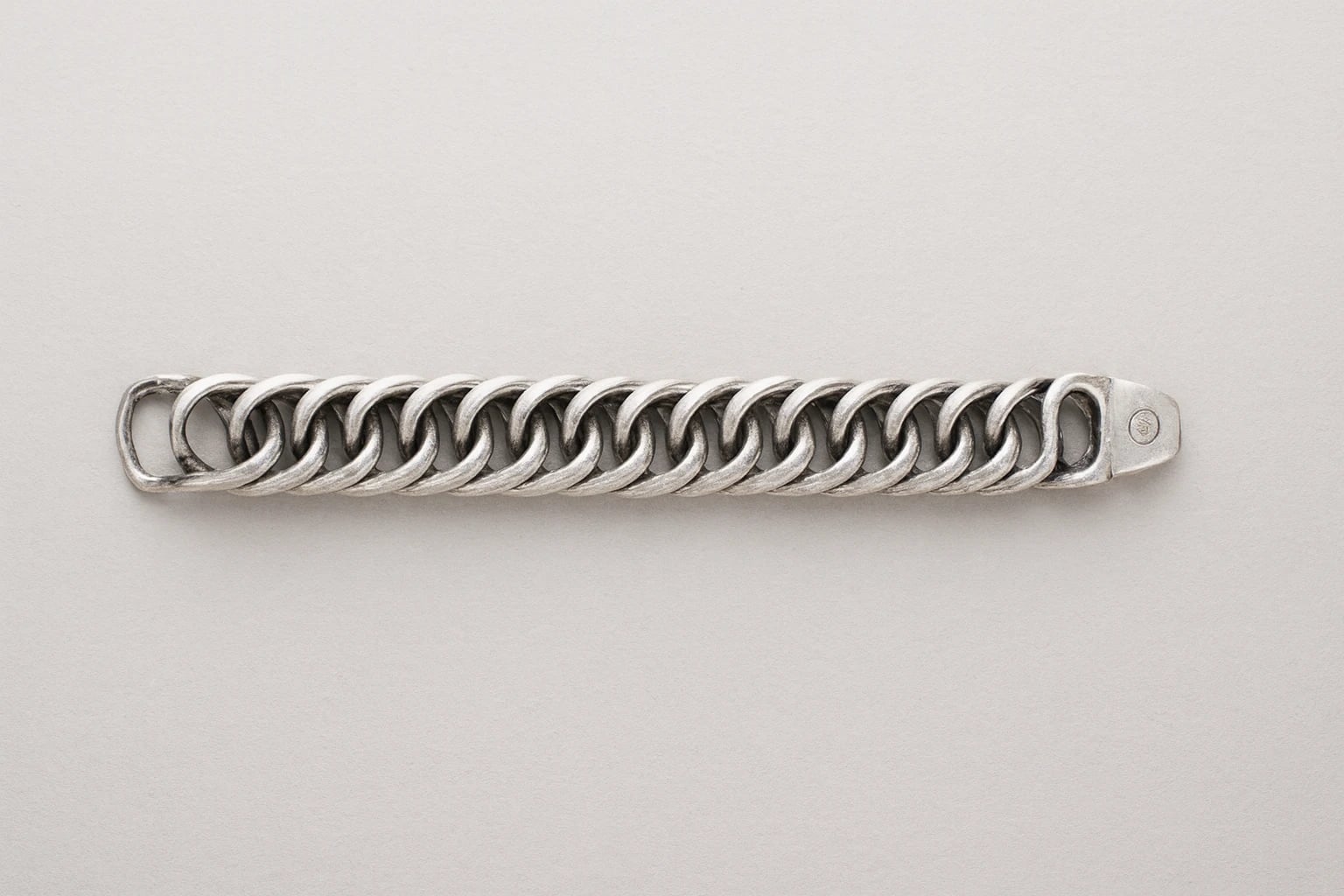
A weighty chain of silver links, each formed and joined by hand, this bracelet reduces its design to the essentials of interval and reflection. There is no pendant charm, no stone, no applied ornament to compete with the movement of the links themselves. What holds the eye is the rhythm of solid metal segments turning against one another, catching light along their edges as the bracelet settles on the wrist. The design belongs to William Spratling's early work at Taxco, a period in which the qualities of the silver, its color, its weight, and its capacity to hold a bright reflective surface, carried the whole of the design.
The construction is direct. Individual links are shaped and closed, then linked in series so that the chain drapes and articulates freely. This flexibility is the point: a rigid cuff imposes a fixed form, while a heavy link chain moves and redistributes its mass as the arm turns. The weight is felt as well as seen, and the substantial gauge of silver gives the bracelet the density that Spratling favored in his early jewelry. Where cutting and piercing (calar) or engraving with the cincel gave other Taxco pieces their surface incident, here the interest lies in the plain faces of the links and the small shadows that gather where one link passes through the next.
Spratling founded the Taller de Las Delicias in Taxco in 1931 and, through the reorganization of design and production there, helped catalyze the broader silver renaissance from which the Taxco School emerged. This bracelet dates to his First Design Period, roughly 1931 to 1946, the years in which he established the formal vocabulary that a generation of designers would extend in their own directions. Chain and link forms recur across that vocabulary, and their appeal rested on the taller system Gobi Stromberg has described, a structure of specialization and skilled hand execution that made careful, repeatable metalwork possible without surrendering the individual forming of each element. The bracelet has been reissued, which means the design outlived its first production and continued to be valued for its clarity.
Within a collection, a piece of this kind documents the plainer, more structural side of early Spratling, distinct from the pieces that draw on ancient Mexican motifs or elaborate surface work. It shows how much a designer could achieve with weight, interval, and the reflective quality of silver alone. The bracelet records a characteristic phase of Spratling's thinking and, through it, a foundational moment in twentieth-century Mexican silver.
Museum of Mexican Silver. “Heavy Silver Link Chain Bracelet.” Catalog no. MoMS-000049. https://museumofmexicansilver.com/pieces/spratling-65
See something wrong with this record? Suggest a correction and the piece details fill in automatically.
William Spratling
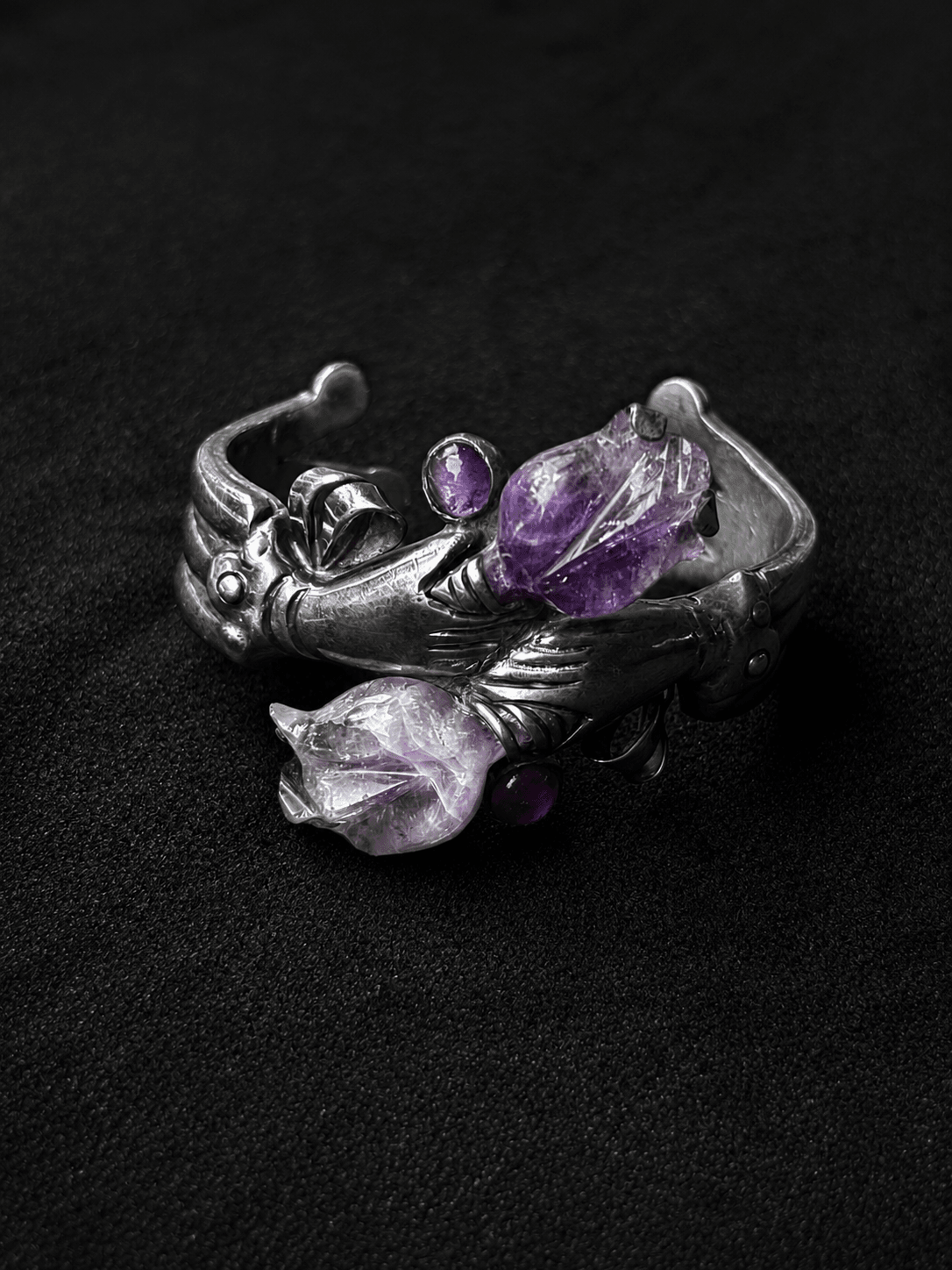
Tulip Amethyst Cuff
First Design Period: 1931 - 1946
Silver