Saves instantly, no account needed. Already a member? Sign in.
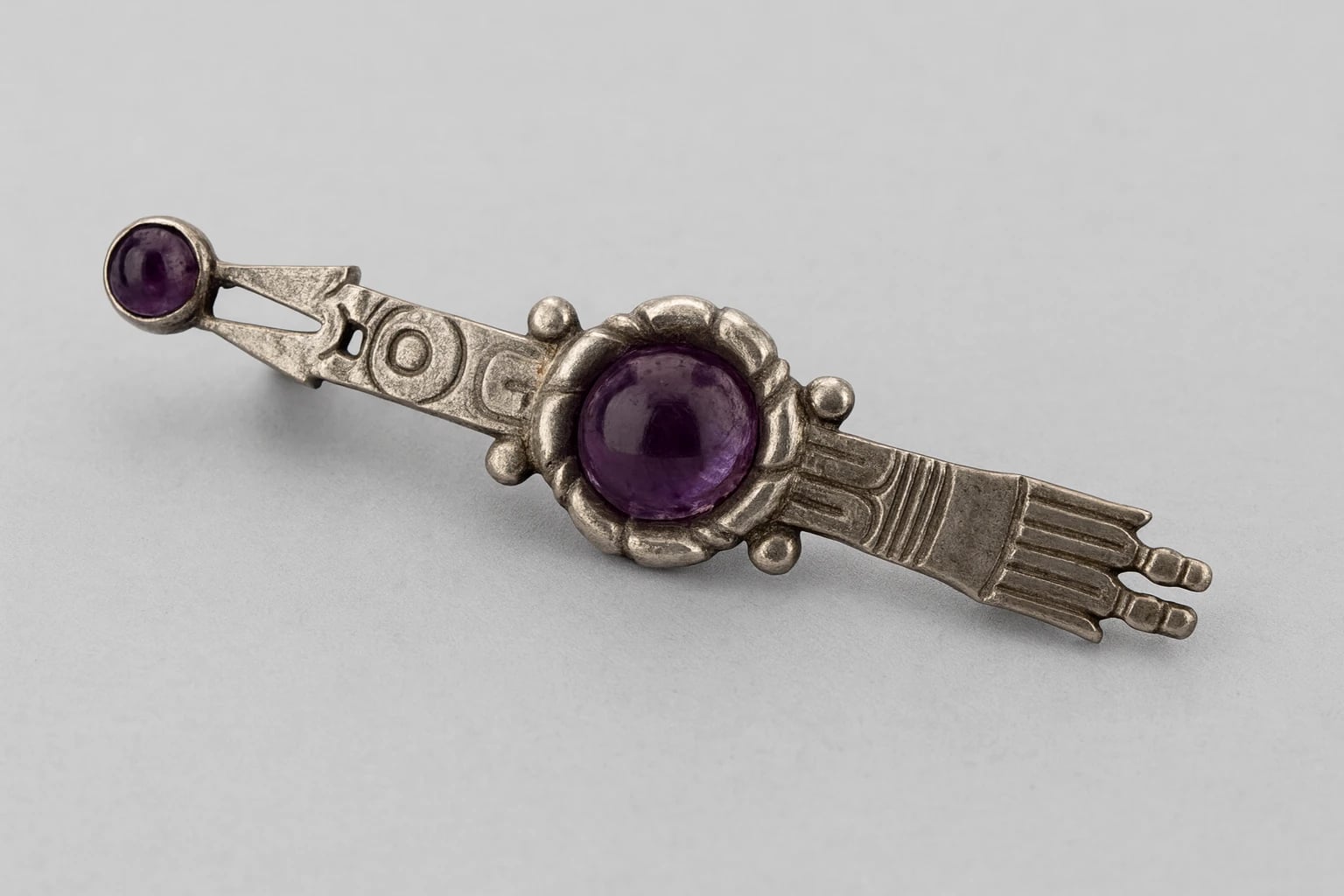
Two arrows crossed in parallel, held taut across the length of a narrow silver bar, drive the entire composition of this brooch. The design compresses movement into a strict horizontal line: the arrowheads point outward at one end, the fletching answers at the other, and the amethysts sit along the shaft like fixed points on a trajectory. There is nothing incidental in it. Spratling reduced a familiar emblem to its most direct geometry, then let the purple of the stones interrupt the reflective silver at measured intervals. The brooch reads as a single decisive gesture rather than an assembly of parts.
The narrowness is the point. Where much Taxco jewelry builds outward into mass, this brooch holds to a slender axis, and the discipline of that choice sharpens every element within it. The amethysts, faceted and cool against the metal, break the continuous shine of the silver and give the eye a rhythm to follow from one end to the other. Spratling made this same design without stones, and the comparison is instructive: without the amethysts, the brooch is pure line and silhouette; with them, the shaft acquires cadence and color, and the arrows gain a sense of weight distributed along their length. The stones are not applied decoration so much as punctuation, marking intervals the way the fletching and heads mark the ends. Color here does structural work, dividing the bar into a measured sequence rather than adorning a finished form.
The arrow belonged to Spratling's vocabulary from the beginning of the Taller de Las Delicias, founded in 1931, when he was drawing on Aztec and colonial motifs and on the pre-Columbian seals in his own collection as points of departure, as he later described that early method. This brooch falls within his first design period, the years through 1946 in which he established the formal language that the wider Taxco renaissance would absorb and transform. Penny Morrill and Carole Berk record the design in their study of twentieth-century Mexican silver, placing it within the documented body of Spratling's work. Spratling was known to make several versions of a basic idea, adjusting elements from example to example, and the stoned and unstoned variants of this brooch belong to that practice of controlled variation within a single design. The choice to set amethysts, a stone native to Mexico, kept the material as well as the motif within a Mexican frame.
For a collection tracing the Mexican silver renaissance, the brooch documents how Spratling built meaning from restraint rather than abundance. It shows a designer taking a legible emblem and refusing to let it sprawl, holding it instead to a single narrow line where every interval counts. The pairing with its stoneless twin lets a collection demonstrate, in two closely related objects, exactly what a set of amethysts contributes to a Spratling composition: not richness for its own sake, but rhythm, division, and a second color introduced with the same economy that governs the silver.
Museum of Mexican Silver. “Double Arrow Brooch with Amethyst.” Catalog no. MoMS-000410. https://museumofmexicansilver.com/pieces/spratling-849
See something wrong with this record? Suggest a correction and the piece details fill in automatically.
William Spratling
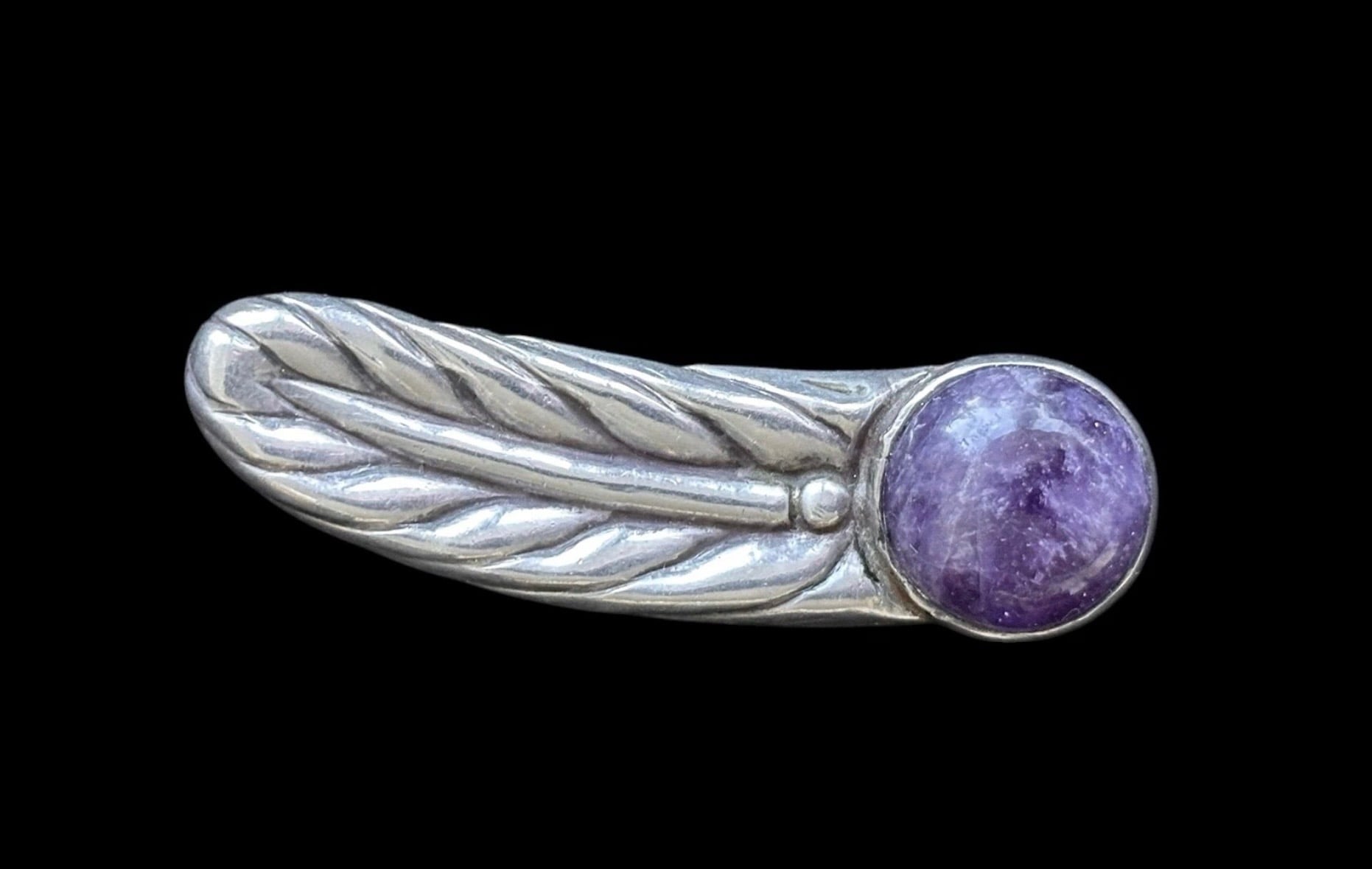
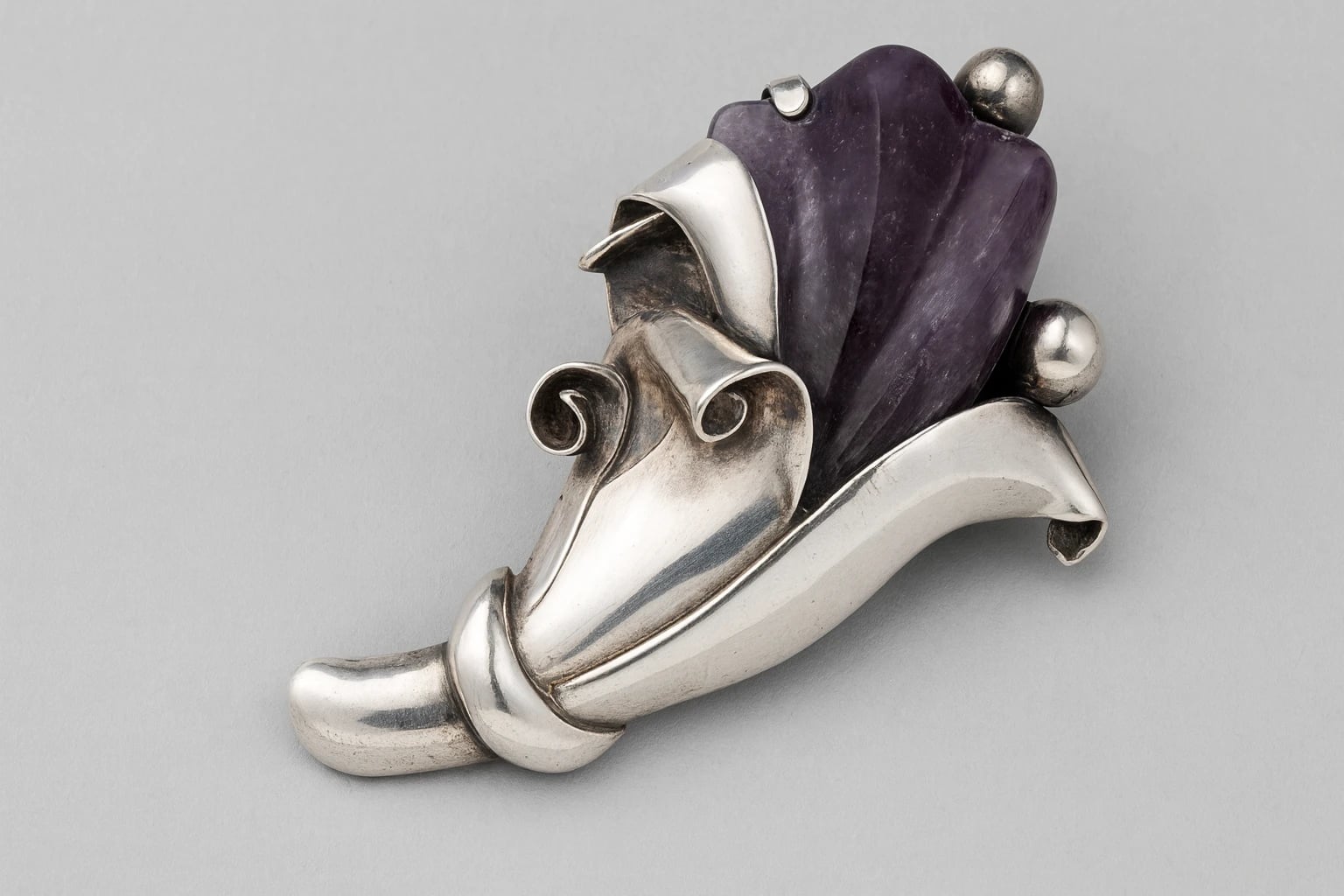
Amethyst Feather Brooch
First Design Period: 1931 - 1946
Silver