Saves instantly, no account needed. Already a member? Sign in.
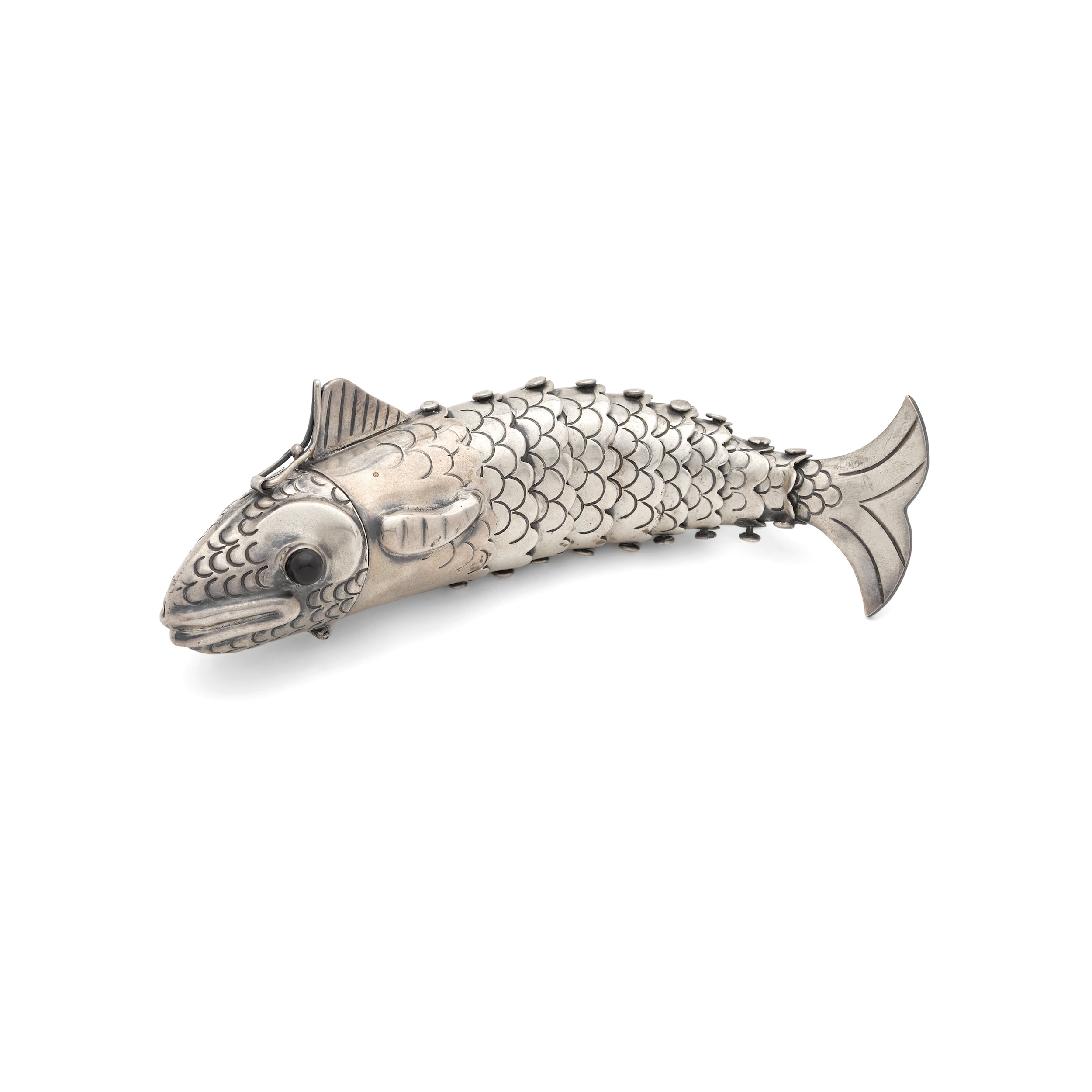
The articulated fish is one of the most beloved forms to come out of William Spratling's workshop, and this example represents its mature, Third Period refinement. Spratling first developed the hinged, fully articulated fish in the early 1940s; this later version, produced during the Third Design Period of 1951 to 1967, is the more sophisticated and slightly smaller of the two, its proportions tightened and its engineering advanced. The head lifts to reveal a hidden cavity for small objects, so that what reads as a purely sculptural fish is in fact a functional box. That marriage of naturalistic sculpture and secret function is exactly the kind of wit that distinguished Spratling's later holloware from the more austere jewelry of his early years.
The achievement of the object is mechanical as much as artistic. The body is built from nine separate segments, each hinged to the next, so that the whole length flexes and undulates as a real fish would, the silver scales overlapping in disciplined rows down the flank. Setting a functioning box within an articulated body is a genuine feat of construction: the head must open cleanly on its hinge while the rest of the body retains its supple, jointed movement, and the scales, fins, and gill plates must remain visually continuous across the joints. The surface is worked throughout, the imbricated scales stamped and layered, the fins and tail engraved with fine radiating lines, the eye set as a dark cabochon. Nothing about the piece is left plain; every plane carries texture, and the result is an object that is as satisfying in the hand, articulating and shifting, as it is to the eye.
The fish belongs to the strain of Spratling's work that drew on Mexico's natural and Pre-Columbian imagery while stylizing it into modern form. In his own account of his sources, Spratling spoke of Aztec and colonial motifs as a point of departure rather than literal models, and the later holloware shows how far he had traveled from those beginnings toward a personal, refined sculptural language. The double serpent and the stylized animal forms Morrill discusses from his 1950s production share this quality: subject matter that alludes to Mexico's past and its fauna, but flattened, patterned, and reconceived so that the design, not the illustration, is the point (Morrill, Mexican Silver, 1994, p. 73). The articulated fish is the most exuberant expression of that impulse.
The importance of this particular design is confirmed by its exhibition history: it was included in the 1965 traveling United States museum exhibition The World of William Spratling, the survey that brought his work to a national museum audience in his final years. Inclusion in that show marks the design as one Spratling and his circle regarded as representative of his achievement, not a minor novelty. The piece is documented in Cederwall and Riney's Spratling Silver and in Goddard's field guide, the two standard references for authenticating and dating his holloware, which place it securely within the Third Period production. Articulated fish of this quality are uncommon; the combination of nine-part articulation, a working box, and exhibition provenance sets this example apart from the simpler fish that circulate.
William Spratling Silver Articulated Fish Box
Amero Auctions · 2022-03-27
A William Spratling silver articulated fish box
John Moran Auctioneers, Inc. · 2021-02-09
William Spratling Silver Fish Box, Taxco Mexican
Auctions at Showplace · 2018-05-20
A MEXICAN OBSIDIAN AND STERLING SILVER ARTICULATED FISH-FORM BOX, WILLIAM SPRATLING, 1964-1967 Taxco
Bonhams (United States)
Museum of Mexican Silver. “Articulated Fish Box.” Catalog no. MoMS-000859. https://museumofmexicansilver.com/pieces/spratling-852
See something wrong with this record? Suggest a correction and the piece details fill in automatically.
A museum collection of twentieth-century Mexican silver would want this object because it captures Spratling at his most inventive and most technically daring, uniting sculpture, mechanism, and function in a single form, and because its documented place in The World of William Spratling ties it directly to the moment his work entered the museum canon. It is, in the fullest sense, a signature Spratling design realized at the height of the workshop's craft.
William Spratling
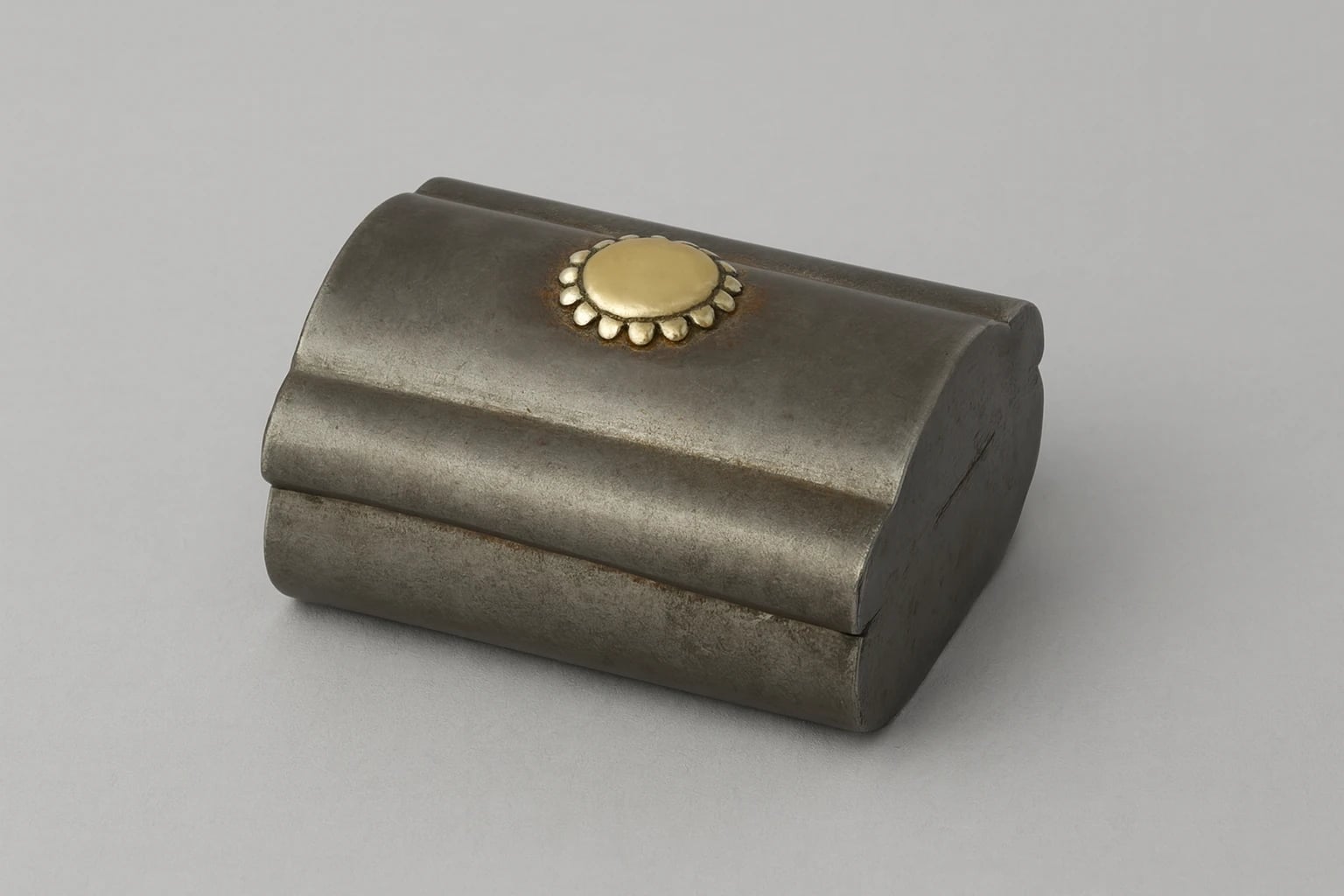
Bronze Sun Tin Box
First Design Period: 1931 - 1946
Tin