Saves instantly, no account needed. Already a member? Sign in.
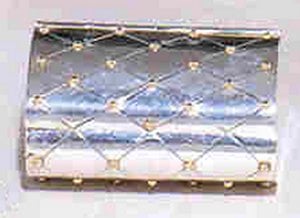
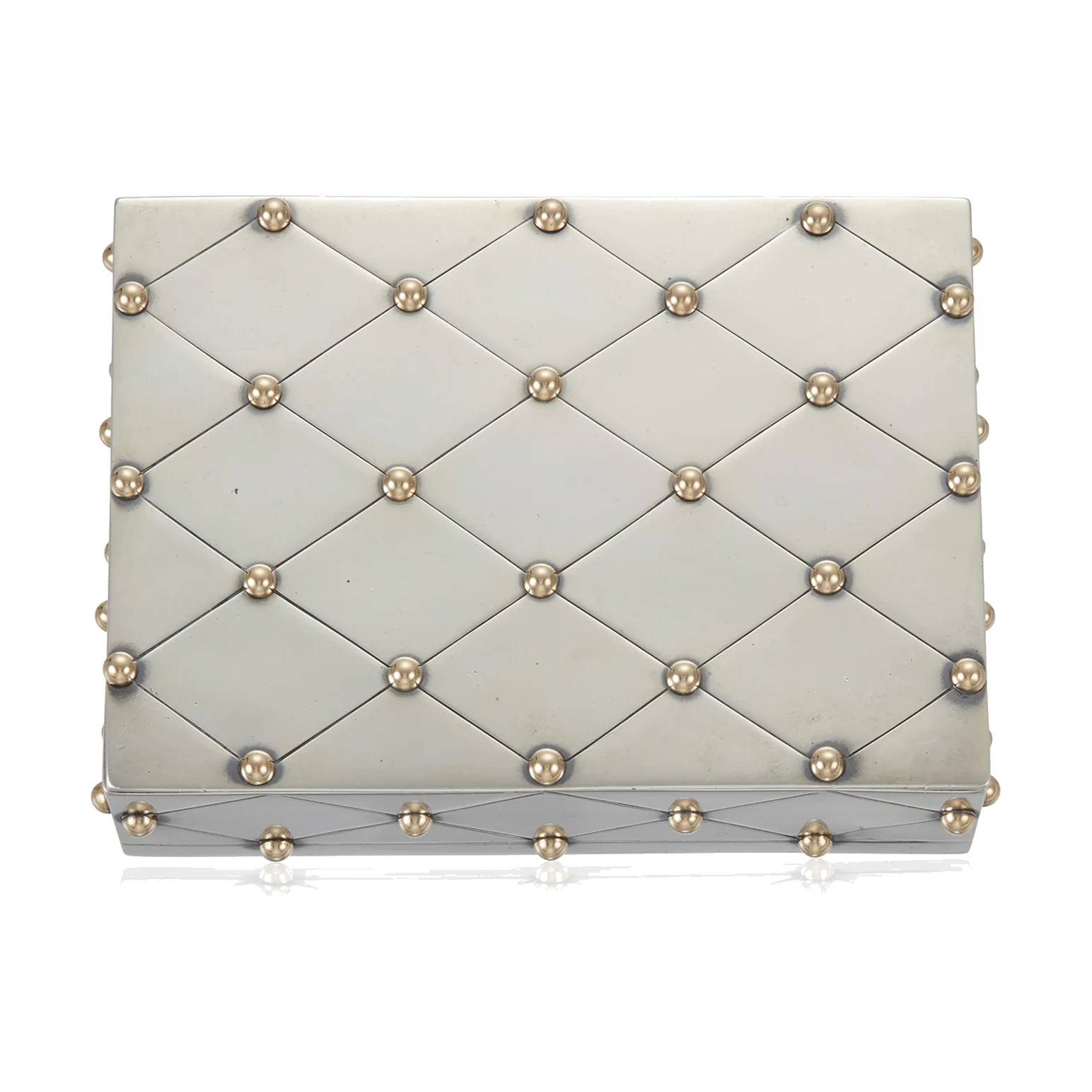
A grid of incised diamonds runs across the flat lid, and at every crossing sits a small gold bead, so the plain casket reads as a panel of buttoned, upholstered metal. The trick is entirely graphic: shallow ruled lines do the quilting, the beads do the tufting, and the clean rectangular block shows the pattern at its most legible. It is a design that converts a utilitarian box into a study in repeated, two-tone ornament.
The same lattice wraps the sides, beads marching along the lower edge so the geometry never breaks at a corner, and the hinged lid lifts to a plain, untreated silver interior — all the decoration kept to the outer skin. Worked flat and rectilinear, the form lets the diamond field carry the whole effect without applied figures or flourish.
The box is sterling, struck WILLIAM SPRATLING TAXCO MEXICO .925 with the WS stamp and the eagle assay, placing it in the later sterling period of the Taxco workshop William Spratling founded, roughly 1956 to 1962. The body is silver throughout while the beads are applied gold, giving the restrained two-tone richness that distinguishes the lattice boxes from the shop's plainer holloware.
Spratling, the American whose work launched the Taxco silver revival in the 1930s, built much of his later production on exactly this kind of disciplined pattern-making, where a single repeated motif and a touch of contrasting metal carry a domestic object. The quilted lattice is that idea at full stretch on the box form.
Museum of Mexican Silver. “Rectangular Box with Gold Beads.” Catalog no. MoMS-002158. https://museumofmexicansilver.com/pieces/william-spratling-lattice-silver-rectangular-box
See something wrong with this record? Suggest a correction and the piece details fill in automatically.
William Spratling
Alaska Project Star Mosaic Box
Second Design Period: 1949 - 1951
Silver