Saves instantly, no account needed. Already a member? Sign in.
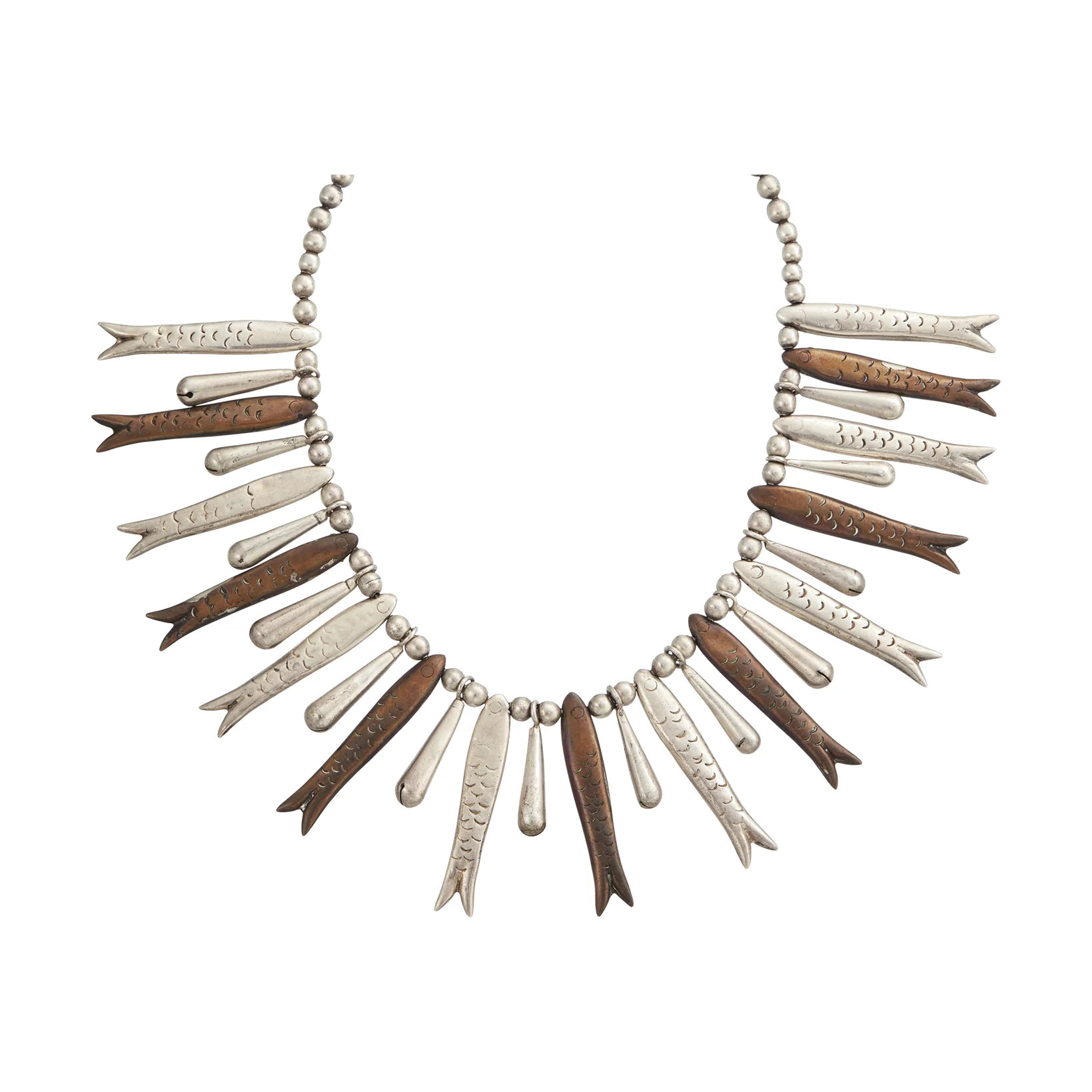
A close-set fringe of fish hangs from a graduated bead collar, each one swinging free on its own loop so the row ripples like a shoal turning together across the chest. The fish alternate between bright silver and warm copper, and they lengthen toward the center, the longest dropping at the throat. Worn, the whole band moves and catches the light, less a static ornament than a small school in motion.
Each fish is shaped in the round and stamped with scales and an eye, simple marks that give the repeated form just enough life to read as a fish rather than a bar. The two-color scheme is the design's engine: copper bodies set warm against their silver neighbours, the alternation carrying the eye around the collar. Drawn from Mexican folk and pre-Columbian imagery, the fish motif is characteristic of William Spratling, who built the Taxco workshop that revived hand silver in the 1930s and looked steadily to native sources for his vocabulary.
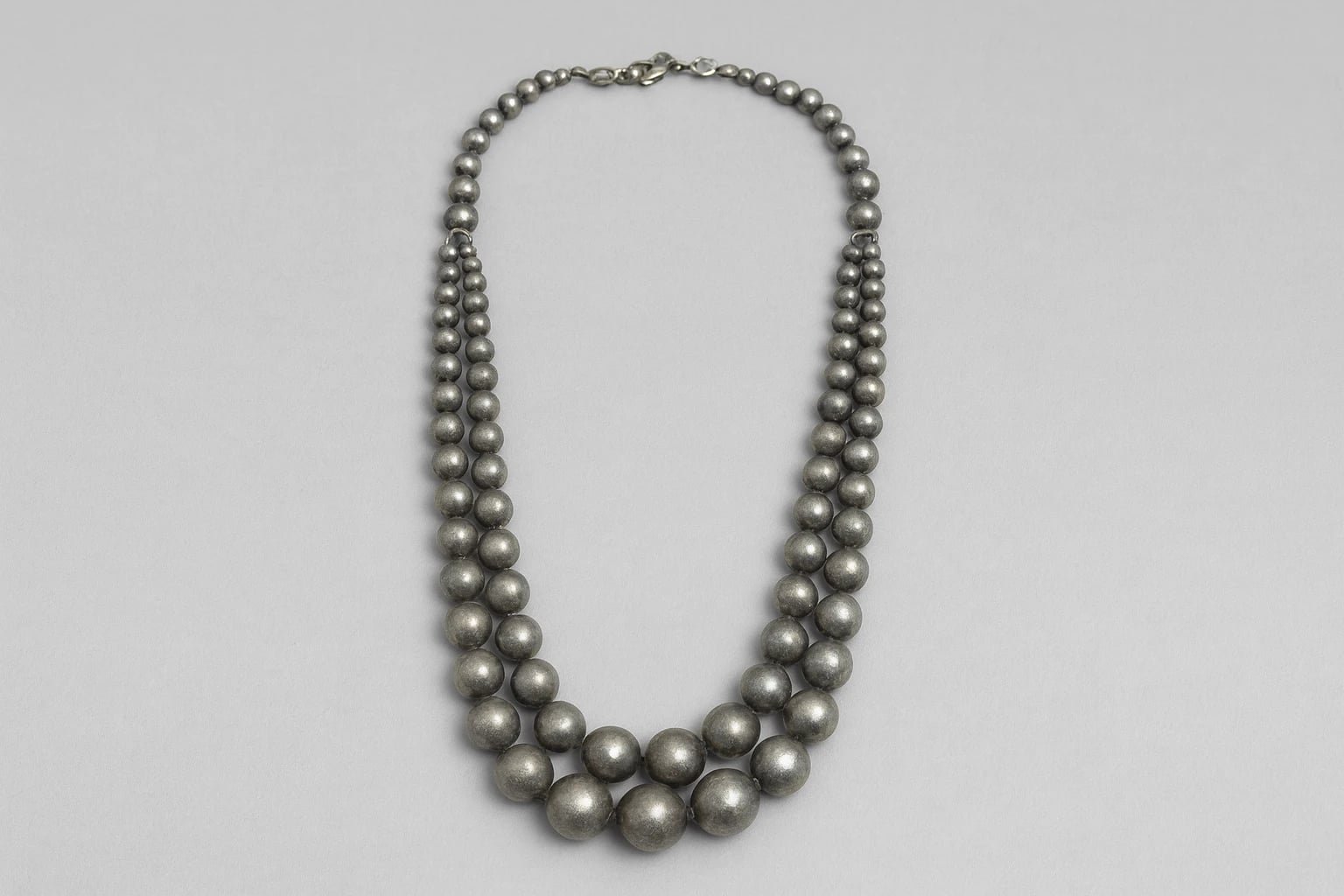
The necklace is strung on a graduated chain of hollow silver beads and closes with a box clasp at the back of the neck. It carries the SPRATLING SILVER MADE IN MEXICO mark, which places it in the early workshop, roughly 1940 to 1946 — the period when, as Morrill records, Spratling insisted on signing each design and was working the higher-content silver that gave his early pieces their soft surface.
Built from one repeated creature in two metals, it turns a folk subject into something kinetic: a band of fish that swims as it is worn.
Museum of Mexican Silver. “Silver and Copper Fish Necklace.” Catalog no. MoMS-002153. https://museumofmexicansilver.com/pieces/william-spratling-silver-and-copper-fish-necklace
See something wrong with this record? Suggest a correction and the piece details fill in automatically.
William Spratling
Jaguar Necklace
Silver