Saves instantly, no account needed. Already a member? Sign in.
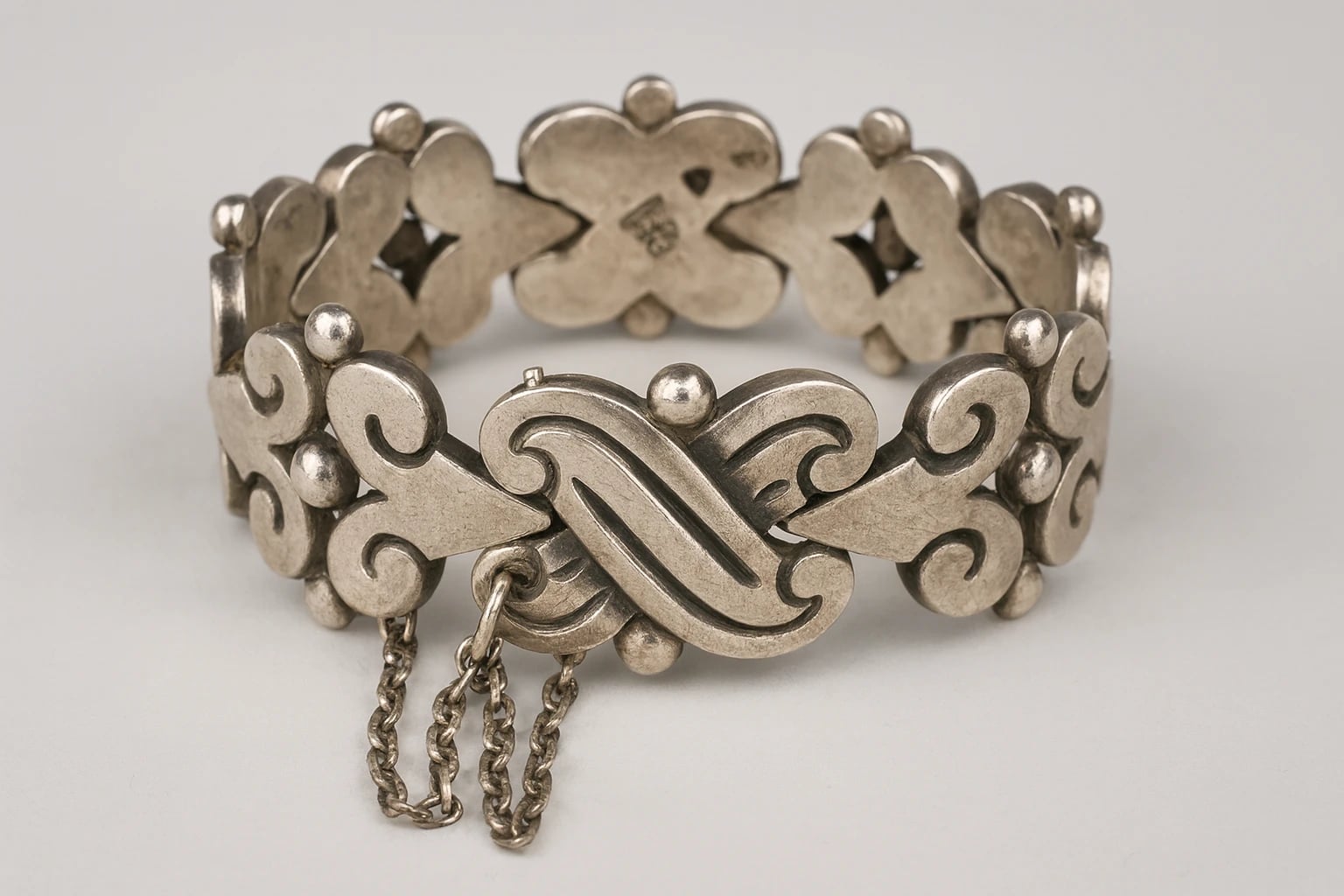
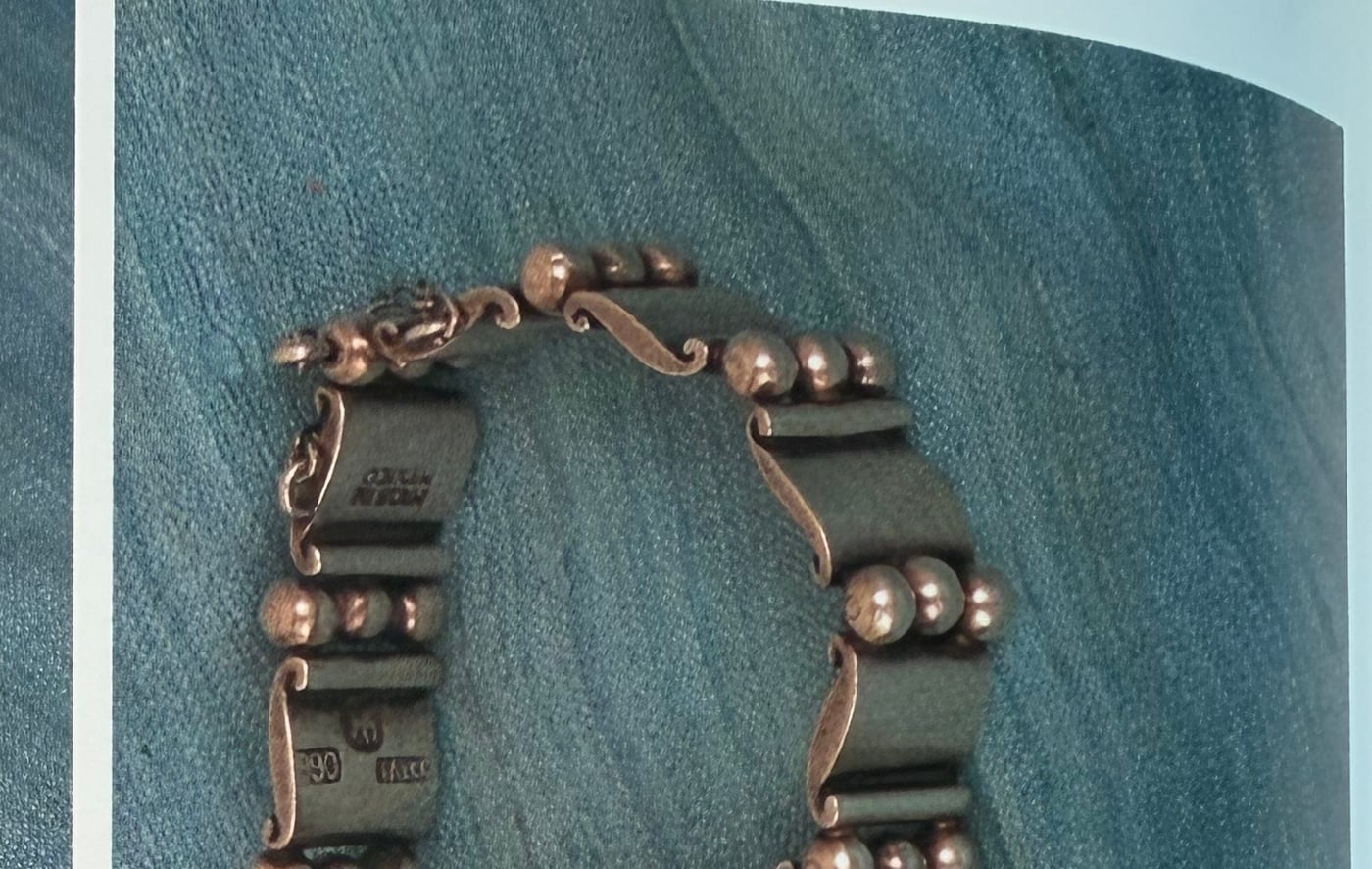
The bracelet organizes its silver around a single link shaped like a small closed book, its spine and covers reading clearly against the flatter band that carries it, punctuated by three plain spheres that gather the eye and set a slow, deliberate rhythm. The goldwash across the surface warms the 940 silver without disguising it, so the metal keeps its weight and structure while the color shifts toward something softer. This is Héctor Aguilar working in the vocabulary that made the Taller Borda recognizable: heavy, architectural forms held in disciplined repetition, ornament that comes from the shaping of solid elements rather than from applied decoration.
The book form is the governing idea. Aguilar favored motifs that behaved like objects rather than patterns, and here the closed volume gives the band a focal mass with real edges and planes, a form that catches light along its spine and goes dark in its recesses. The three beads answer it by contrast, rounded where the book is squared, smooth where the book is faceted by its own construction. That pairing of a shaped emblem with a small sequence of spheres recurs across Aguilar's bracelets of the mid-1950s, including the Knot and Three Beads and the Bead and Band bracelets recorded from the same period, and it reflects a workshop habit of building a design around one clear element and letting simple repeated units carry the rest. The 940 alloy, slightly finer than sterling and standard in Aguilar's production, supports this taste for substantial forms that hold their shape on the wrist.
Penny Morrill documents this bracelet in Silver Masters of Mexico as one of a pair, the goldwash version dated about 1955 alongside a 990 silver example dated about 1940, indicating that Aguilar returned to the Book and Three Beads design across at least fifteen years and reworked it in different surfaces. The hallmark period code recorded for this piece places its fabrication in the workshop's later years, and the goldwash treatment belongs to that phase rather than to the design's first appearance. Aguilar founded the Taller Borda in Taxco in 1939, and his authority there was as workshop head and designer directing a team of silversmiths; the hallmark identifies the taller and its design language, not the hand of a single maker at the bench. The comparison with the earlier silver version is useful precisely because it separates the conception of the design from this later goldwash realization of it.
Within a collection, the value of this bracelet lies in its documentation and its position within a known series. It is the goldwash top of a recorded pair, published by the leading scholar of Aguilar's work, and it shows how the Taller Borda revisited a successful form and varied its surface over time. The book motif distinguishes Aguilar from the more austere geometric bracelets of his Taxco contemporaries, tying his production to a fondness for legible, almost narrative objects rendered in heavy silver. As a dated and published example of that practice, it clarifies both the designer's range and the way a Taxco workshop treated a design as something to return to rather than to fix once.
Museum of Mexican Silver. “Book and Three Beads Bracelet.” Catalog no. MoMS-001636. https://museumofmexicansilver.com/pieces/aguilar-book-three-beads-bracelet-1955
See something wrong with this record? Suggest a correction and the piece details fill in automatically.
Héctor Aguilar
Amethyst Pyramid Cuff
1939-1962
Amethyst