Saves instantly, no account needed. Already a member? Sign in.
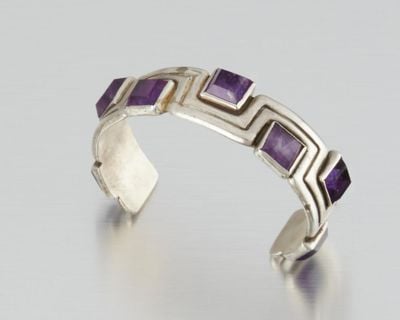
The cuff sets a row of square amethysts along the raised crest of a folded silver band, letting the stepped channels rise and fall so that the metal itself carries the rhythm. Rather than repeating identical rows, the design works in angular, zigzagging bands, and the amethysts sit above the surface on raised settings that catch light at the edge of each fold. The result is a bracelet organized around a single ridge of color and reflection, with the silver structure doing as much visual work as the stones.
The band opens rather than closing fully around the wrist, a construction Héctor Aguilar's workshop favored for cuffs of this kind. The stepped silver channels give the surface a series of planes that shift as the wearer moves, and the purple squares interrupt that movement at intervals along the highest line of the form. Amethyst here is chosen for opacity and color as much as for the class of stone: the deep, cool purple reads against the warm reflectivity of silver, and the square cut keeps each stone aligned with the angular geometry of the channels. The raised settings lift the color clear of the metal so that the two materials stay distinct rather than blending into a single surface.
Aguilar led the Taller Borda in Taxco, and amethyst set into silver was a recurring vocabulary across his bracelet production. Margot Morrill's survey of his work records a range of related pieces, among them a Square Amethyst Bracelet dated to about 1940, curved and hinged amethyst bracelets, and versions with braided or diamond-shaped hinges. Within that group, this cuff belongs to the squared, angular branch of the vocabulary rather than the rounded or braided variants. Morrill's account of the taller also credits designers and silversmiths working under Aguilar's direction, including the maestro Dámaso Gallegos, whose amethyst bracelet is singled out for the way flanged square settings and repeating oxidized lines were made to offset the verticality of the stones. That description clarifies a working principle shared by this cuff: the interplay between raised stone settings and the linear, shadowed channels of the surrounding silver.
The cuff shows how Aguilar's workshop treated a stone and a structural fold as equal parts of a design, building ornament out of the geometry of the band rather than applying it. It records a characteristic phase of Taller Borda production, when the taller developed the amethyst-and-silver bracelet into several distinct formal solutions, and it preserves the angular, stepped version of that idea among Aguilar's better-documented rounded and braided examples.
Museum of Mexican Silver. “Amethyst Pyramid Cuff.” Catalog no. MoMS-001348. https://museumofmexicansilver.com/pieces/aguilar-bracelet-cuff-amethyst
See something wrong with this record? Suggest a correction and the piece details fill in automatically.
Héctor Aguilar
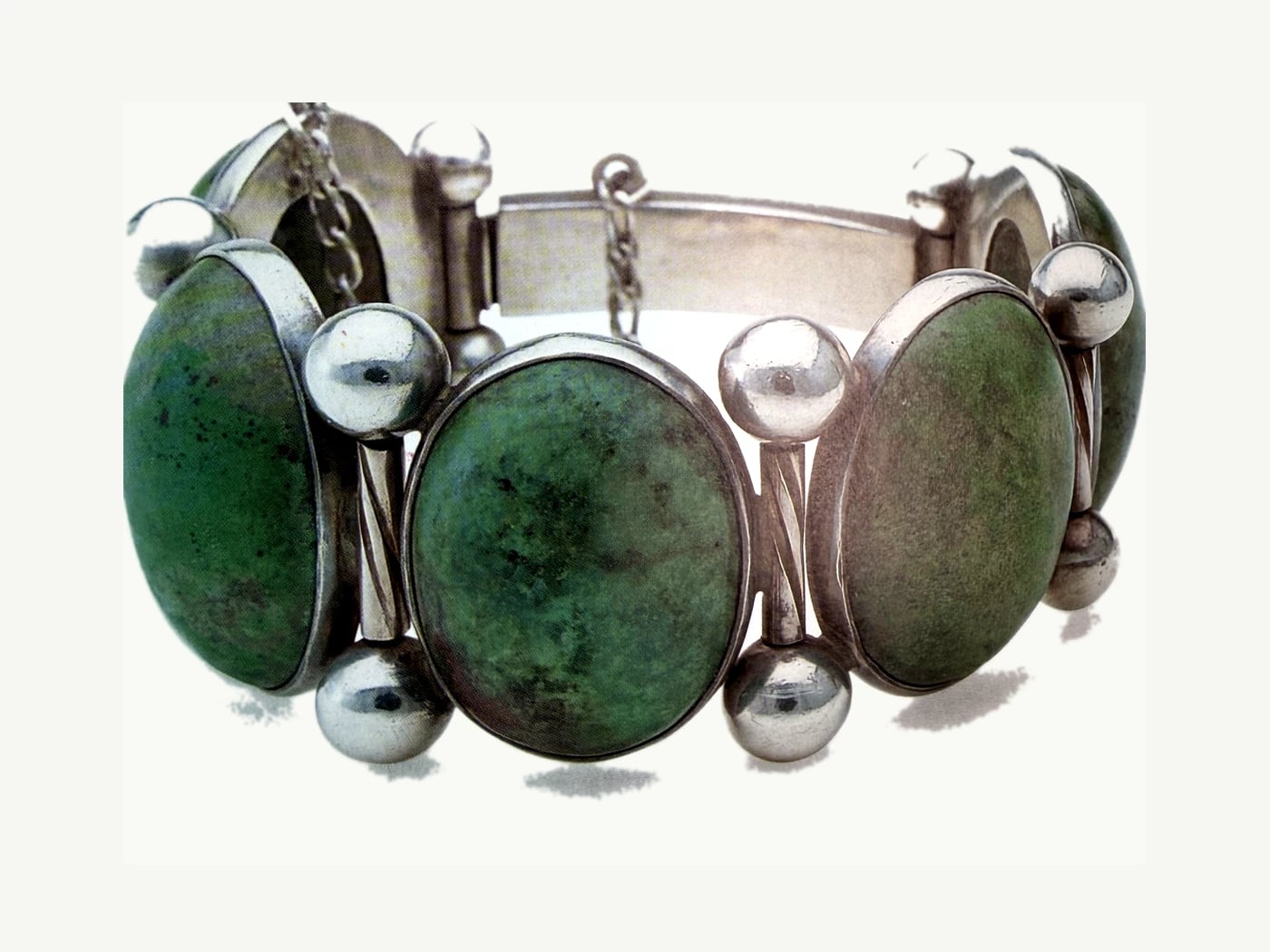
Bracelet with Malachite Cabochons, Roped Links, and Silver Beads
1948-1962
Silver