Saves instantly, no account needed. Already a member? Sign in.
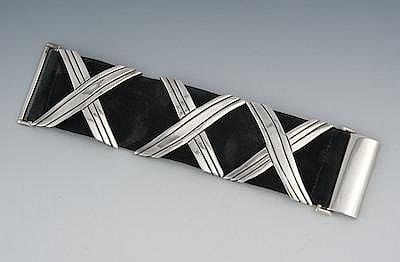
Few objects better embody Héctor Aguilar’s contribution to the Taxco School than the celebrated X-bracelet, now widely known as the “Georgia O’Keeffe bracelet.” Designed around 1940, the bracelet transforms an everyday material—black leather—into a sophisticated modernist composition through broad bands of hand-forged silver that cross in rhythmic X-shaped intersections. Rather than relying on gemstones or overt Pre-Columbian symbolism, Aguilar achieved drama through proportion, negative space, and architectural geometry. The result is unmistakably Mexican in craftsmanship yet completely international in its modernist language, illustrating how Taxco’s finest designers moved beyond revivalism to create jewelry that belonged alongside the best industrial and decorative design of the twentieth century. The bracelet is illustrated in the standard reference Mexican Silver by Penny Chittim Morrill and appears in the landmark exhibition catalog Silver Seduction, where it is identified as one of Aguilar’s signature leather-and-silver designs.
The bracelet’s enduring significance is inseparable from its association with Georgia O’Keeffe. Photographs from 1951 show O’Keeffe wearing the bracelet during her visit to Taxco, where she likely acquired it or received it as a gift while visiting Rosa Covarrubias. That image has become one of the defining photographs linking the worlds of Mexican silver and American modernism. O’Keeffe’s affinity for clean, sculptural forms mirrored Aguilar’s own design philosophy, making the pairing feel inevitable rather than incidental. Unlike celebrity provenance that merely adds market appeal, O’Keeffe’s documented use of the bracelet validates its place within the broader story of twentieth-century modern art, where jewelry functioned as wearable sculpture rather than ornament alone.
From a curatorial perspective, the X-bracelet represents a pivotal moment in the evolution of the Taxco School. Aguilar had already distinguished himself after leaving William Spratling’s workshop, but this design demonstrates his mature confidence as an independent designer. The juxtaposition of forged silver with leather challenged contemporary expectations of precious jewelry while producing an object of remarkable visual strength and comfort. Its construction is deceptively complex: each silver element had to be individually formed, fitted, and tensioned over the leather foundation while maintaining perfect symmetry. Surviving examples are uncommon, and complete original bracelets in excellent condition are decidedly scarce. Because leather naturally deteriorates with age, intact examples with original leather retain exceptional historical integrity and are significantly more desirable than later restorations.
Museum of Mexican Silver. “Georgia O’Keeffe Bracelet.” Catalog no. MoMS-001342. https://museumofmexicansilver.com/pieces/aguilar-bracelet-suede
See something wrong with this record? Suggest a correction and the piece details fill in automatically.
Today the Georgia O’Keeffe bracelet occupies a secure position among the canonical works of Mexican modernist silver. It is documented in the foundational literature on the Taxco renaissance, illustrated in major scholarly references, and linked to one of the twentieth century’s most important artists through period photography. For collectors, it represents far more than an attractive Aguilar design: it is one of the defining visual statements of the Taxco movement, a museum-caliber object that captures the convergence of modern art, innovative silversmithing, and cross-cultural exchange at the height of Mexico’s silver renaissance.
Héctor Aguilar
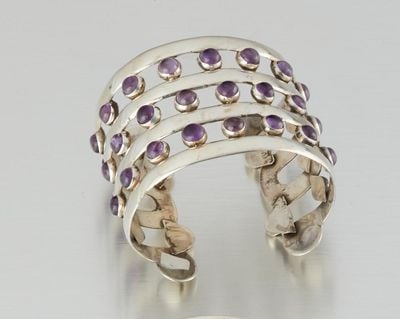
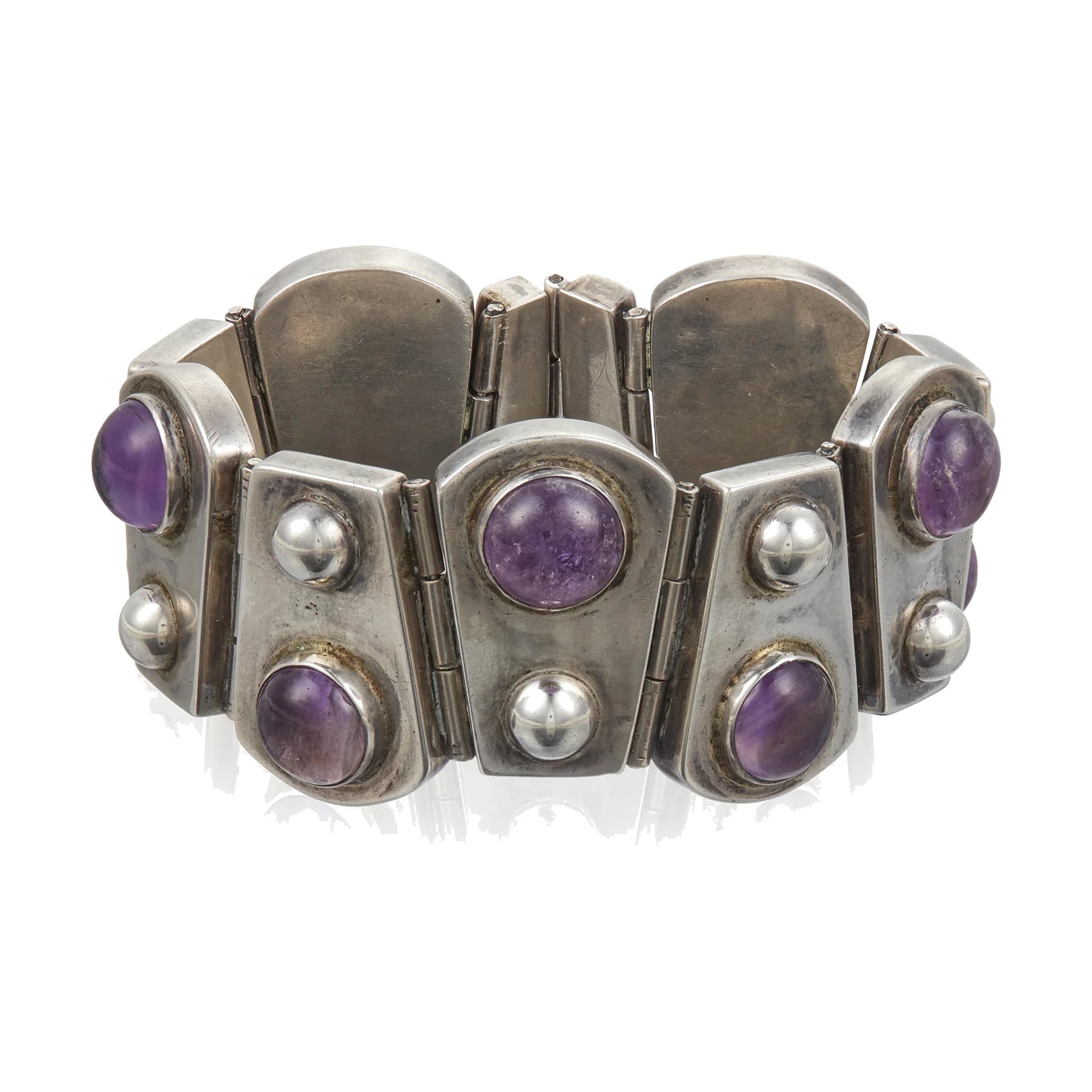
Amethyst Wide Four Bands Bracelet
1939-1962
Amethyst