Saves instantly, no account needed. Already a member? Sign in.
A wearable crown is the rarest form Antonio Pineda ever turned his hand to. Where his jewelry was made in quantity through a large workshop, regalia of this kind is by nature a near-singular object, tied to the ceremonial world of the Taxco Silver Fair and its Silver Queen rather than to a production line. That this crown survives, complete with its full crowned mark and the 970 standard, makes it an unusually complete document of Pineda at the height of his sculptural ambition.
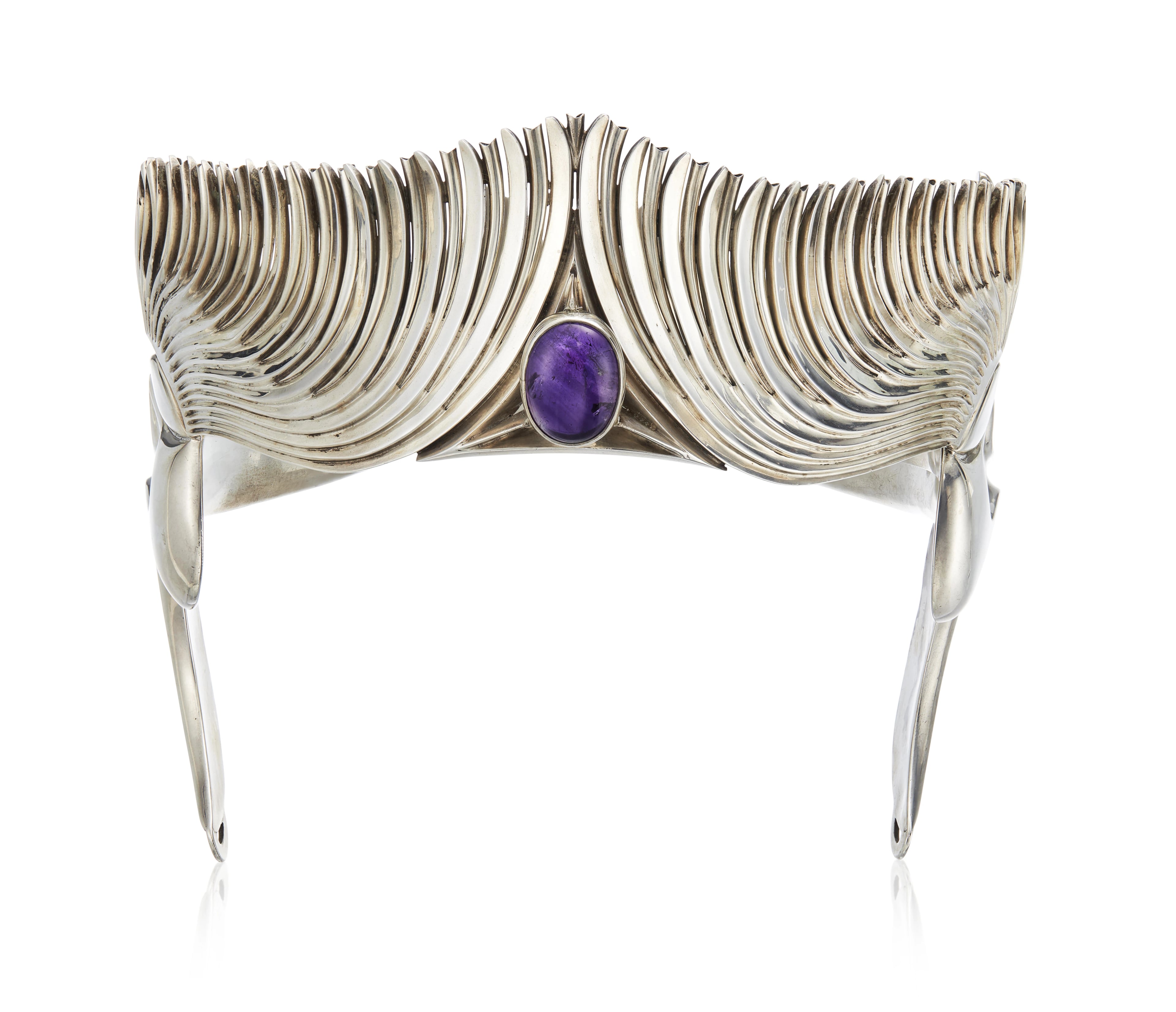
Two great sweeps of fluted silver rise from a central spine and fall away like drawn curtains, each blade hammered and ranked in close parallel so that the metal reads as cascading fabric rather than as a band of jewelry. At the meeting point of the two sweeps sits a single cabochon amethyst, its violet held in a plain bezel that lets the stone float clear of the surrounding silverwork; on the reverse a smaller cabochon of aventurine quartz answers it. With an interior circumference of roughly 55.5 centimeters, this is not a brooch but a wearable crown, a sculptural headpiece in 970 silver weighing more than eight hundred grams.
The form belongs unmistakably to Pineda's modernist vocabulary. Where many of his contemporaries in Taxco worked in cast or assembled motifs, he treated silver as a sculptural medium, marshaling repeated hand-wrought elements into forms that move with the body. The setting here is characteristic: the amethyst is held with as little metal touching it as possible, the "floating" treatment of semiprecious stones that defines his jewelry and that the Fowler Museum's survey of his work singled out as central to his art. The pairing of a forward-facing amethyst with a concealed aventurine on the reverse is the gesture of a designer thinking in three dimensions, finishing the back of an object as carefully as its face.
The marks place the piece securely in the maker's mature production. The crowned ANTONIO TAXCO signature, used after he had established his own taller, appears alongside HECHO EN MEXICO, the 970 silver standard he favored over sterling, and the eagle assay stamp of the period. By the years this crown was made, the workshop had grown from a handful of smiths into a large taller in which master silversmiths executed his designs, and the 970 alloy, slightly finer than sterling, gave his sculptural forms their particular bright weight.
That the object is a crown at all is the heart of its interest. Pineda's connection to Taxco's silver culture was direct and official: he served on the organizing committee of the town's annual Silver Fair and won its national prize repeatedly, and the published record documents a Pineda "Crown for the Silver Queen" of the late 1950s, the ceremonial headpiece made for the Reina de la Plata who presided over the fair. This crown sits in that lineage, the rare case in which he turned his sculptural instinct toward regalia rather than adornment, and the pairing of amethyst and aventurine with the fluted, curtain-like construction shows that instinct fully realized.
Museum of Mexican Silver. “Silver Crown for the Taxco Silver Fair with Amethyst and Aventurine Quartz.” Catalog no. MoMS-002100. https://museumofmexicansilver.com/pieces/antonio-pineda-amethyst-aventurine-quartz-and-silver-crown
See something wrong with this record? Suggest a correction and the piece details fill in automatically.
Antonio Pineda
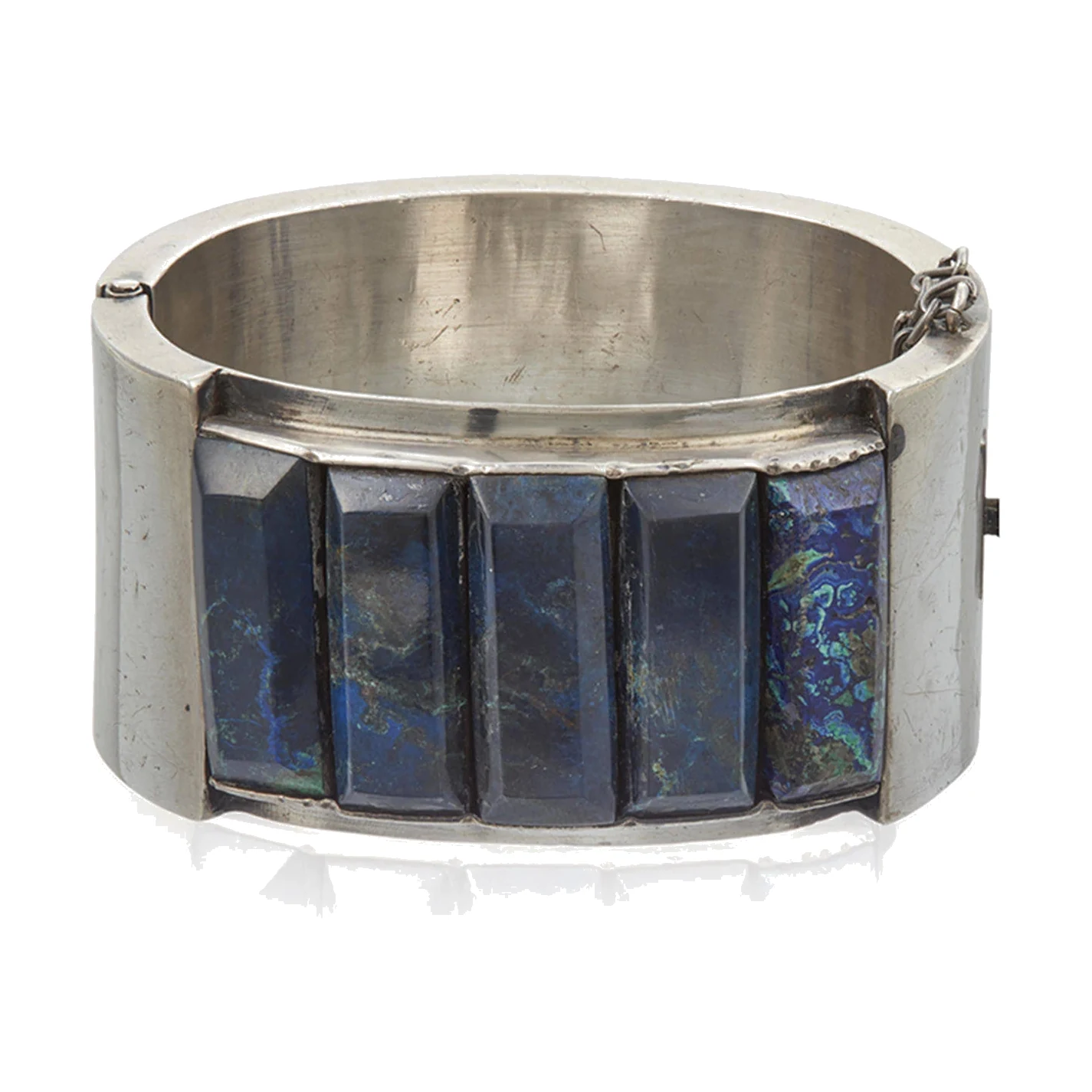
Azurmalachite and Silver Cuff Bracelet
Silver