Saves instantly, no account needed. Already a member? Sign in.
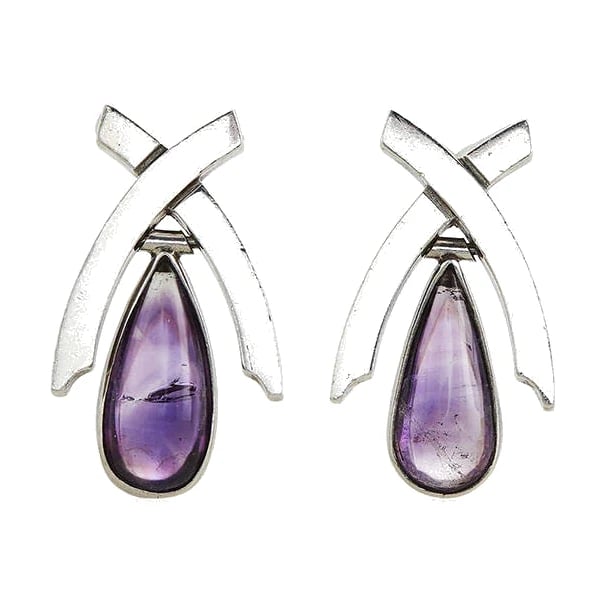
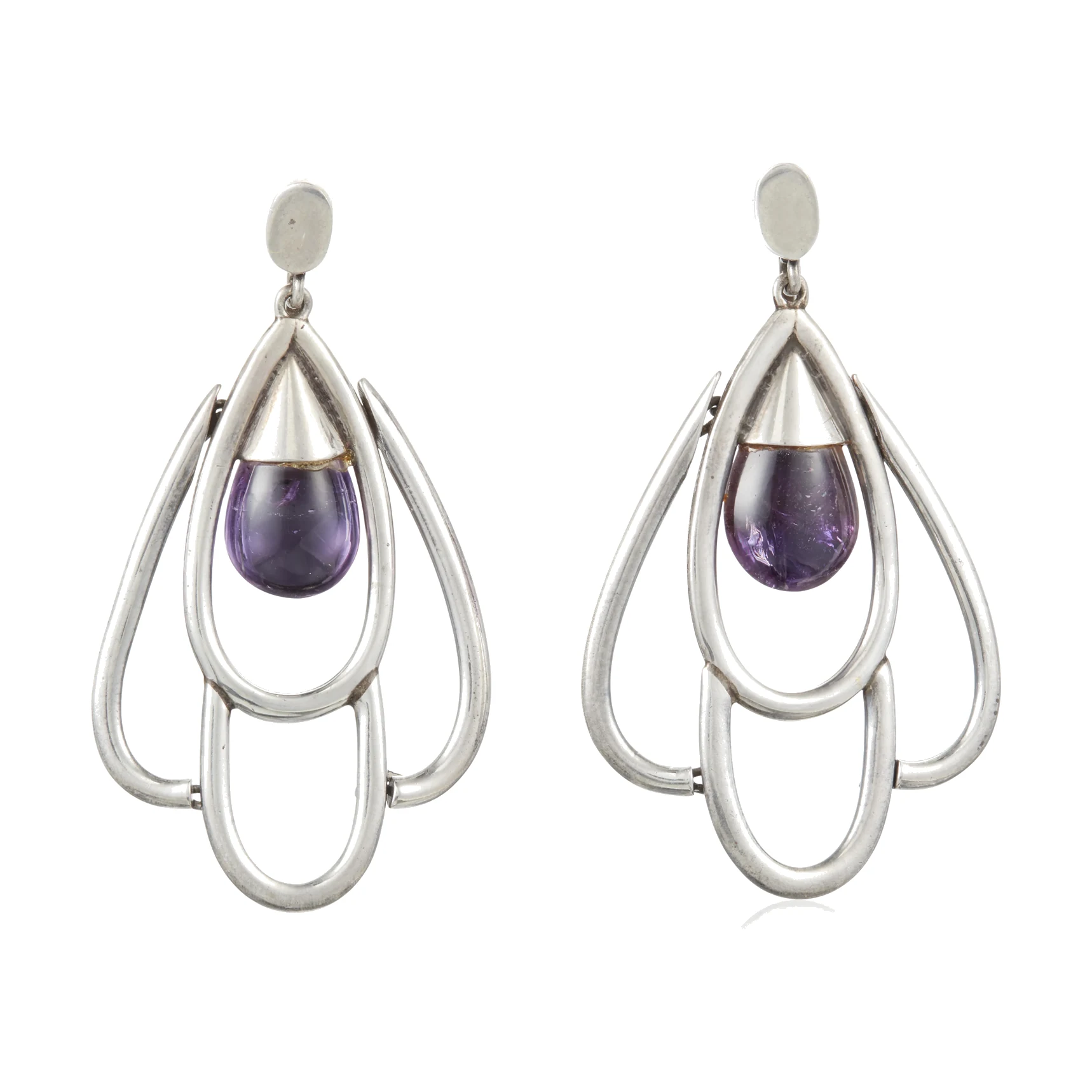
Open silver loops nest one within the next on each ear, and at the heart of the frame a polished amethyst drop hangs free from a slim conical cap, swinging inside the bright outline as the wearer moves. The idea is to suspend a single stone within an armature of empty line, so the drop reads in movement and shadow as much as in metal — sculptural, kinetic, and squarely in the modernist vein Antonio Pineda worked in silver.
The structure is articulated rather than solid. A teardrop loop frames the stone, and a second open loop hinges below it, extending the drop downward and letting the lower element sway on its own. Polished to a high shine and pared back to outline, each earring carries its length in line and interval, with the amethyst as the one note of color and mass.
Each is struck 970 — the finer-than-sterling standard Pineda favored through his Taxco years — and carries his Antonio-Taxco crown mark with the eagle-17 assay stamp, the hallmark sequence Stromberg records for the workshop. The amethyst is a smooth cabochon drop, set under the cap so it depends freely; the backs retain their original screw fittings for unpierced ears.
Worn as a pair, the two drops mirror each other in their nested loops and matched stones. It is Pineda treating an earring as small kinetic sculpture — open line, a suspended stone, and movement built into the form.
Museum of Mexican Silver. “Caged Amethyst Teardrop Earrings.” Catalog no. MoMS-002125. https://museumofmexicansilver.com/pieces/antonio-pineda-teardrop-amethyst-and-silver-earrings
See something wrong with this record? Suggest a correction and the piece details fill in automatically.
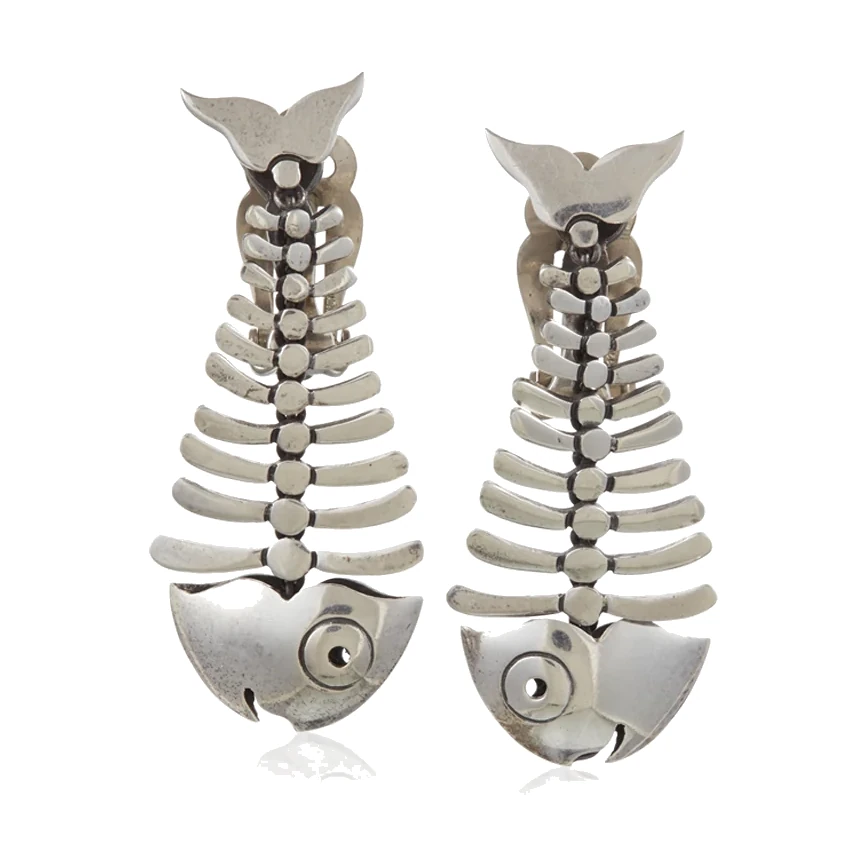
Antonio Pineda
Skeletal Fish Earrings
Silver