Saves instantly, no account needed. Already a member? Sign in.
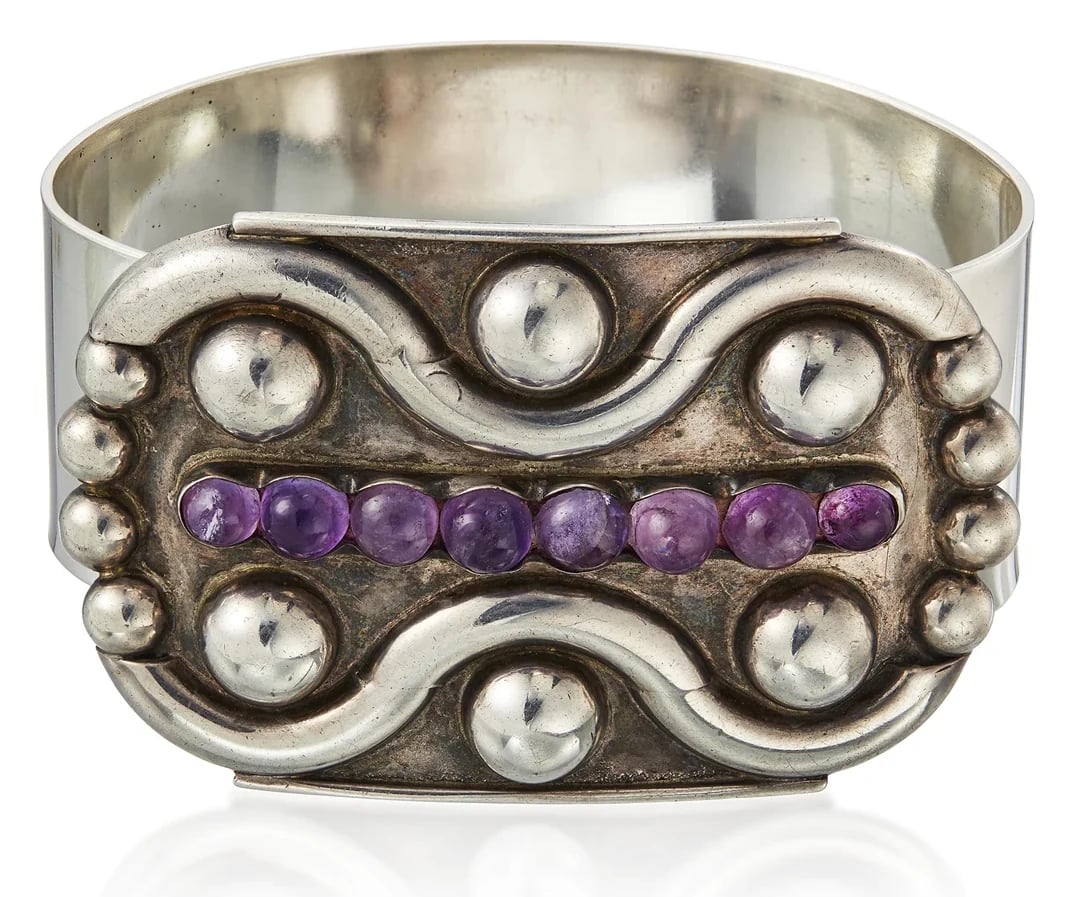
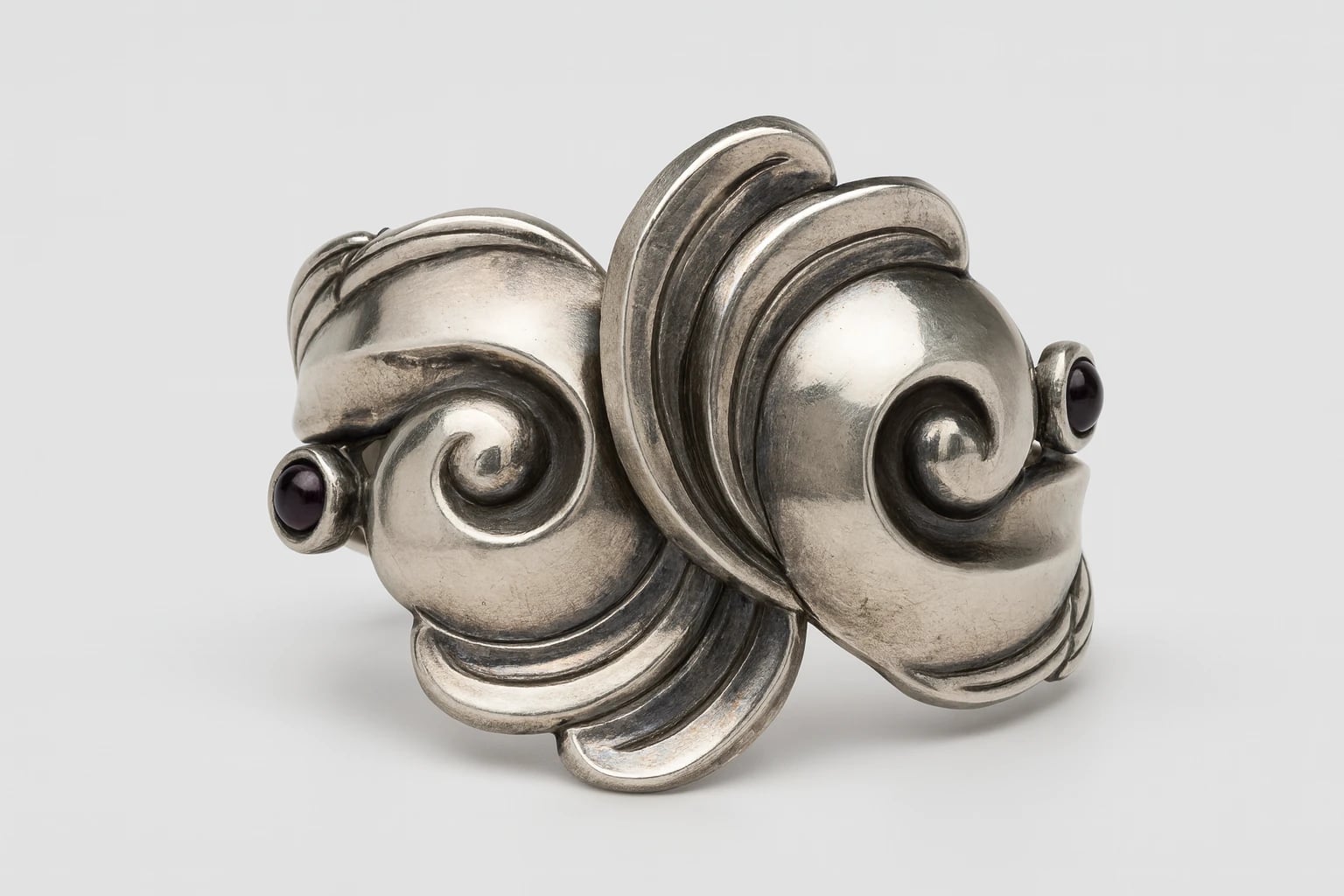
The bracelet concentrates its drama in a compact frontispiece of silver scrolls, swelling domes, and faceted amethysts. Its face measures only about one by two and one quarter inches, but the design enlarges that small field through compression. The two principal silver forms curl inward like opposing volutes, their polished surfaces interrupted by raised ribs and recessed channels that catch patina in the cuts. At the sides, the amethysts are not treated as separate ornaments applied to a bracelet. They punctuate the movement of the silver, giving color and depth to a composition otherwise organized through reflection, shadow, and rounded mass.
That sense of concentrated volume is characteristic of Enrique Ledesma’s strongest jewelry. The front is much wider and more sculptural than the narrow band, which measures about three eighths of an inch at the back and allows the bracelet to close around the wrist without carrying the same visual weight all the way around. Ledesma uses this change in scale deliberately. The band supports the object, while the front becomes a small modeled relief. The scrolls do not simply decorate the cuff surface. They build the surface, turning the bracelet into a study of curved silver pushed, folded, and channeled around small points of violet stone.
The marks place the bracelet within Ledesma’s mature independent production in Taxco: Ledesma, Taxco, 925, Hecho en Mexico, and eagle 3. Hougart records this combination among Ledesma marks in use from 1955 to 1979 and identifies eagle numbers 3 and 60 with his work. The same reference notes that Ledesma studied painting and sculpture at the San Carlos Academy of Art before entering silver, worked in the major Taxco workshops of William Spratling, Los Castillo, and Héctor Aguilar’s Taller Borda, and opened Platería Ledesma at Exconvento number 10 around 1950. That formation matters here because the bracelet is conceived less as a jeweled band than as a miniature sculpture fitted to the body.
Morrill’s account of Ledesma is especially useful for understanding this object. She emphasizes his fine lapidary work and his preference for compositions in which stone and silver share the same formal plane rather than occupying separate roles as setting and gem. A published Ledesma cuff with faceted alexandrites is dated circa 1955 to 1960, and several other Ledesma bracelets and mixed media works from the period show how consistently he explored the relation of modeled silver to colored or dark stone. This amethyst bracelet belongs to that same line of inquiry. Its importance is not in the size of the stones, but in the disciplined way color, patina, and silver relief are made to carry a single midcentury design idea. It shows why Ledesma’s jewelry occupies a distinct place within the Mexican silver renaissance: tactile, compact, formally assured, and rooted in the Taxco workshop world without being absorbed by any one predecessor.
Museum of Mexican Silver. “Double Scroll Bracelet with Amethysts.” Catalog no. MoMS-002320. https://museumofmexicansilver.com/pieces/enrique-ledesma-bracelet-rich-colored-faceted-amethysts-highlight-this
See something wrong with this record? Suggest a correction and the piece details fill in automatically.