Saves instantly, no account needed. Already a member? Sign in.
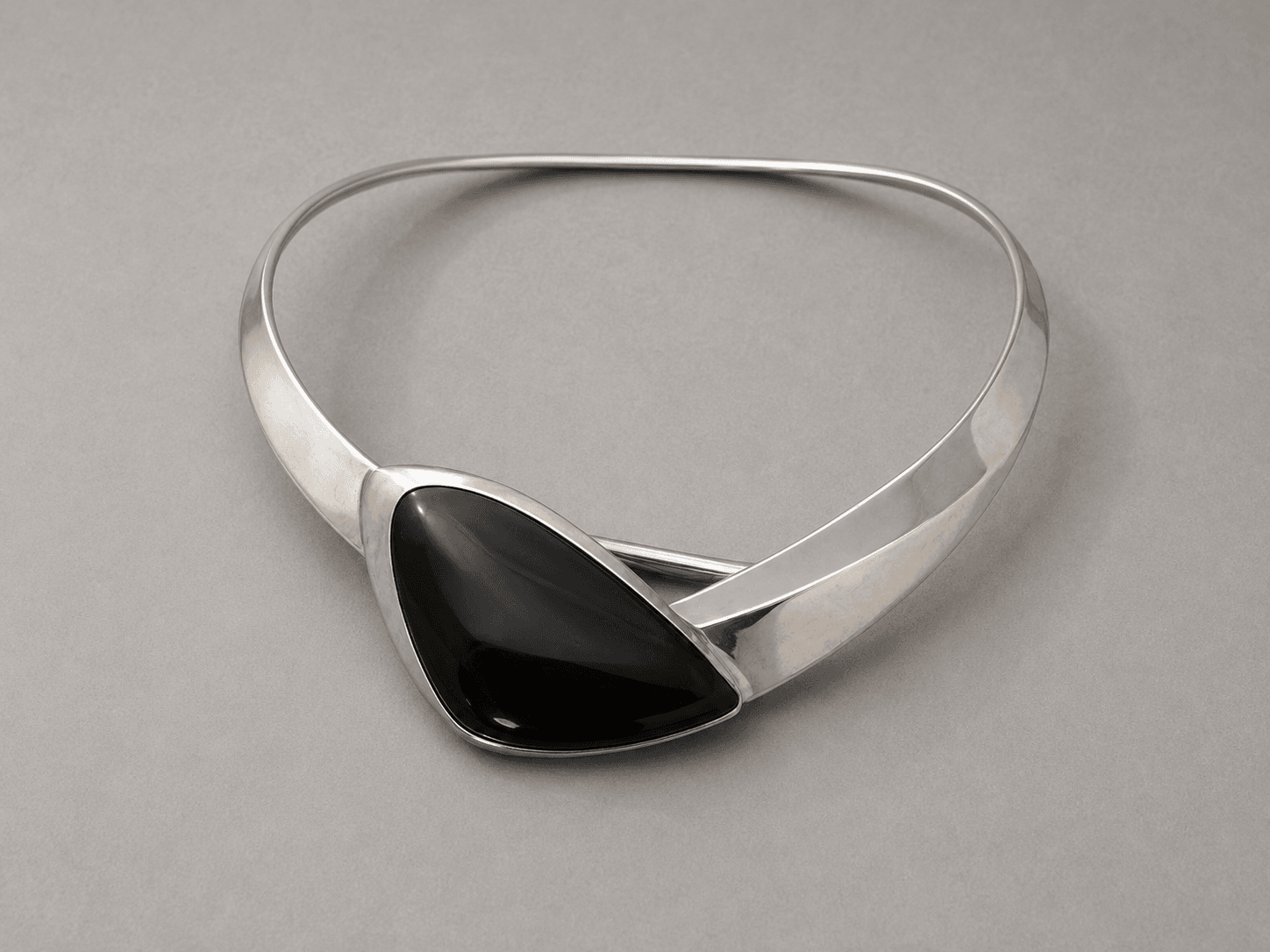
This Obsidian Choker Collar is one of the clearest demonstrations of Ledesma’s ability to transform jewelry into a unified sculptural composition. Rather than treating the obsidian as a stone placed within a conventional setting, he allows the polished black mass and the silver collar to merge into a single continuous form. The two broad silver planes cross and narrow toward the center, framing the asymmetrical obsidian element while simultaneously appearing to pass behind and through it. Worn high at the base of the neck, the piece reads less as a necklace than as a compact modernist sculpture engineered for the body.
This integration of stone and metal is central to Ledesma’s mature work. Contemporary scholarship notes that he selected stones not merely for decoration but for their capacity to contribute color, mass, pattern, and line; silver and stone were often brought onto the same visual plane rather than separated into mount and setting. The unattributed quotation formerly carried here — "slow-moving and elegant" — has been removed: the note gave neither a publication nor the object it described, and applied language written about a different design to this collar. If the source is identified it can be restored with a page reference and an explicit statement that it concerns a related, not identical, piece. The deep, reflective black of the obsidian gives the necklace a distinctly Mexican material identity, while its abstraction and controlled asymmetry place it firmly within the international language of postwar modernism.
The collar also reflects Ledesma’s unusual standing within the Taxco School. Trained in the orbit of William Spratling, he later worked at Los Castillo before establishing his independent workshop around 1950. His technical authority was such that Spratling selected him as one of only three master silversmiths to train Alaskan Native craftsmen in Taxco in 1949. His own shop quickly became known for exceptional execution, and period sources identified him among Taxco’s principal creative producers. The apparent simplicity of this necklace conceals demanding construction: the sweeping collar must retain tension and balance around the neck, the crossing silver elements must align precisely, and the large obsidian form must be integrated without disrupting either comfort or visual flow.
Attribution and evidence: the record does not yet hold a photograph of this collar's hallmark, a measured dimension, or a published citation for this specific object. The attribution to Ledesma rests at present on design characteristics — the crossing collar planes, the integration of a single large obsidian element, the asymmetry — which are consistent with his documented work but are not by themselves proof. A hallmark photograph, a measurement of the interior circumference and collar width, and a published or auction citation for this example are the three things needed to firm the record up.
Museum of Mexican Silver. “Obsidian Choker Collar.” Catalog no. MoMS-002172. https://museumofmexicansilver.com/pieces/enrique-ledesma-obsidian-choker
See something wrong with this record? Suggest a correction and the piece details fill in automatically.
Claims removed: earlier versions of this note asserted that large intact Ledesma collars are rare, that this example is "especially desirable," and that it should be regarded as a "museum-caliber" expression of the Taxco school. None of the three was sourced, and all have been removed. Statements about relative scarcity would need production or auction figures behind them.