Saves instantly, no account needed. Already a member? Sign in.
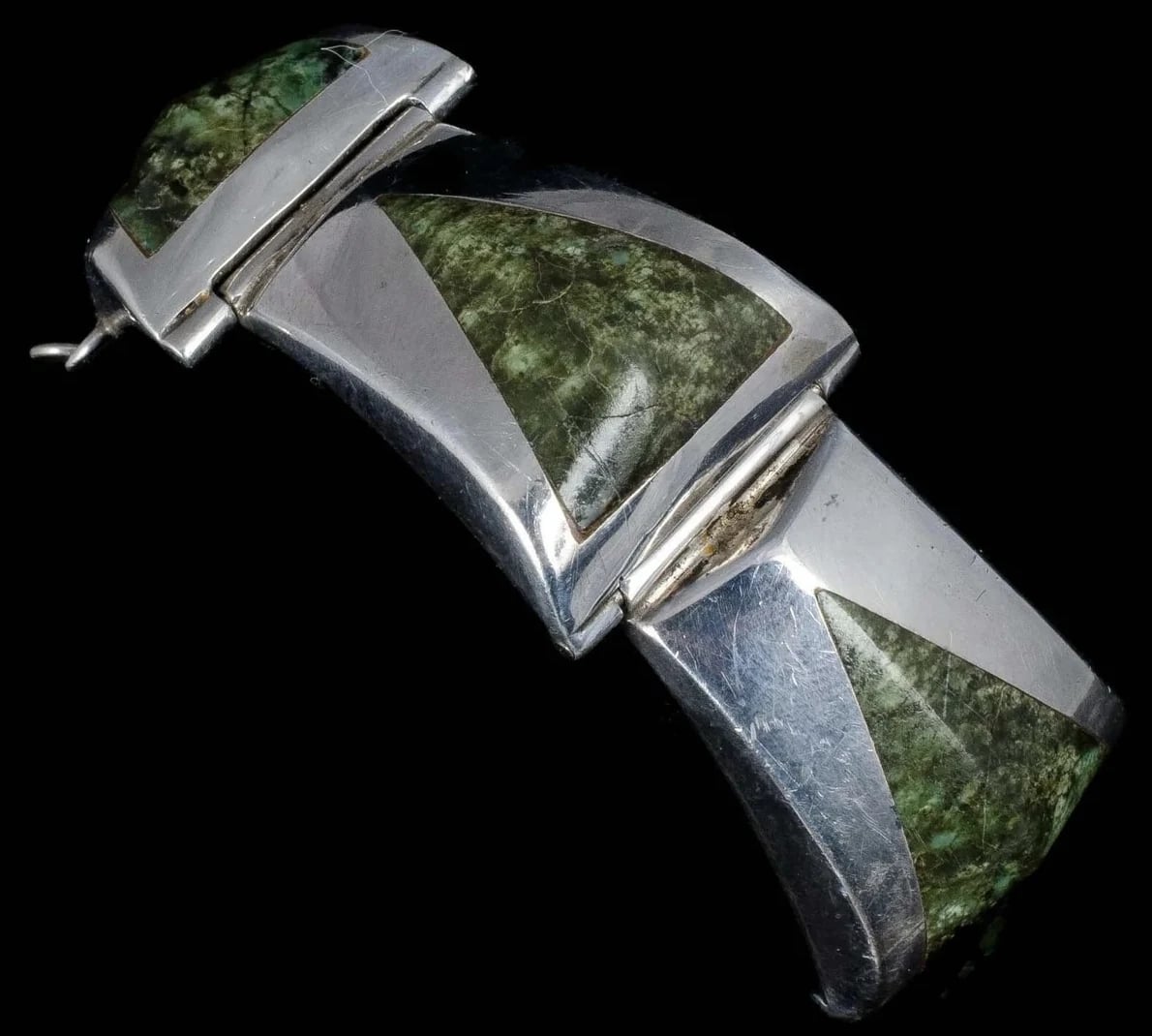
Constructed as a sequence of curved silver panels joined by barrel hinges, this wide bracelet turns the wrist into a moving field of chevrons: triangular green hardstone inlays are set into each arched plaque so that stone and silver make a single advancing, arrow-like rhythm. No hallmark or design number is visible in the supplied photographs, so the catalogue attribution rests on design correspondence rather than an observed signature. The form accords closely with Enrique Ledesma’s documented chevron bracelets, published as large and small versions in silver with obsidian and as a large version in azurite, circa 1955, with design numbers 206 and 207, and with the broader body of hinged stone-and-silver bracelets associated with his workshop.
The bracelet’s authority lies in the way the silver does not merely frame the stones. Morrill and Berk emphasize that Ledesma chose stones for their beauty but avoided conventional settings, instead creating compositions in which stone and silver share form, color, pattern, and line. That observation is especially apt here: the triangular inlays are not decorative inserts applied to a bracelet, but structural planes that determine the bracelet’s geometry. The broad polished silver bands sweep around and through the hardstone, while the hinged construction gives the massive form enough articulation to behave as jewelry rather than as a rigid cuff.
Ledesma’s work is rooted in the technically ambitious strain of the Taxco school. Hougart records Enrique Ledesma as trained at the San Carlos Academy of Art before working in silver, and lists his career through William Spratling’s Taller de Las Delicias, Los Castillo, and Héctor Aguilar’s Taller Borda before the opening of Platería Ledesma at Exconvento 10 around 1950; Hougart further identifies Ledesma Plateros, S.A., the Ledesma mark, eagle numbers 3 and 60, and registration ML-64. Morrill and Berk describe his later jewelry as technically flawless wearable art, and the muscular handling of dense green stone here offers a close design-language parallel to that assessment.
This bracelet is important because it represents Ledesma at the point where Taxco modernism becomes sculptural. Unlike the pictorial silver of the 1930s and 1940s, this design is abstract, hinged, and architectural: it depends on mass, interval, polish, stone color, and mechanical articulation. That combination places it among the mature circa-1955 works for which Ledesma is most valued, and within the circle of Taxco makers who transformed silver jewelry into modern wearable sculpture.
Museum of Mexican Silver. “Malachite Arrow Bracelet.” Catalog no. MoMS-002169. https://museumofmexicansilver.com/pieces/enrique-ledesma-malachite-arrow-bracelet
See something wrong with this record? Suggest a correction and the piece details fill in automatically.