Saves instantly, no account needed. Already a member? Sign in.
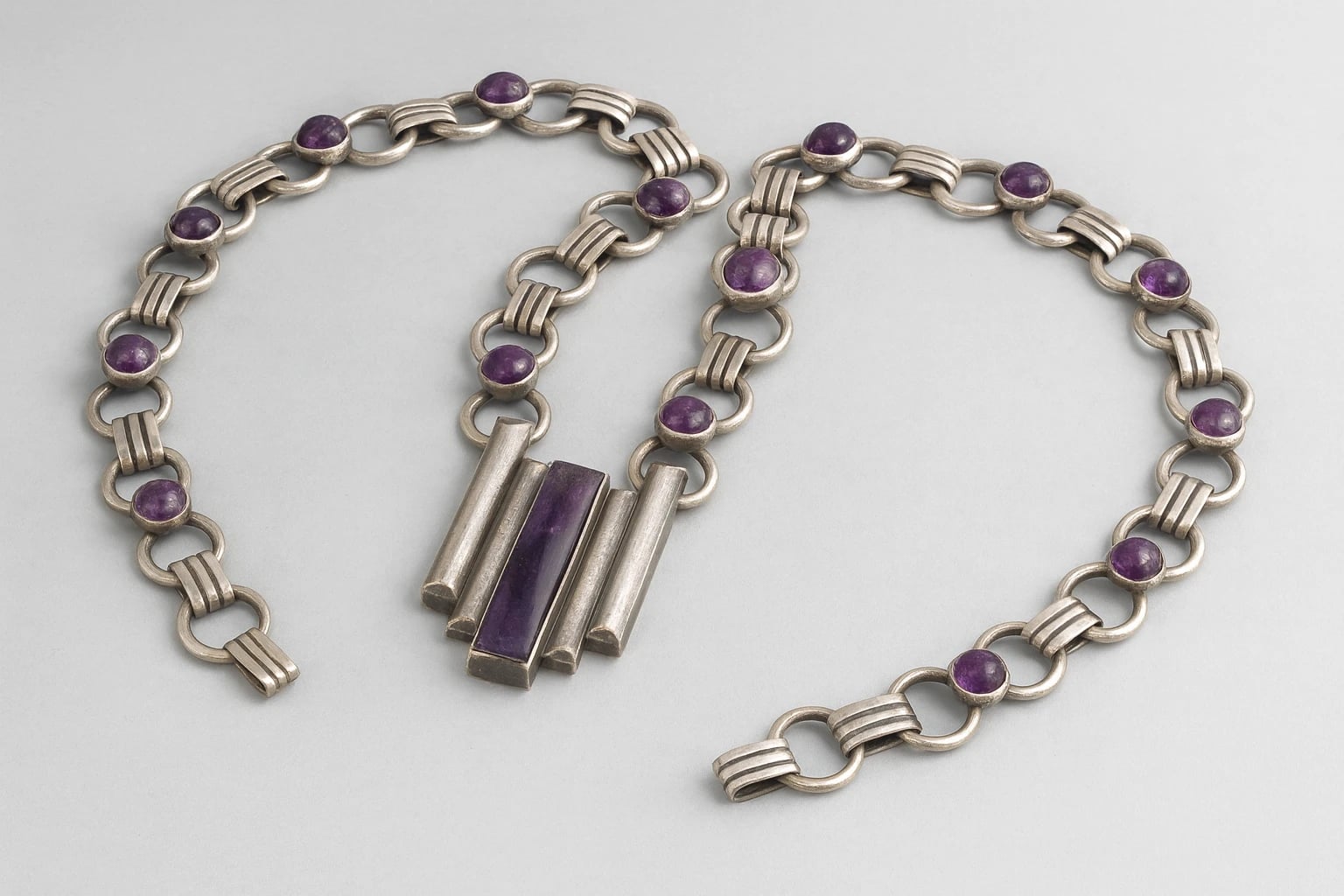
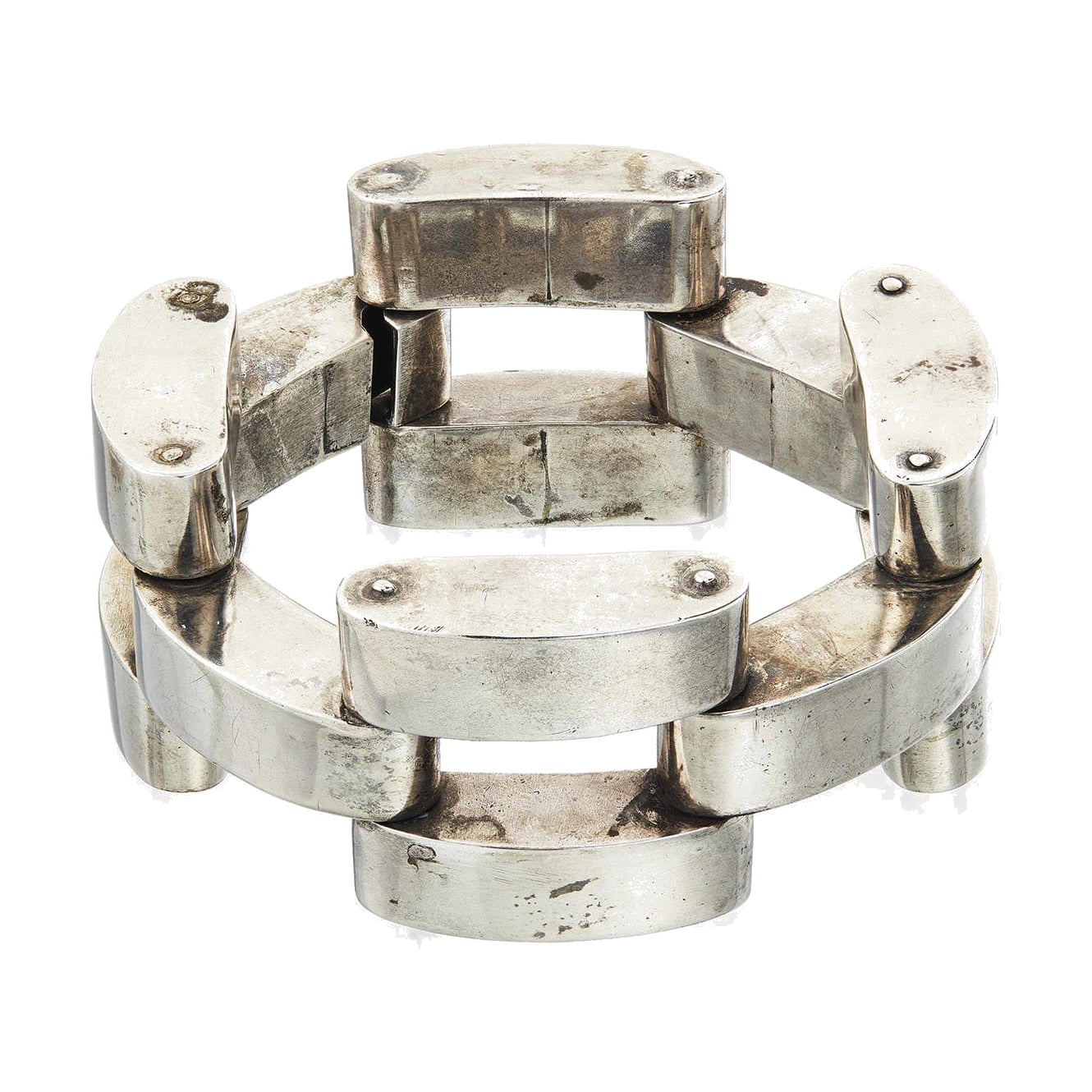
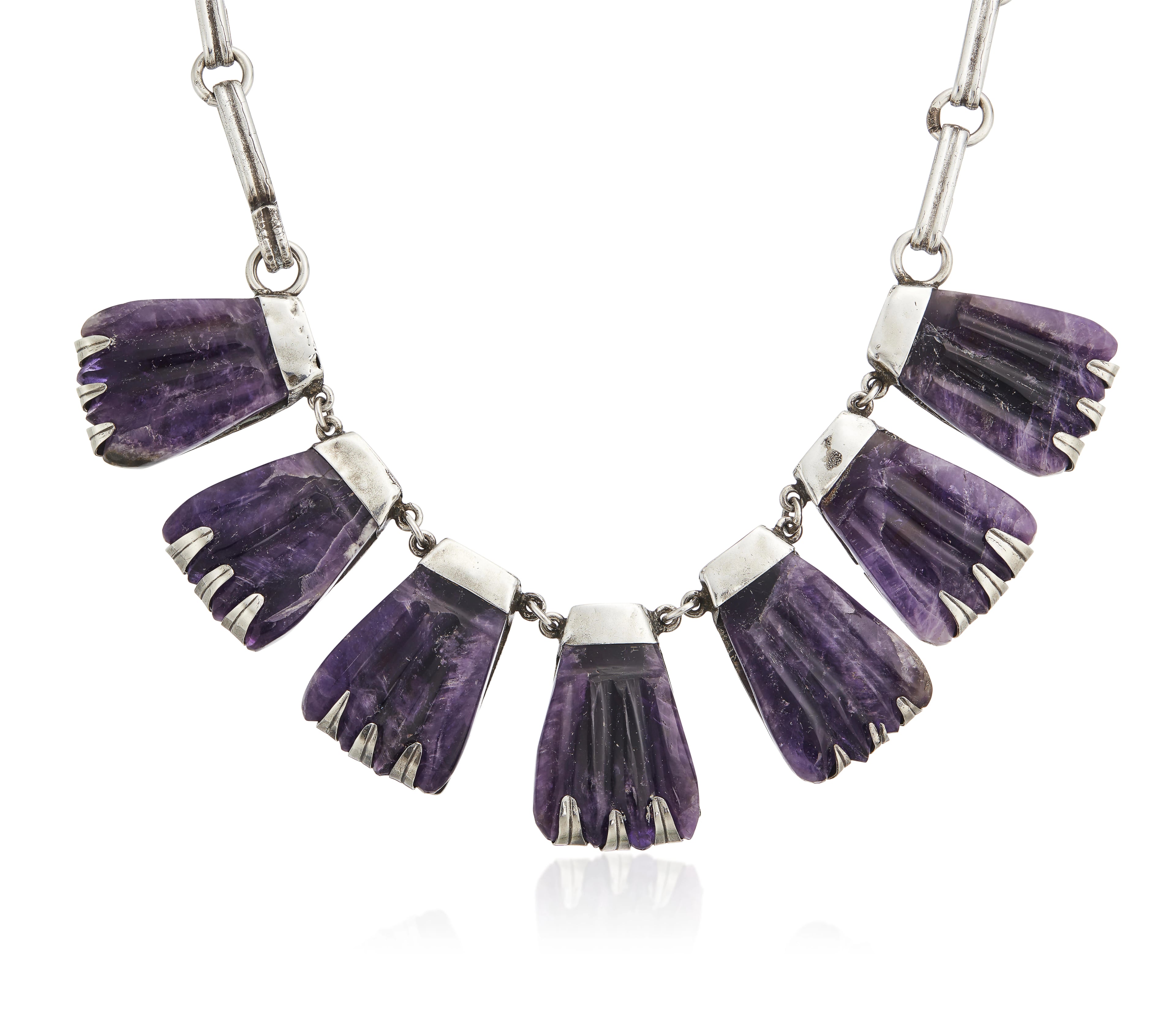
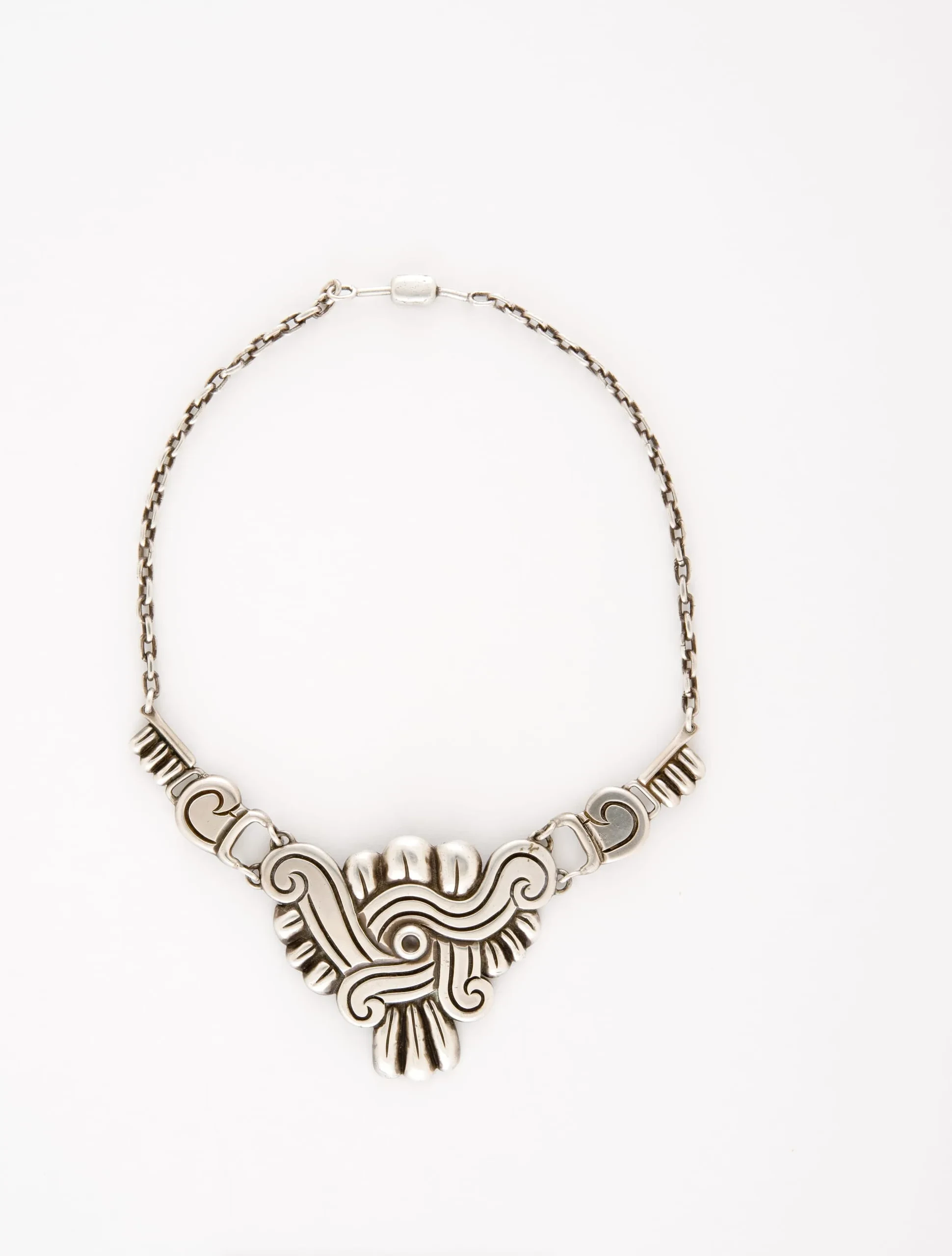
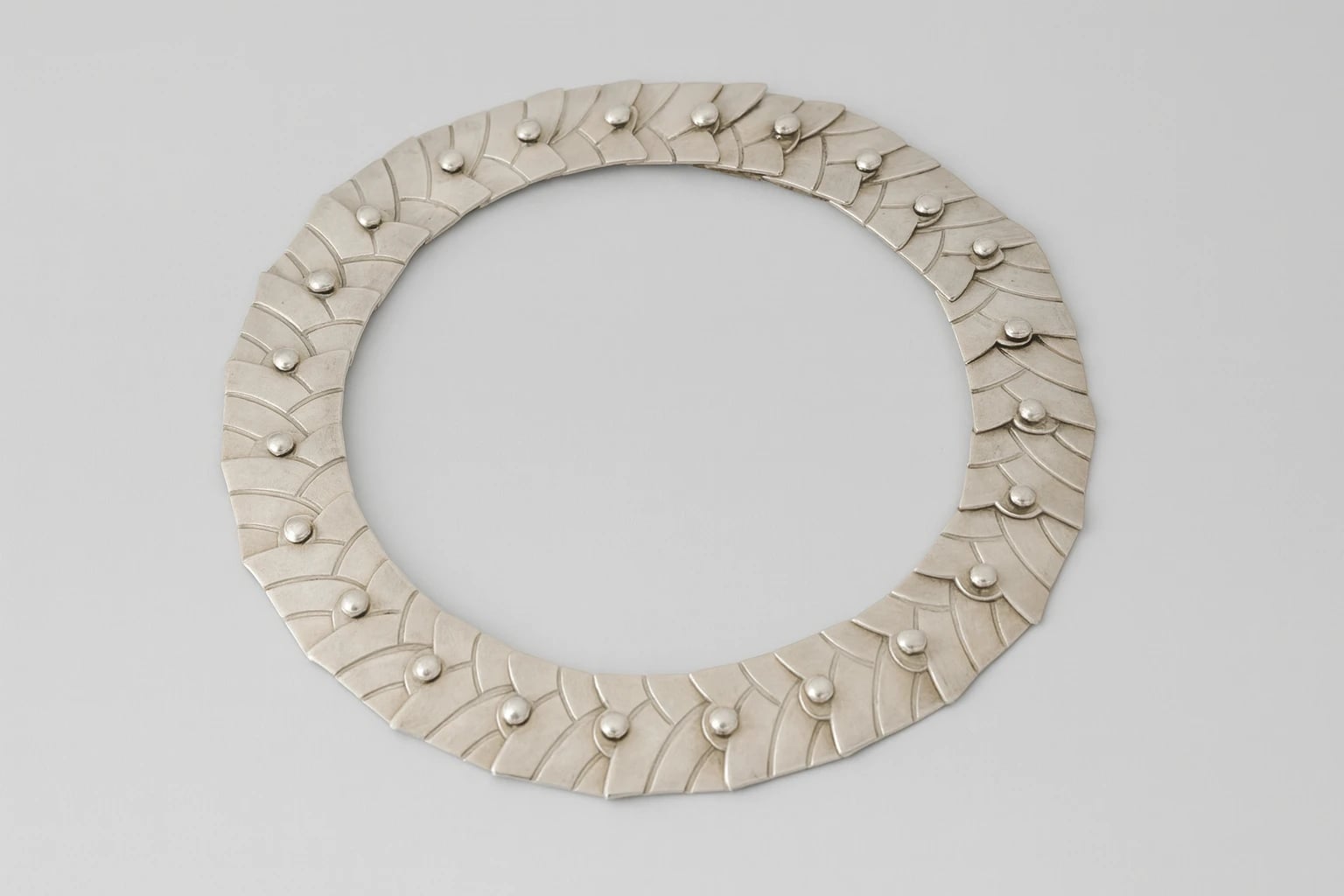
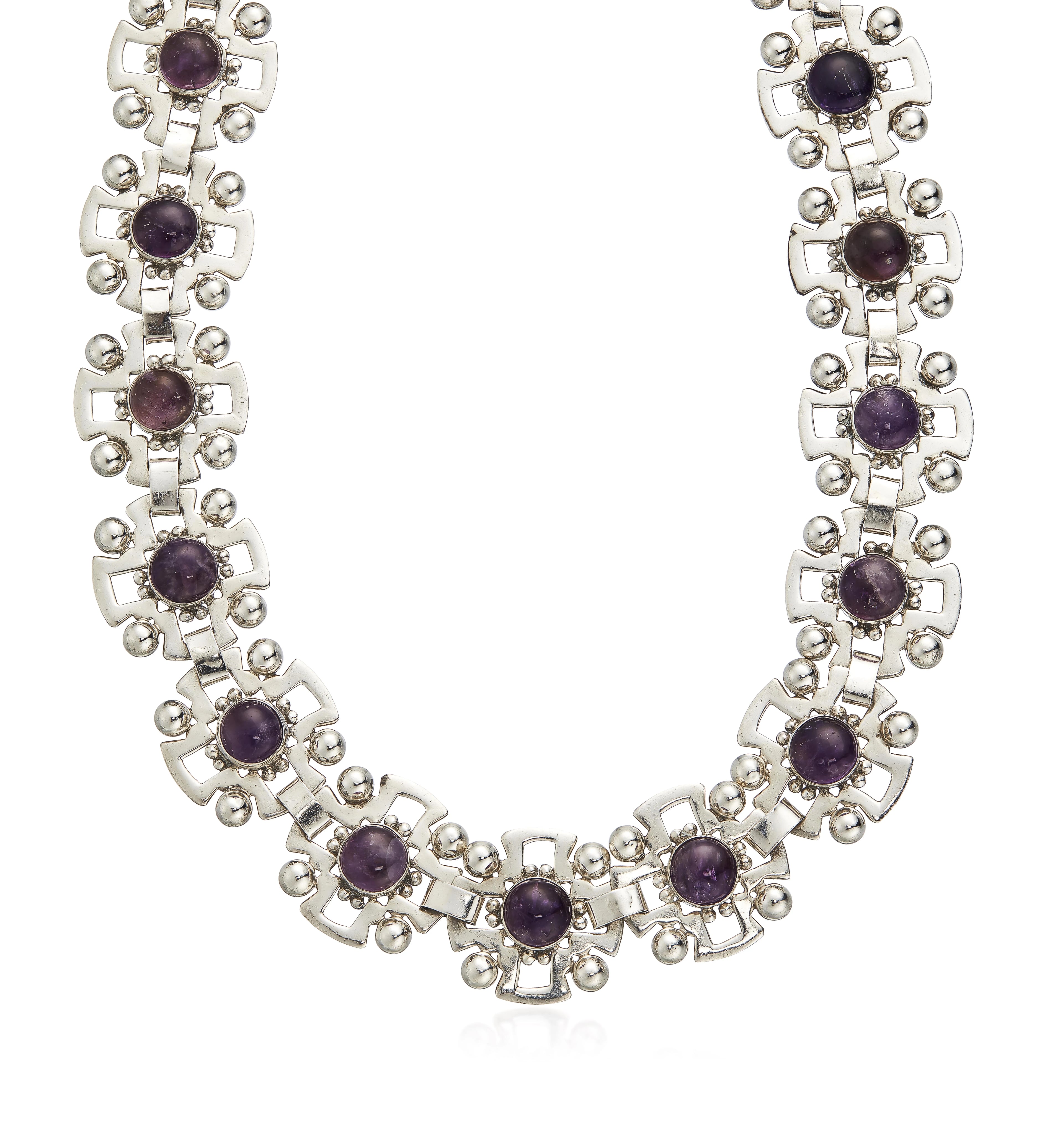
A procession of seventeen amethyst-centered modules transforms the necklace from ornament into a sequence of small architectural events. Rather than relying on a single frontal pendant, the design distributes emphasis across the whole circumference, giving the wearer a continuous rhythm of polished silver, open voids, cabochon color, and bead-like relief. That compositional ambition places the work among the strongest jewelry associated with Frederick Davis, whose signed silver occupied a crucial position between Mexico City craft networks and the emerging language of modern Mexican jewelry. Morrill and Berk describe Davis as a designer and patron who sought out master silversmiths, absorbed regional jewelry traditions, and helped produce work understood in its period as “unmistakably Mexican” (Morrill and Berk, 1994, p. 24). This necklace gives that program a particularly lucid form: a modern linked collar whose repeated motifs recall ancient glyphic structure without copying an archaeological source.
The design belongs to Davis’s sustained exploration of silver and amethyst, a pairing that Morrill and Berk single out as one of his most inventive material combinations. In their discussion of Davis’s amethyst bracelets, they note the tension between dense colored stone and lightened silver structure, where the stone remains the focal point but does not overwhelm the composition. The present necklace expands that idea into a full chain. Each openwork link uses negative space to reduce visual mass, while the cabochon amethyst anchors the center like a solar or ceremonial node. The rounded silver bosses at the corners create a second rhythm, more tactile than linear, and their high polish activates the surface against the darker, inward glow of the stones. At 59.5 cm long and 3.1 cm wide, with a gross weight of 131.7 g, the necklace is substantial but not static. Its linked construction allows the modules to articulate around the body, turning a potentially rigid geometric scheme into a wearable curve.
The available evidence suggests a work rooted in Davis’s mature Mexico City milieu, probably in the broad 1930s to 1940s context represented by comparable FD pieces. Stromberg’s Silver Seduction illustrates Davis bracelets from the same culture of bold silver construction, including a probably 1940s bracelet with domed amethysts and a conjoined FD mark (Stromberg, 2008, p. 85). Hougart identifies Davis as an important designer and student of Mexican arts and crafts who contracted selected silversmiths, including Abraham Paz and Jesús Cázares, while also selling work by figures such as Valentín Vidaurreta, William Spratling, and Miguel Covarrubias (Hougart, 2018, p. 46). That collaborative production model matters here, since the necklace’s authority lies not in studio isolation but in the meeting of design direction, workshop skill, and Mexico’s postrevolutionary revaluation of indigenous and popular arts. Its openwork geometry touches Art Deco and International Modernist clarity, but its cadence, cabochon centers, and silver globes belong to a specifically Mexican modernism in which archaeological memory, folk jewelry, and urban sophistication could occupy the same object.
Museum of Mexican Silver. “Openwork Amethyst Link Necklace.” Catalog no. MoMS-002183. https://museumofmexicansilver.com/pieces/fred-davis-openwork-amethyst-link-necklace
See something wrong with this record? Suggest a correction and the piece details fill in automatically.
No production total is documented for this necklace design. A necklace of seventeen stone-set openwork links required far more labor, stone matching, and structural control than the smaller bracelets and brooches more commonly encountered in Davis’s signed output. Hougart records the raised conjoined FD among the core Davis marks and notes that Davis produced mostly jewelry, with more limited production in hollowware and related objects (Hougart, 2018, pp. 46-47). Serious collections value such a work because it demonstrates the full ambition of early Mexican silver as an art of construction, not merely surface decoration. It deserves museum inclusion as a complete statement of Davis’s contribution: a necklace that joins archaeological abstraction, modern design discipline, and handwrought Mexican silver into an object whose cultural meaning is inseparable from its wearability.
Fred Davis
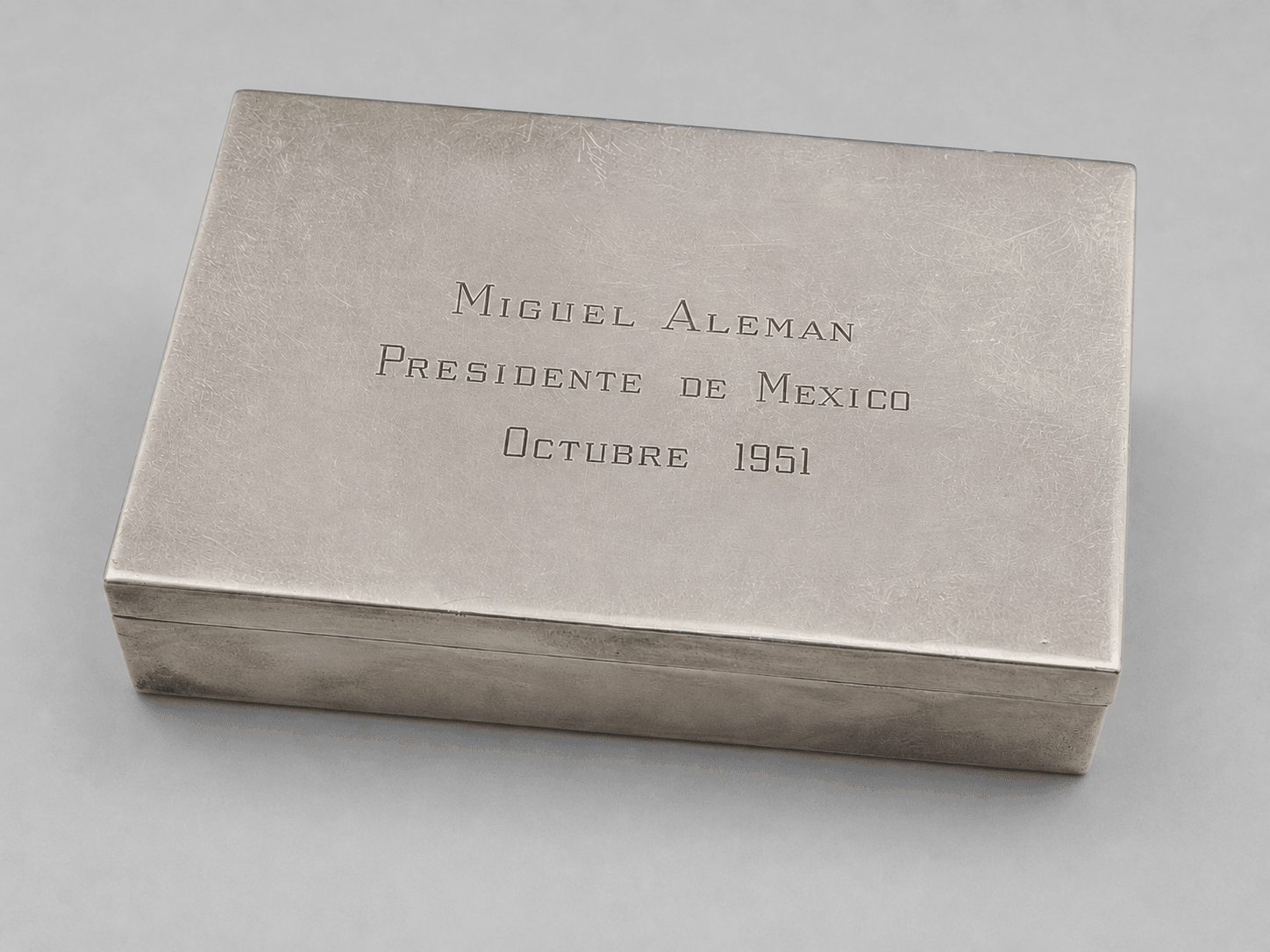
Presidential Cigar Box
1951
Sterling silver