Saves instantly, no account needed. Already a member? Sign in.
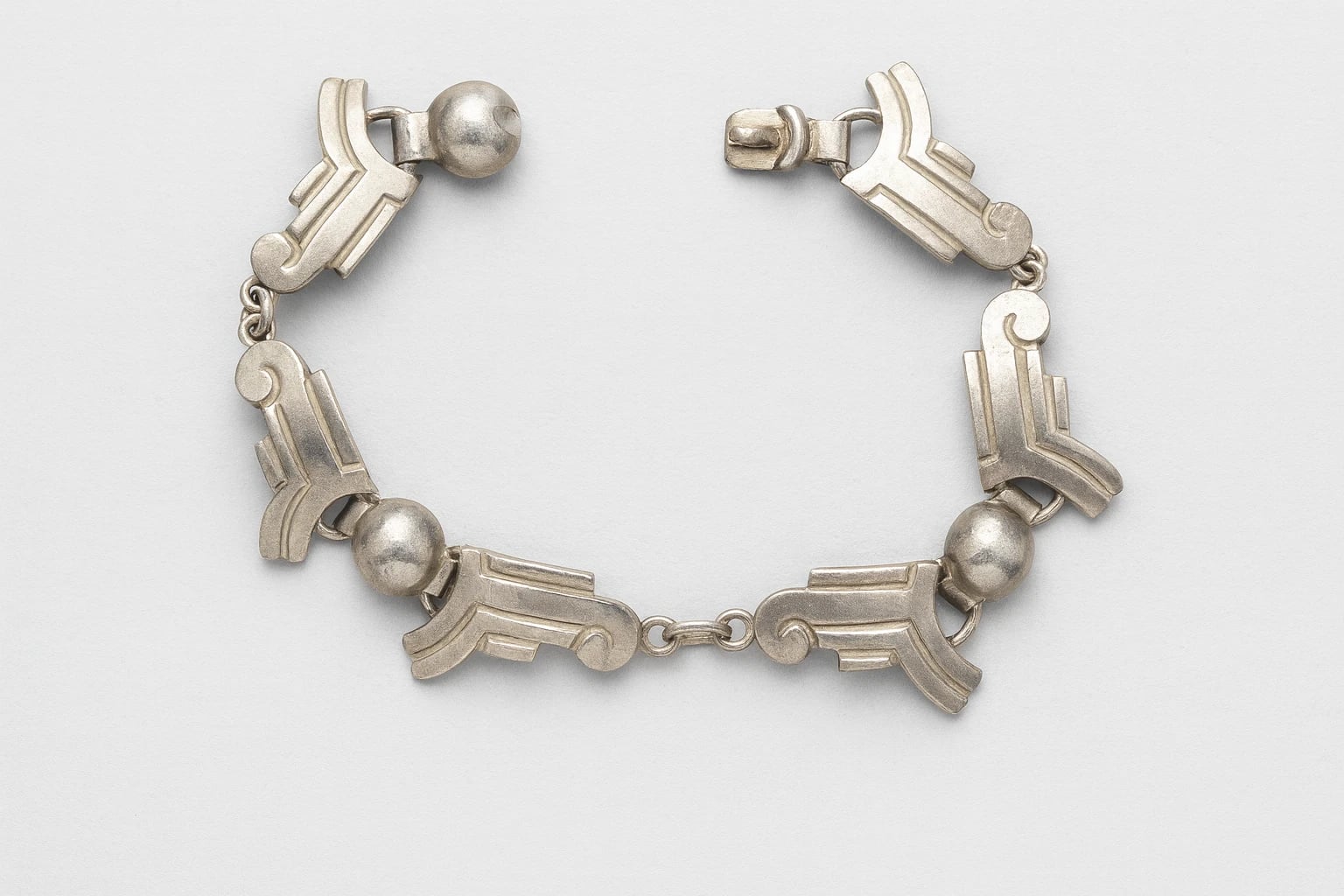
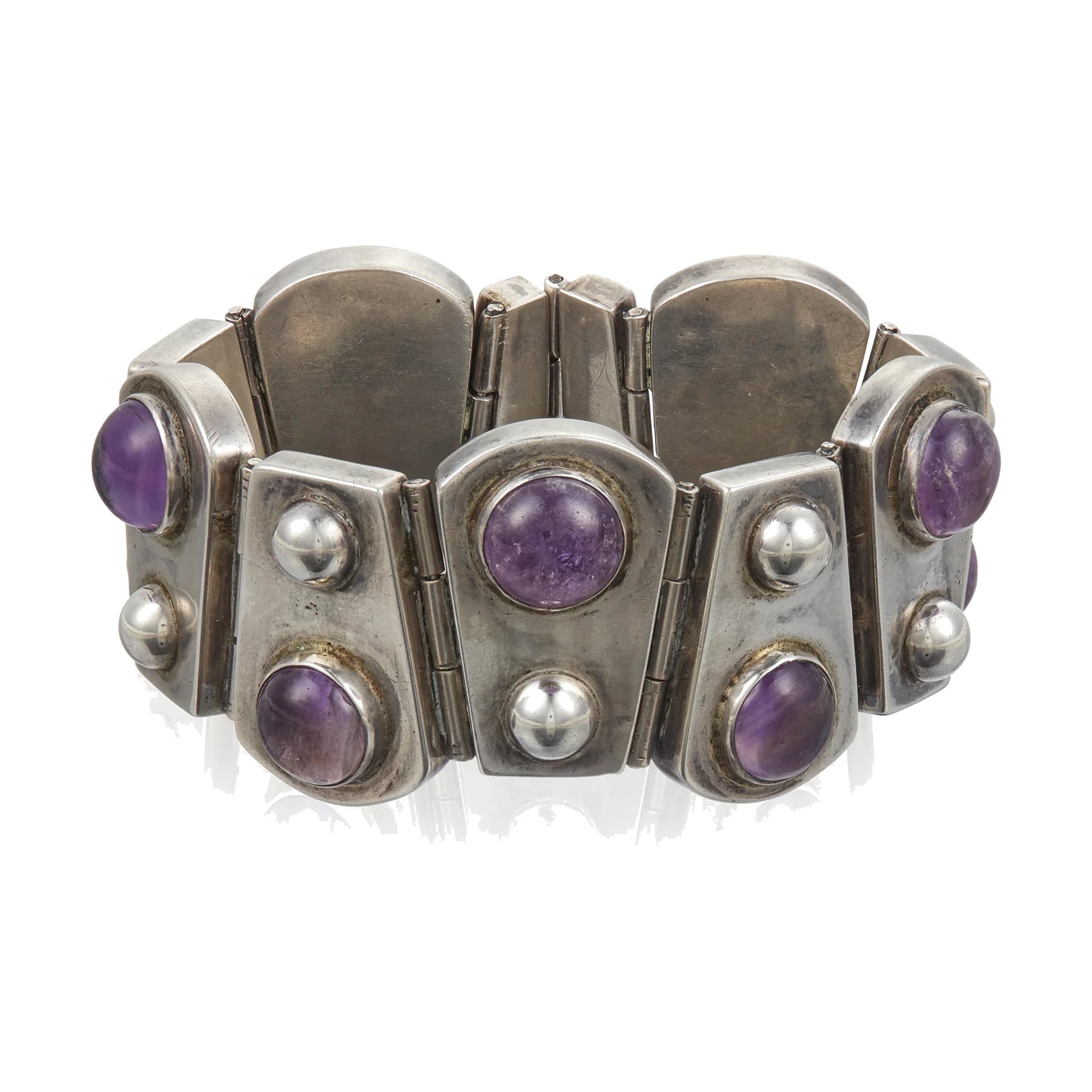
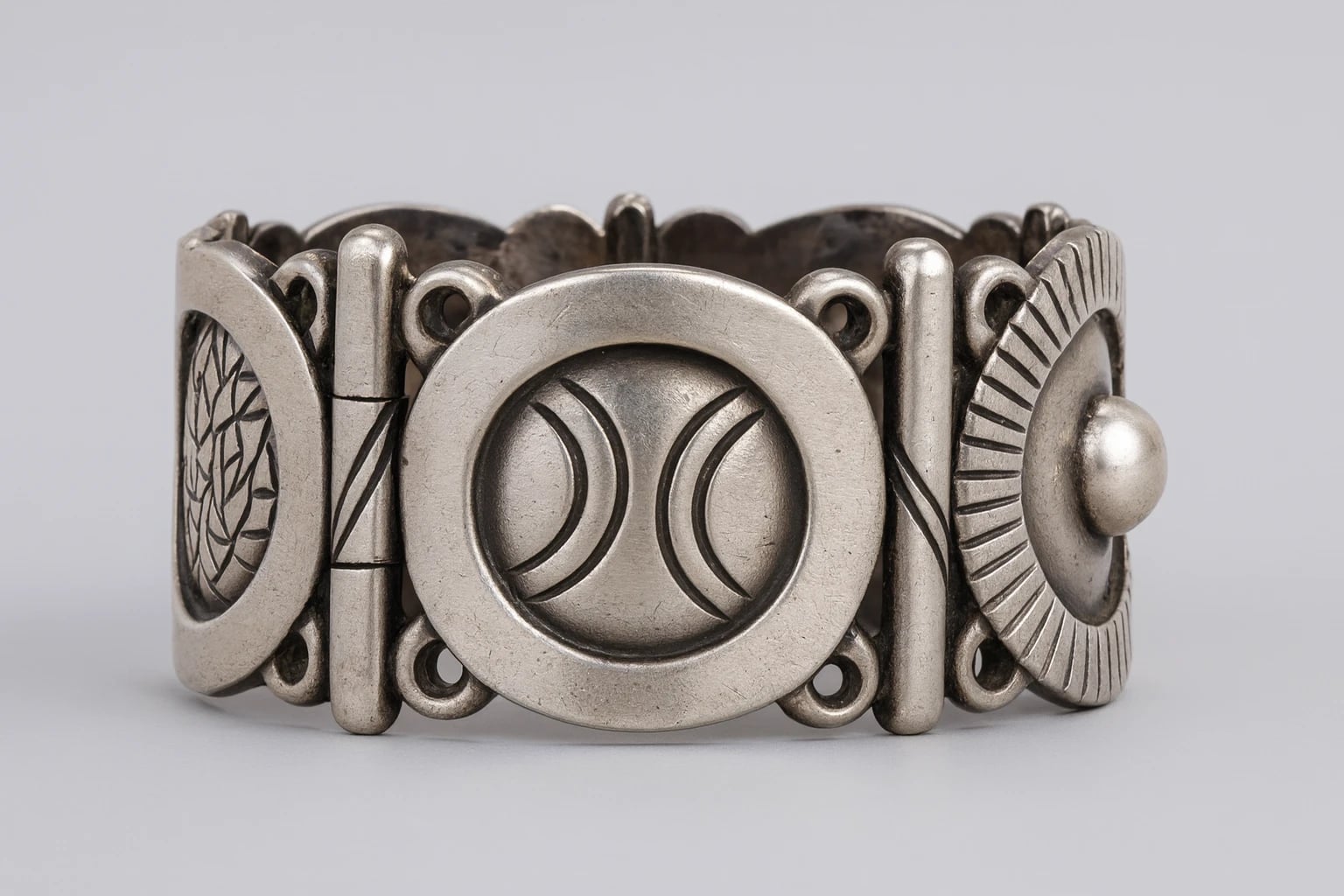
This bracelet is a strong example of mid-century Taxco modernism: large in scale, architectural in structure, and deliberately sculptural in its handling of silver. Its broad, linked panels are joined by prominent tubular hinges, turning the functional mechanism of the bracelet into a visible part of the design. Each panel contains a framed field—circular or oval—in which abstract, curvilinear motifs are set against oxidized recesses. The contrast between polished high points and darkened linework gives the bracelet its graphic force, while the softened rectangular panels and scalloped lower edges prevent the form from becoming rigid.
The design belongs to the Pre-Columbian revival vocabulary that became central to the Taxco School. Scholarly accounts describe Aguilar’s jewelry as drawing primarily on Aztec and Mixtec art and architecture, not through literal copying, but through stylization, repetition, and simplification of ancient forms. That approach is visible here: the bracelet’s medallion-like panels suggest shields, glyphs, architectural reliefs, or codex-derived ornaments, yet the overall composition remains modern, abstract, and wearable.
Aguilar’s particular strength was a dramatic economy of form. Morrill and Berk characterize his style as forceful and stripped of unnecessary embellishment, with pieces whose sculptural weight can make them appear almost carved from silver. This bracelet reflects that sensibility. The motifs are bold but contained; the silver is heavy-looking but carefully articulated; the hinge system allows the object to move with the wrist while retaining the commanding presence of a cuff.
Historically, the bracelet should be understood within the context of Taller Borda, the workshop Aguilar founded after leaving William Spratling’s Las Delicias in 1939. His move, along with that of the Castillo brothers, marked a major expansion of Taxco’s silver industry, and Aguilar brought with him a group of trained silversmiths who helped establish the workshop’s technical range. Aguilar later operated from the historic Borda Palace in Taxco, where the silver, copper, tin, carpentry, and retail operations of Taller Borda were housed. During the Second World War, Taller Borda expanded to more than three hundred artisans and supplied major American retailers including Saks Fifth Avenue, Neiman Marcus, Gump’s, and Filene’s.
The bracelet also illustrates the larger achievement of Taxco silver design. The Taxco School fused Pre-Columbian, Colonial, and popular Mexican sources with modernist design principles, producing jewelry that was both nationally rooted and internationally legible. In that context, Aguilar’s work is not simply adornment; it is a form of portable sculpture, part of the same cultural moment that made Taxco a center for modern Mexican design.
Museum of Mexican Silver. “Aztec Panel Bracelet.” Catalog no. MoMS-001961. https://museumofmexicansilver.com/pieces/aguilar-aztec-panel-bracelet-16
See something wrong with this record? Suggest a correction and the piece details fill in automatically.
Héctor Aguilar
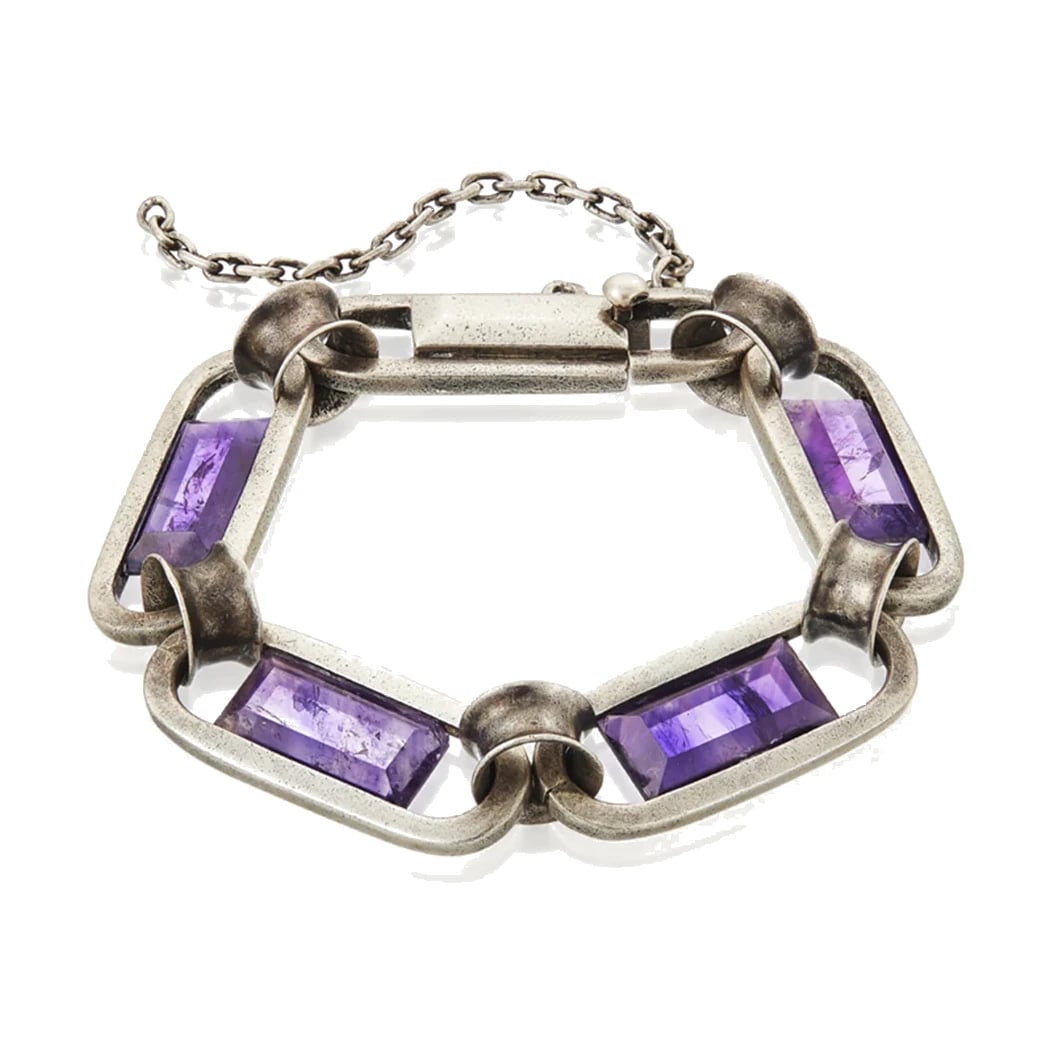
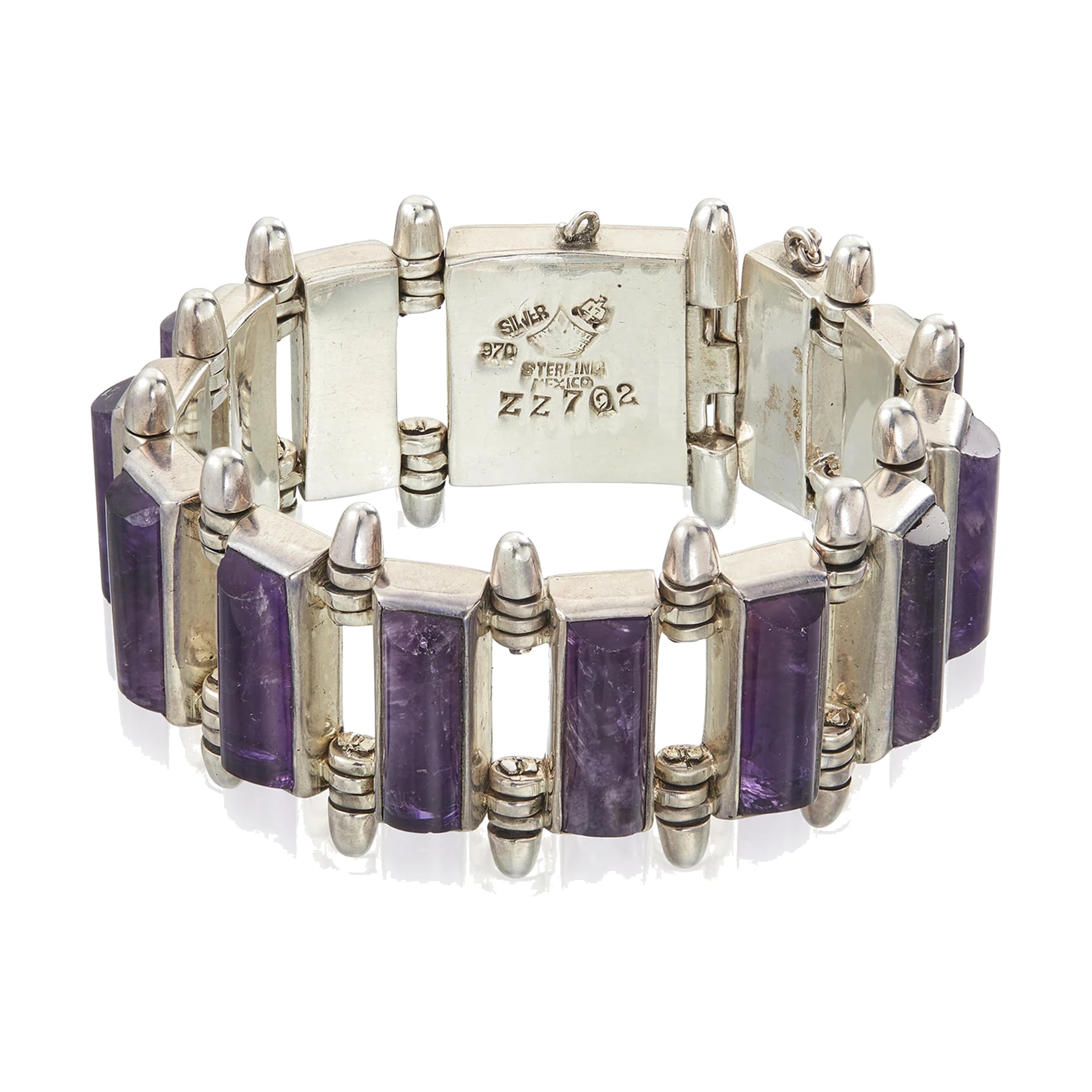
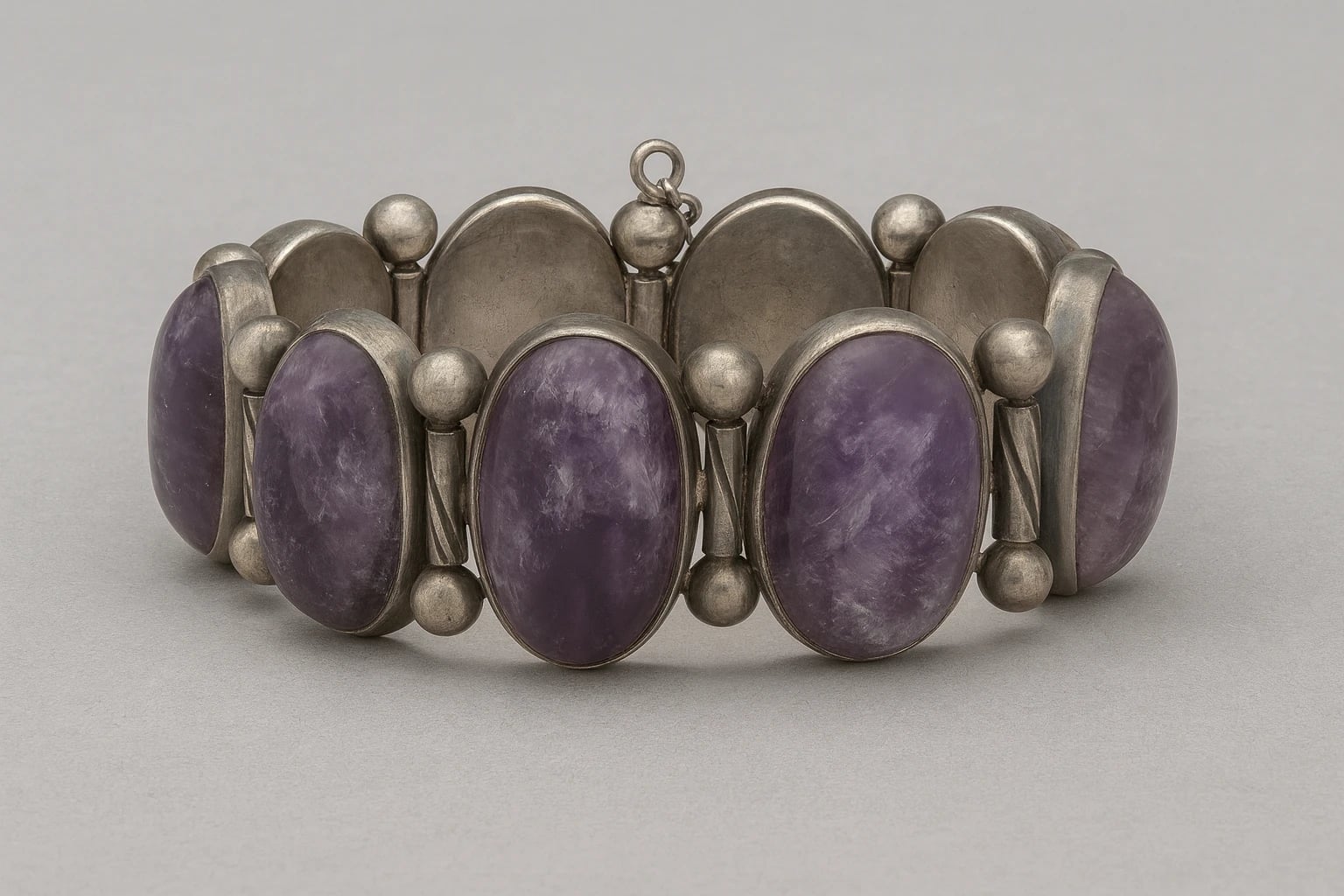
Bracelet with Amethyst Cabochons, Roped Links, and Silver Beads
1939-1962
Silver