Saves instantly, no account needed. Already a member? Sign in.
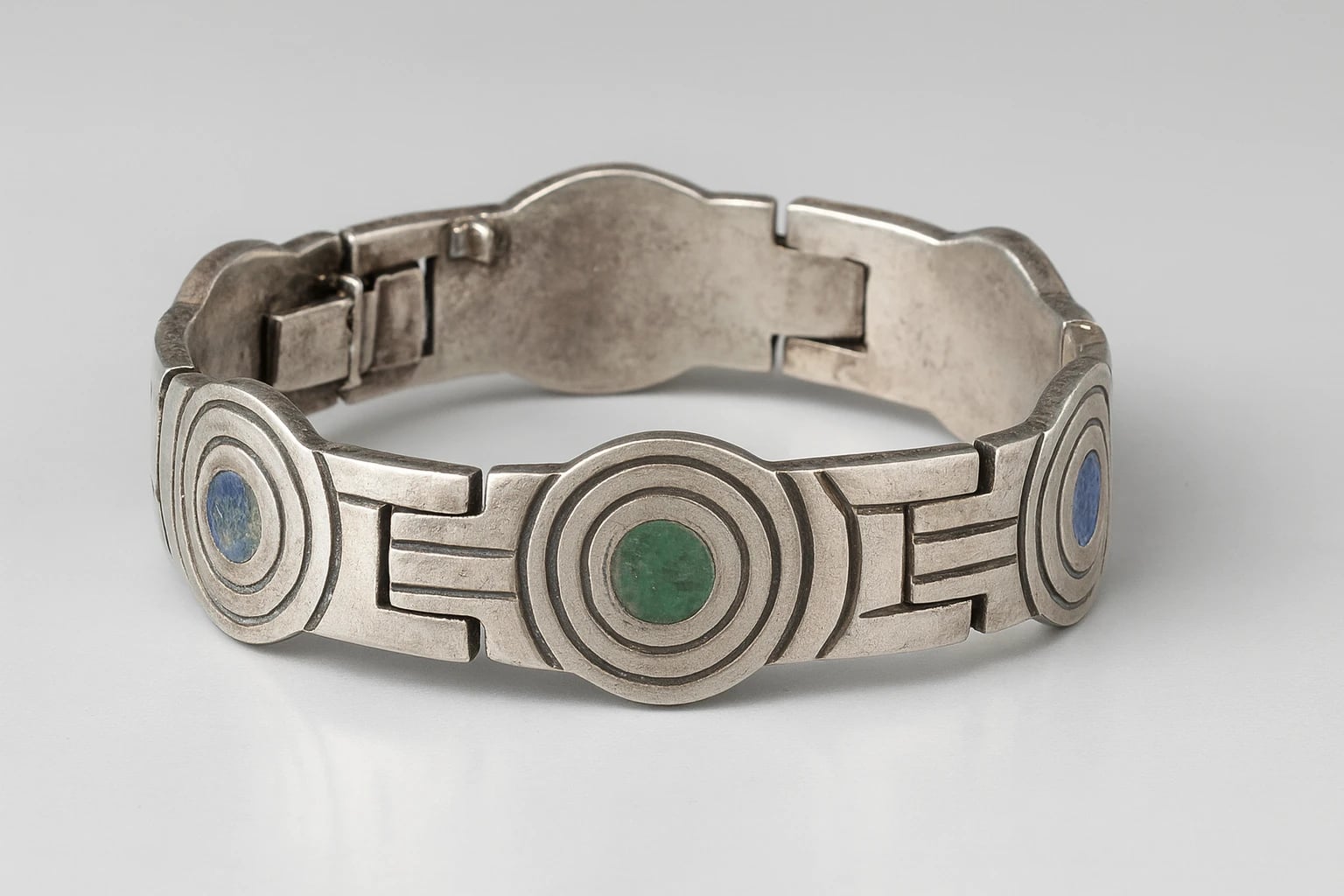
A malachite bracelet by Los Castillo turns stone into the dominant voice and lets silver recede to structure. The banded green of the malachite, cut so its concentric growth rings read as landscape, carries the eye across the piece, while the eagle motif organizes the composition into a heraldic emblem rather than a loose arrangement of set stones. This is the achievement of the mature Los Castillo workshop: the metal frames and joins, but the mineral does the speaking. Lapis appears as a foil, its saturated blue set against the green so that two opaque stones, each prized for depth of color rather than transparency, hold the surface without a single facet catching light.
The design depends on contrast between two opacities. Malachite and lapis both refuse the glitter of faceted gems; they read as color fields, matte and dense, closer to inlay or mosaic than to conventional jewel setting. Los Castillo built a reputation on exactly this sensibility, developing named lines around stone and material combination, including the Mosaico Azteca enamel work and stone inlay techniques documented in the workshop's hallmark record. In a bracelet, the choice matters to the wrist: opaque stone reads as sculpture in motion, changing not by refraction but by the shift of green banding as the arm turns. The eagle, presiding over this field, gives the piece a center and a subject, drawing on the bird as a Mexican national and ancient emblem, the eagle of the Mexica founding, without illustrating any single source too literally.
Los Castillo was founded by brothers who trained in William Spratling's Taller de Las Delicias before establishing their own workshop in Taxco, and by the 1940s they had become one of the most inventive tallers of the renaissance, precisely for their experiments with stone, metal marriage, and mosaic. The workshop's hallmark history, rebuilt from Hougart's reference, records an evolution from early 980-fine marks of about 1939 to 1945 through sterling and eagle-15 assay marks, and it names the very techniques on which the firm built its identity: Esmalte a Fuego, Mosaico Azteca, Pluma Azteca, Onix Negro. A stone bracelet like this one belongs to that current of thinking, where the workshop treated color and material as the primary design problem and silver as the disciplined armature that made ambitious combinations wearable. Because Los Castillo classic designs have been reproduced in later decades with legally acquired marks, dating any single example rests on the specific hallmark and on genuine patina rather than on the design alone.
Museum of Mexican Silver. “Eagle Malachite Bracelet.” Catalog no. MoMS-001243. https://museumofmexicansilver.com/pieces/los-castillo-bracelet-eagle-malachite
See something wrong with this record? Suggest a correction and the piece details fill in automatically.
What such a bracelet contributes to a collection is a clear demonstration that the Taxco renaissance was as much about mineral as about metal. Los Castillo advanced a distinctly Mexican decorative language in which native and imported stones were cut and joined for color, and in which an emblem like the eagle could be composed rather than merely engraved. Seen beside the workshop's enamel and mosaic lines, a malachite and lapis eagle bracelet shows the same intelligence applied to hardstone: color held flat, structure kept quiet, and a national symbol carried on the wrist as design rather than decoration.
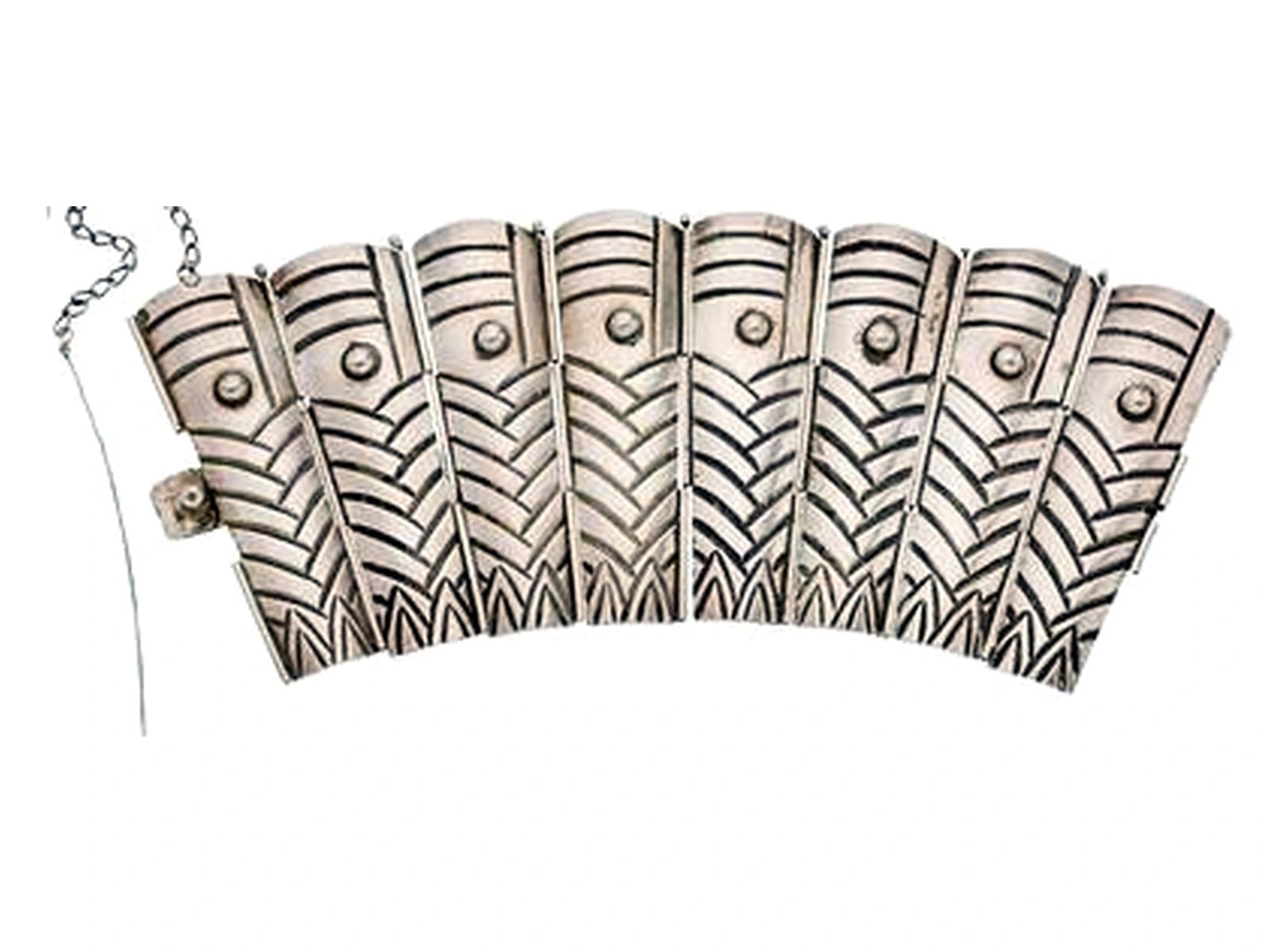
Los Castillo
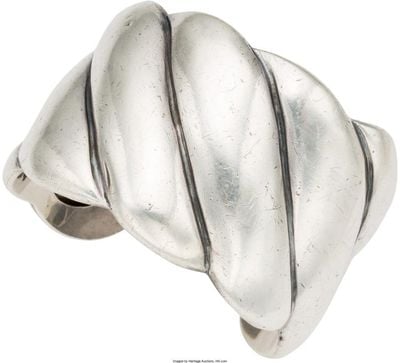
Pair of Feather Gauntlet Bracelets
1939 or later
Sterling silver