Saves instantly, no account needed. Already a member? Sign in.
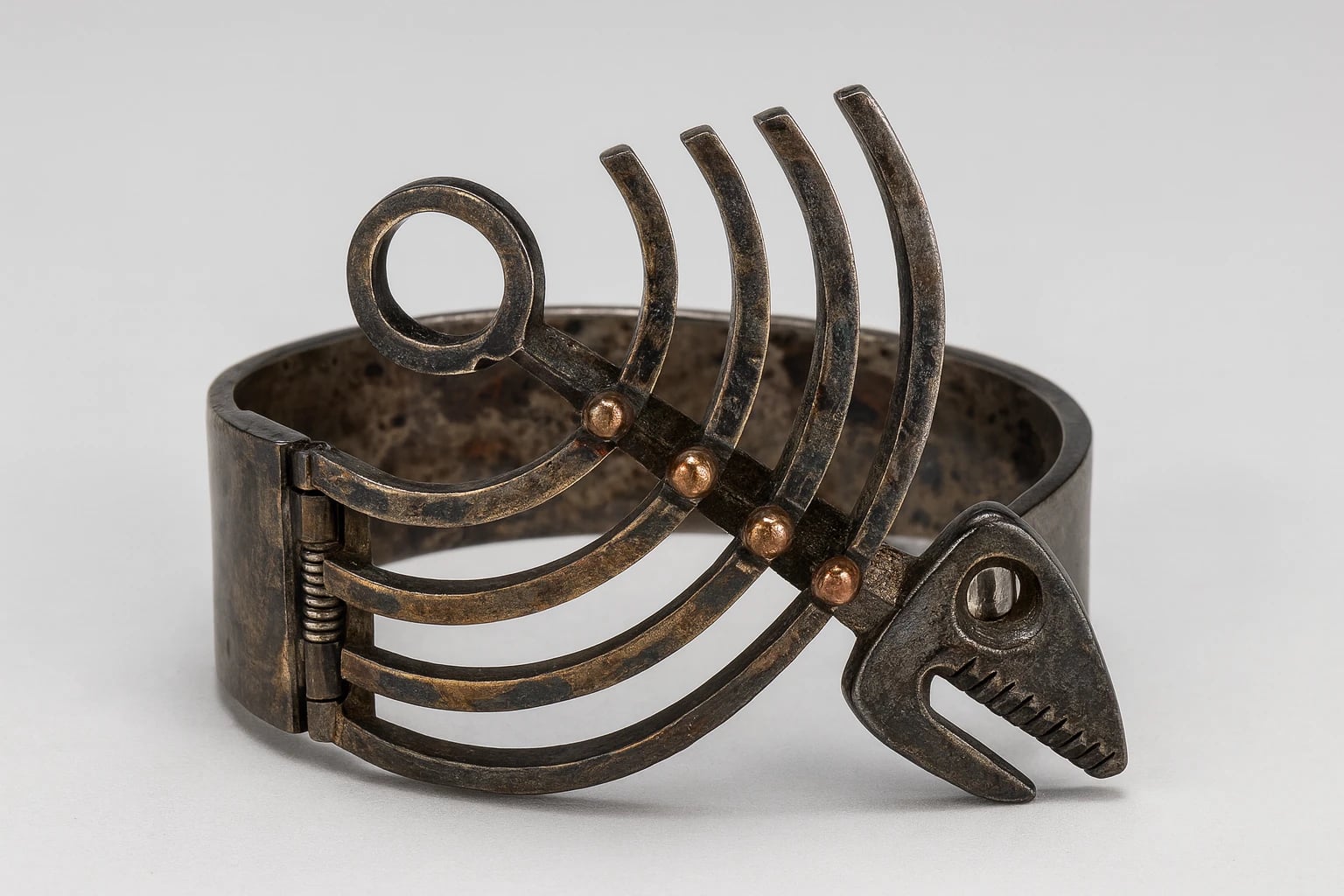
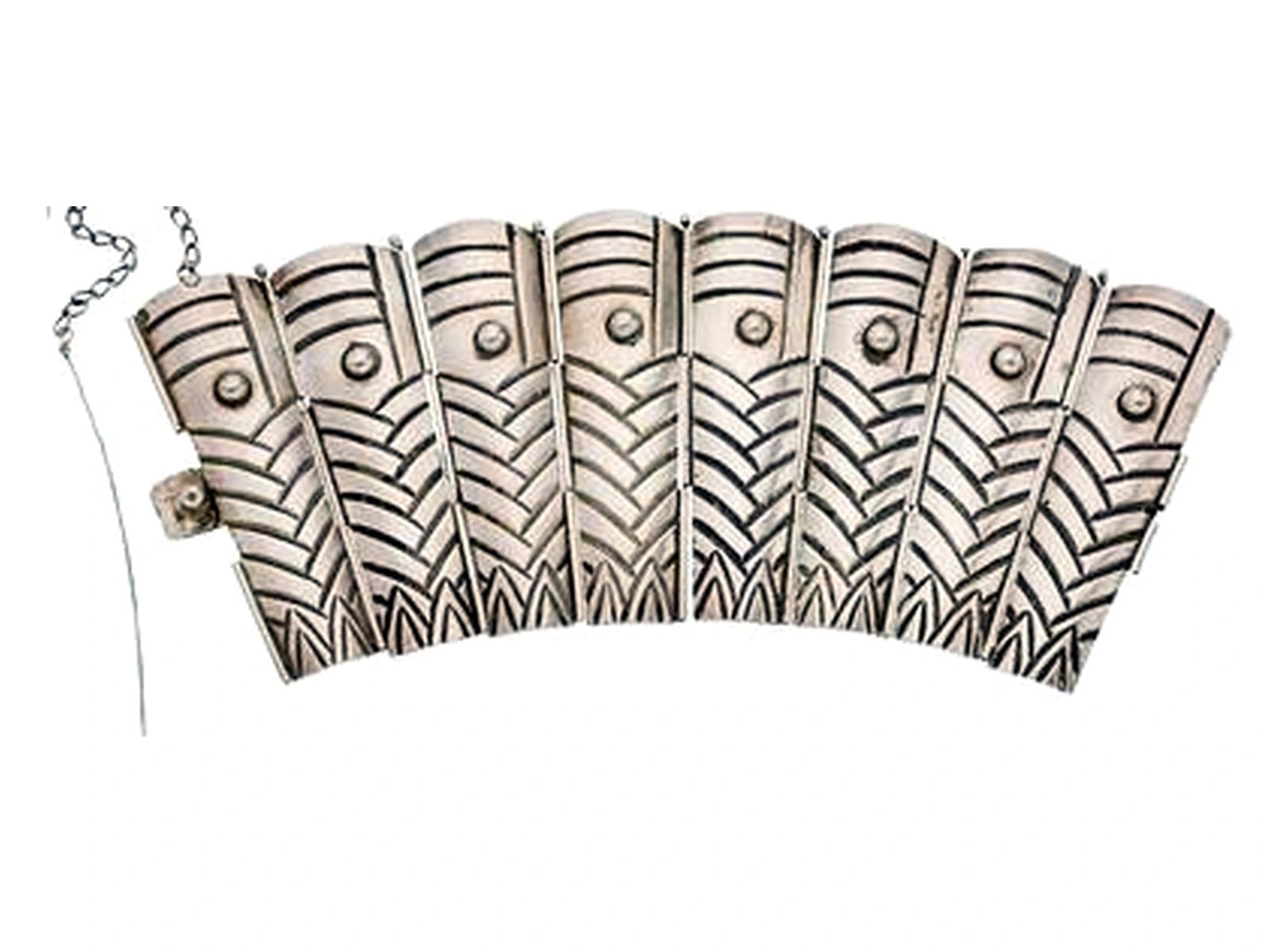
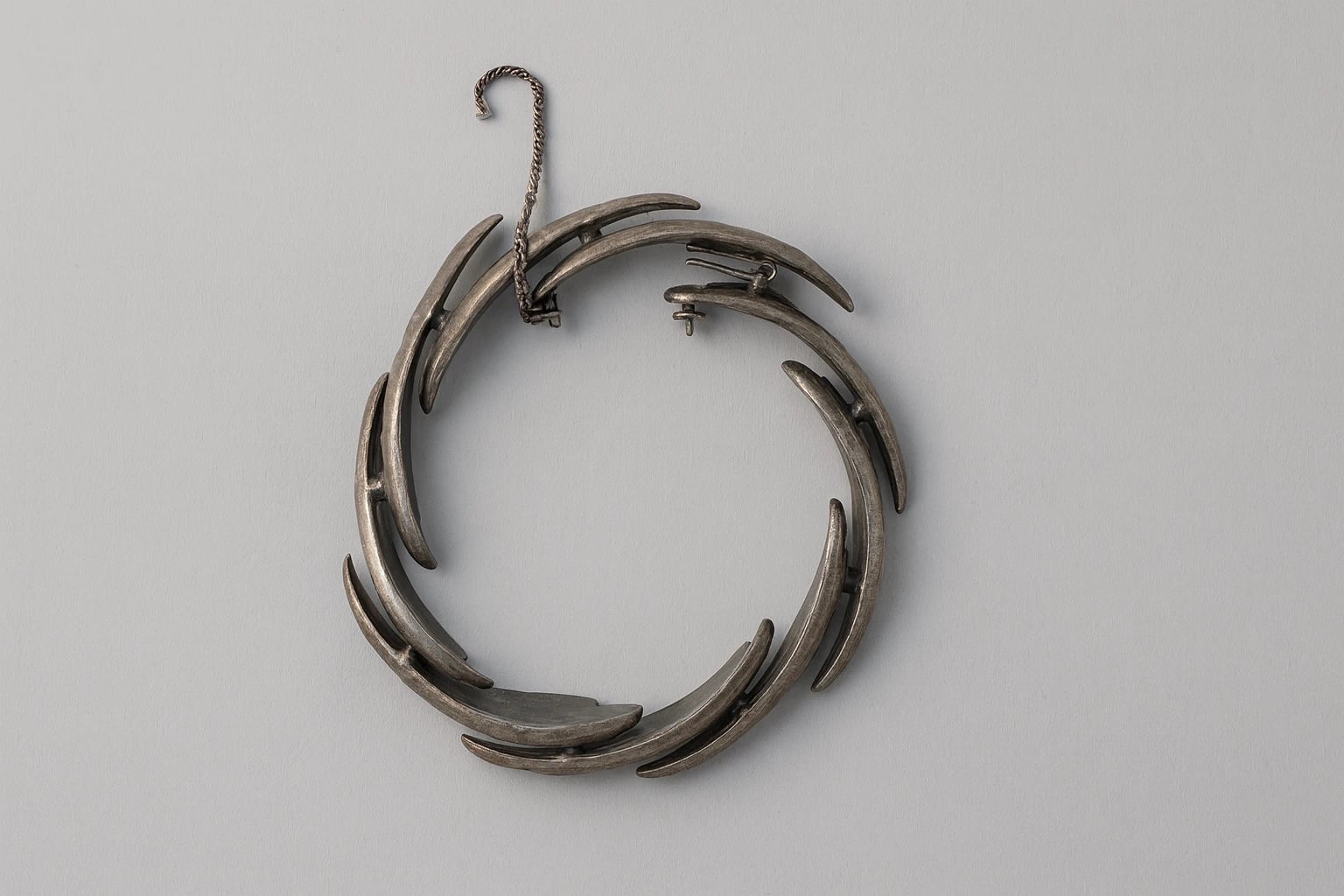
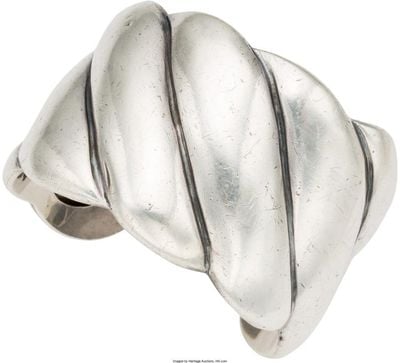
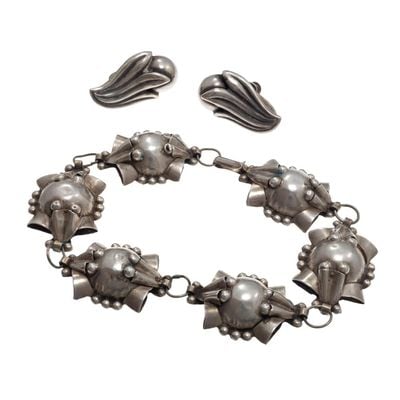
An eagle worked in sterling anchors this bracelet, its wings and head compressed into a form that reads as much as ornament as emblem. Los Castillo built many of its early bracelets around a single recognizable motif carried across linked panels or set as a central plaque, and the eagle here follows that logic. The bird is not rendered naturalistically but reduced to the essential silhouette that survives at the scale of the wrist, where a design must remain legible as the metal catches and releases light with the movement of the arm.
The strength of the piece lies in how the motif is fitted to the constraints of a bracelet. The eagle motif is stylized into flat planes and firm contours, a treatment that lets sterling do the work through reflection rather than through added color or stone. This connects the bracelet to a group of figurative Los Castillo designs from the workshop's first decade, among them the Female Dancers and Parrot Head bracelets recorded by Morrill with design numbers 519 and 266, both dated to roughly 1940 to 1945. Those pieces share the same instinct: an animal or human figure pared down until it becomes a repeating or centered ornament, sturdy enough to be worn and clear enough to be read at a glance.
Los Castillo was founded in 1939 by Antonio Castillo with his brothers Justo and Jorge and his cousin Salvador Terán. Antonio had arrived in Taxco in 1923 and worked for William Spratling at the Taller de las Delicias before opening his own taller, and many of the workshop's earliest designs came from Margot van Voorhies, to whom he was married until their divorce in 1946. That formative period, when the workshop was establishing its vocabulary of figurative and animal subjects, is the context in which an eagle bracelet belongs. The taller would later become widely known for its married metals, combining silver with copper and brass, but a design carried entirely in sterling shows the earlier reliance on form and surface alone. Frances Toor described the workshop's output as ranging from chaste simplicity to near overwhelming, and a single-motif sterling bracelet sits toward the restrained end of that range.
The eagle carried particular weight in postrevolutionary Mexico as a national symbol, and Los Castillo's decision to treat it as jewelry rather than heraldry places a familiar emblem into the register of modern personal ornament. What the bracelet preserves is a record of how the workshop translated recognizable subjects into wearable geometry during its first decade, before the married-metal technique became its signature. It documents the figurative side of Los Castillo's early practice and the confidence with which the taller reduced a complex image to the terms sterling could hold.
Museum of Mexican Silver. “Eagle Bracelet.” Catalog no. MoMS-001189. https://museumofmexicansilver.com/pieces/los-castillo-bracelet-eagle-pair
See something wrong with this record? Suggest a correction and the piece details fill in automatically.
Los Castillo
Link Bracelet
Sterling silver