Saves instantly, no account needed. Already a member? Sign in.
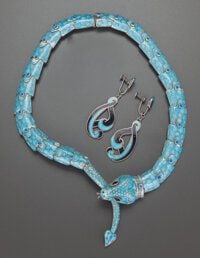
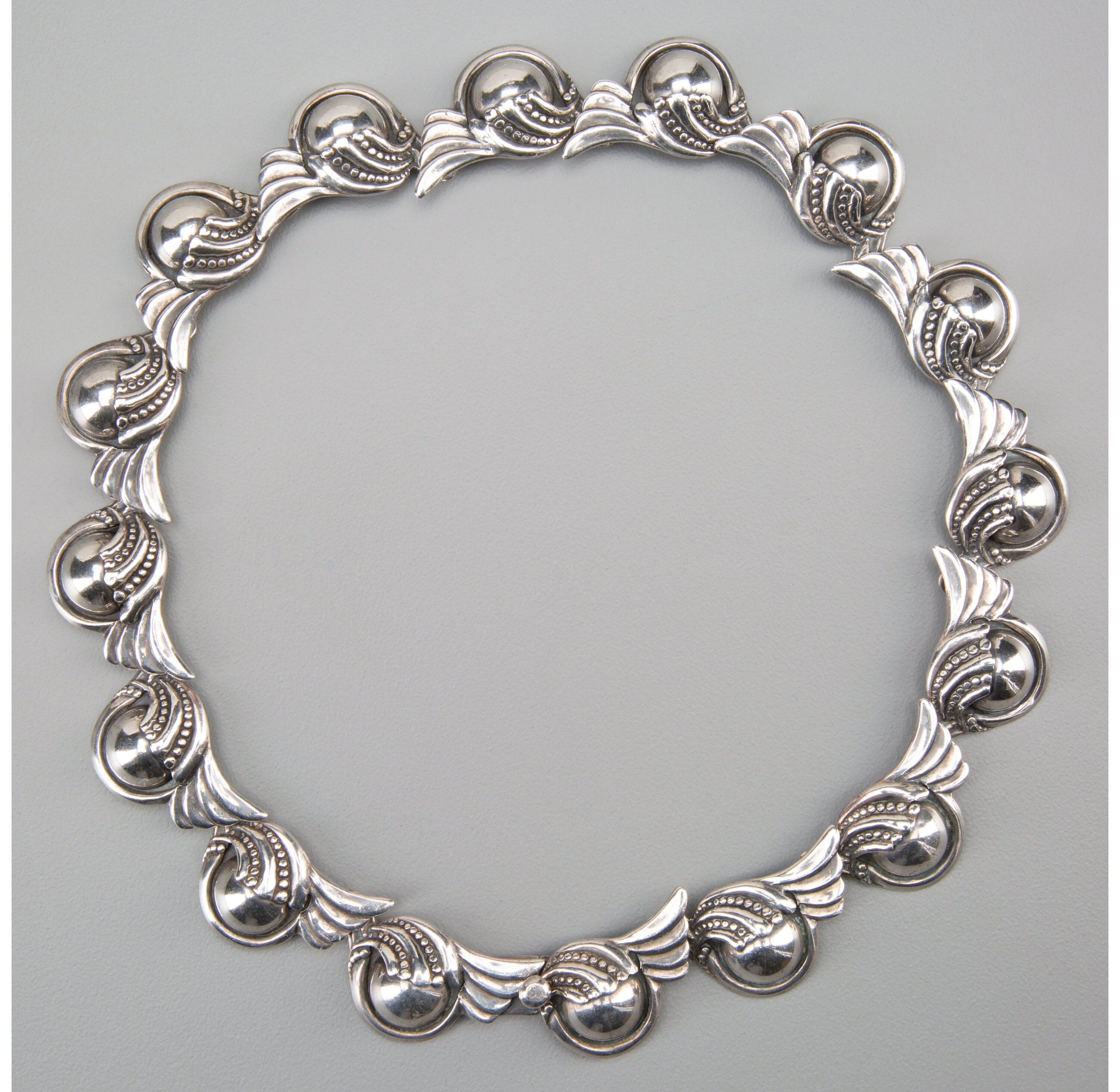
Design 5240 belongs to the champlevé enamel pendant necklace program that Margot van Voorhies Carr developed after adding her enamel-on-silver line in 1955 — work that Morrill & Berk describe as "glittering displays of color, texture, and technical perfection" (Mexican Silver, 1994, p. 166). At seventeen inches with a pendant measuring two by one and five-eighths inches, the piece carries the "Margot de Taxco Sterling" script and the Eagle 22 assay mark on the pendant's reverse, the full hallmark suite her workshop maintained consistently across the span of its production.
The numbered design system Margot used was operationally precise: she kept a written book specifying exact instructions for each design — the number of dies required, color choices for enameling, assembly and finishing sequence — with drawings that served as templates for her enamelers (Morrill & Berk, 1994, p. 168). Each page also indicated clasp placement and which earrings were paired with a given pendant. Morrill & Berk note that this insistence on meticulous documentation sustained a consistent level of workmanship across everything she signed. In her inventory, lower numbers generally indicate earlier work; 5240 places itself in the mature phase of the line's development.
The champlevé technique she employed had been initiated at Los Castillo by Reveriano Castillo and Miguel Melendez, but it was Margot who perfected and built it into one of her major lines of jewelry (Morrill & Berk, 1994, p. 166). Her design vocabulary drew from Pre-Columbian motifs she found compatible with Art Deco geometry, the curling modeled forms she adapted from Taxco's Santa Prisca facade, and the lineage of Parisian Art Nouveau jewelry (Morrill & Berk, 1994, p. 168). Almost all workshop pieces were formed with molds, with enameling executed to the specifications she had documented.
The consistency of mark and finish is characteristic of what her production system was built to produce. The pendant's wearable proportion — two inches of focal area on a full-length chain — is typical of Margot's approach to jewelry conceived to be worn on the figure rather than admired in hand.
Museum of Mexican Silver. “Design 5240 Necklace.” Catalog no. MoMS-001025. https://museumofmexicansilver.com/pieces/margot-necklace-5240
See something wrong with this record? Suggest a correction and the piece details fill in automatically.
Margot de Taxco
Design 5316 Necklace
Sterling silver