Saves instantly, no account needed. Already a member? Sign in.
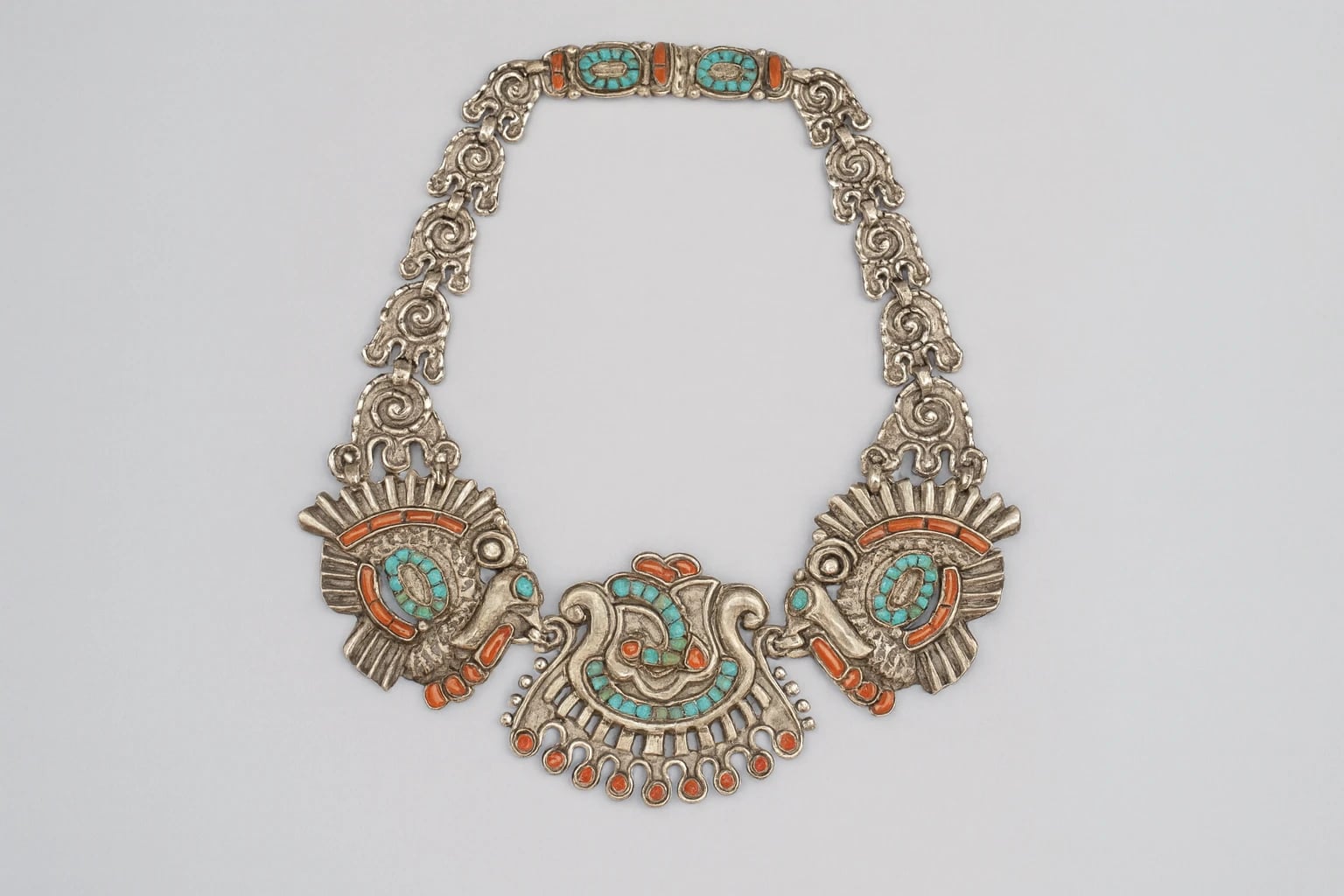
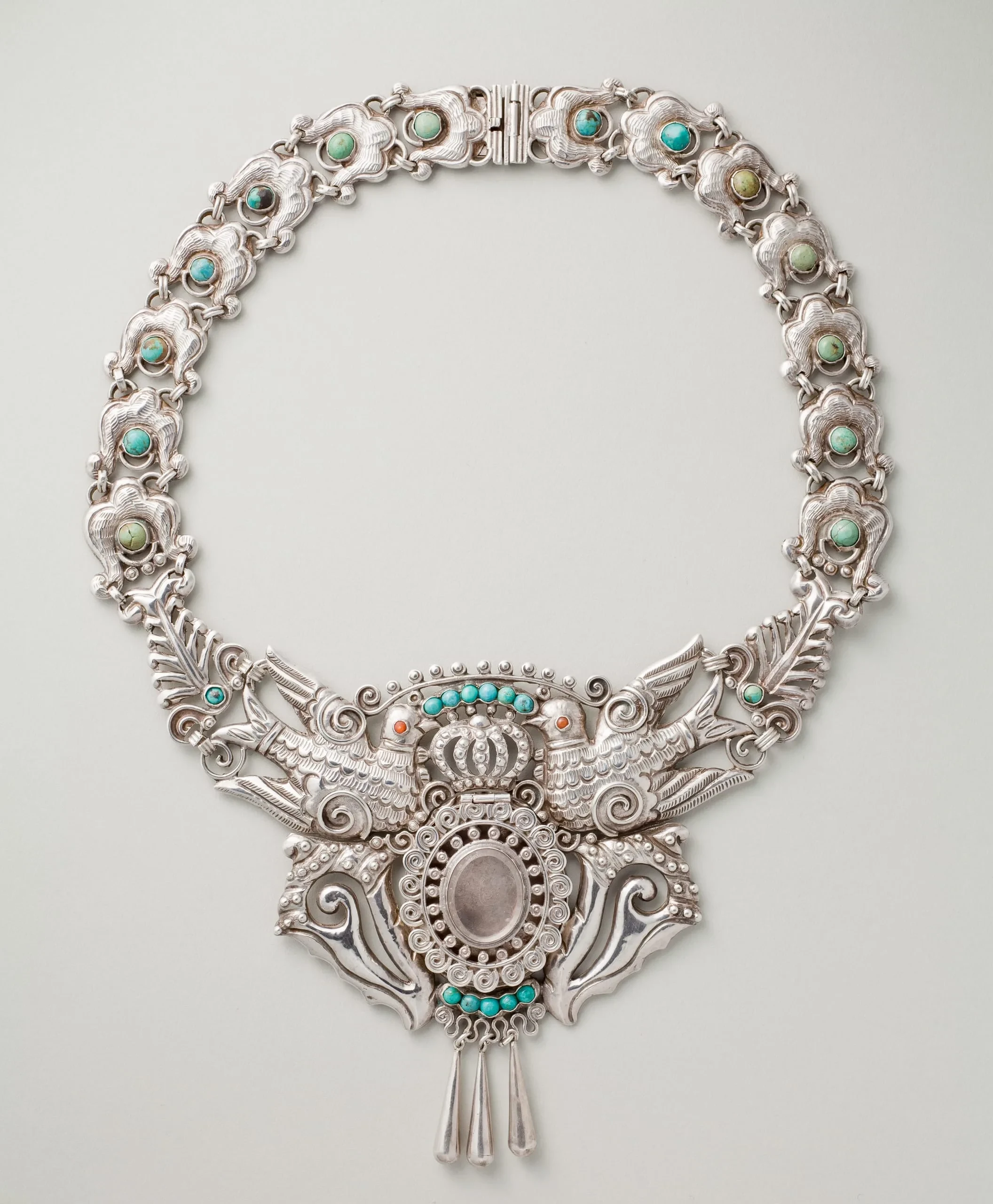
The necklace organizes a large bird-form locket into a full collar, so that the central pendant does not hang as an isolated ornament but grows out of a chain of repeated silver and turquoise links. LACMA records the work as MATL, Matilde Poulat, Necklace with Locket (Collar con medallón), circa 1950, in silver, turquoise, and rock crystal. Its scale is unusually frontal: two birds stretch outward from the locket, their bodies and long tails forming a broad lower span, while the linked upper collar curves around the neck in smaller, cloudlike units. The central oval rock crystal is held within a dense setting of beadwork, scrolls, and concentric borders. Below it, three pendant drops add a vertical counterweight to the horizontal spread of the birds.
The design depends on repetition without regularizing the whole object into a strict geometric pattern. Each upper link carries a rounded turquoise cabochon inside a raised bezel, surrounded by swelling silver forms worked with fine linear texture. These repeated links soften the transition from body to pendant. Their hinges and connecting loops remain part of the design, not hidden interruptions. At the lower edge, the necklace changes tempo. Spirals, dotted borders, featherlike channels, and small suspended elements gather around the locket. The rock crystal is pale and quiet beside the brighter turquoise, which appears in single stones along the collar and in clustered rows on the pendant. That material contrast gives the necklace much of its force: the crystal centers the locket, while the turquoise marks rhythm, direction, and emphasis.
Matilde Poulat’s MATL workshop occupied a distinctive position within the Mexican silver renaissance because it developed a visual language apart from the severe modernist geometry often associated with Taxco. Hougart records that Poulat studied at the San Carlos Academy of Art, opened her shop in 1934, and used MATL as a registered trademark, number 142093, a name connected to the Nahuatl word for water (Hougart, page 128). Morrill and Berk describe her work as part of the postrevolutionary search for a Mexican aesthetic and connect her sources to Mixtec gold jewelry from Monte Albán, to doves, flowers, tiny bells, and to the forms of Mexican popular art (Morrill and Berk, page 216). This necklace belongs to that world of layered ornament, but it is not casual or picturesque. Its birds, scrolls, pellets, cabochons, and pendant drops are organized with a careful sense of weight and symmetry, turning abundance into structure.
Museum of Mexican Silver. “Bird Locket Necklace with Turquoise and Rock Crystal.” Catalog no. MoMS-002272. https://museumofmexicansilver.com/pieces/matl-bird-locket-necklace-with-turquoise-and-rock-crystal
See something wrong with this record? Suggest a correction and the piece details fill in automatically.
The workshop history helps explain that density of detail. Morrill and Berk note that Poulat received international recognition in 1941 through the Latin American silver exhibition at the Pan American Union in Washington, D.C., and that wartime demand expanded the taller to thirty-three silversmiths (Morrill and Berk, page 216). They also record the close collaboration of Poulat and her nephew Ricardo Salas, who later continued the MATL designs after her death in 1960 (Morrill and Berk, page 216). Hougart similarly states that Salas continued Poulat’s folk art designs and supervised substantial workshop production (Hougart, page 136). The absence of a visible hallmark in the available image should not distract from the object’s documented attribution, but it does remind us that MATL jewelry was produced through a taller system in which design, supervision, carving, setting, and assembly could involve several trained hands.
Within a museum collection, this necklace clarifies why MATL cannot be treated as a decorative sideline to Mexican modernism. Its modernity lies in the transformation of historical and vernacular sources into a wearable architecture of silver, stone, motion, and surface. The collar keeps the body in view through its articulated curve, while the locket concentrates the imagery of birds, waterlike scrolls, and luminous stones into a single frontal field. Poulat’s work enlarges the story of midcentury Mexican silver beyond Taxco’s better known formal austerity. Here, modern design is carried by profusion, color, and devotional intensity disciplined into an object meant to move.
MATL (Matilde Poulat)
Scroll-Link Fringe Necklace with Coral
1934 or later
Coral