Saves instantly, no account needed. Already a member? Sign in.
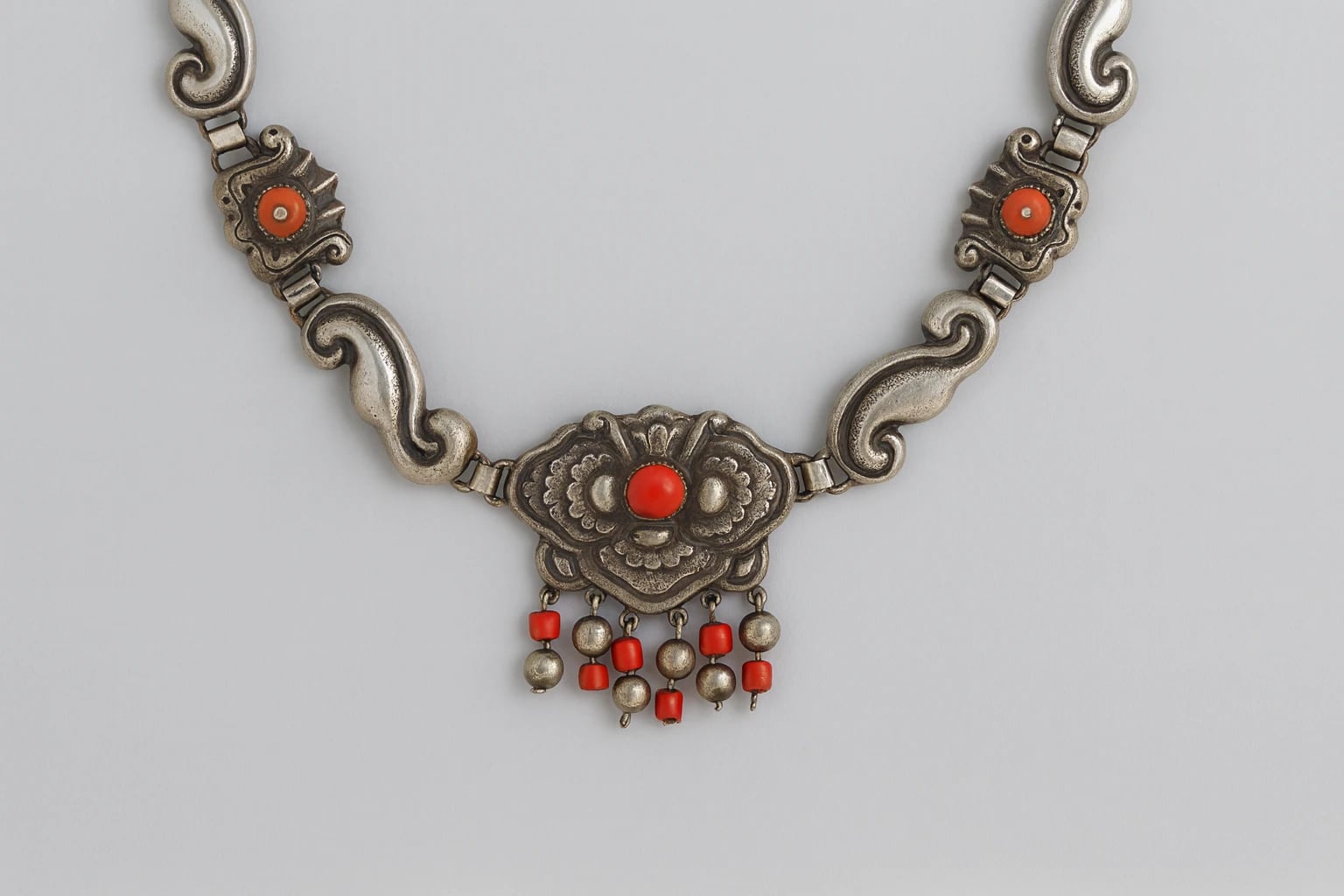
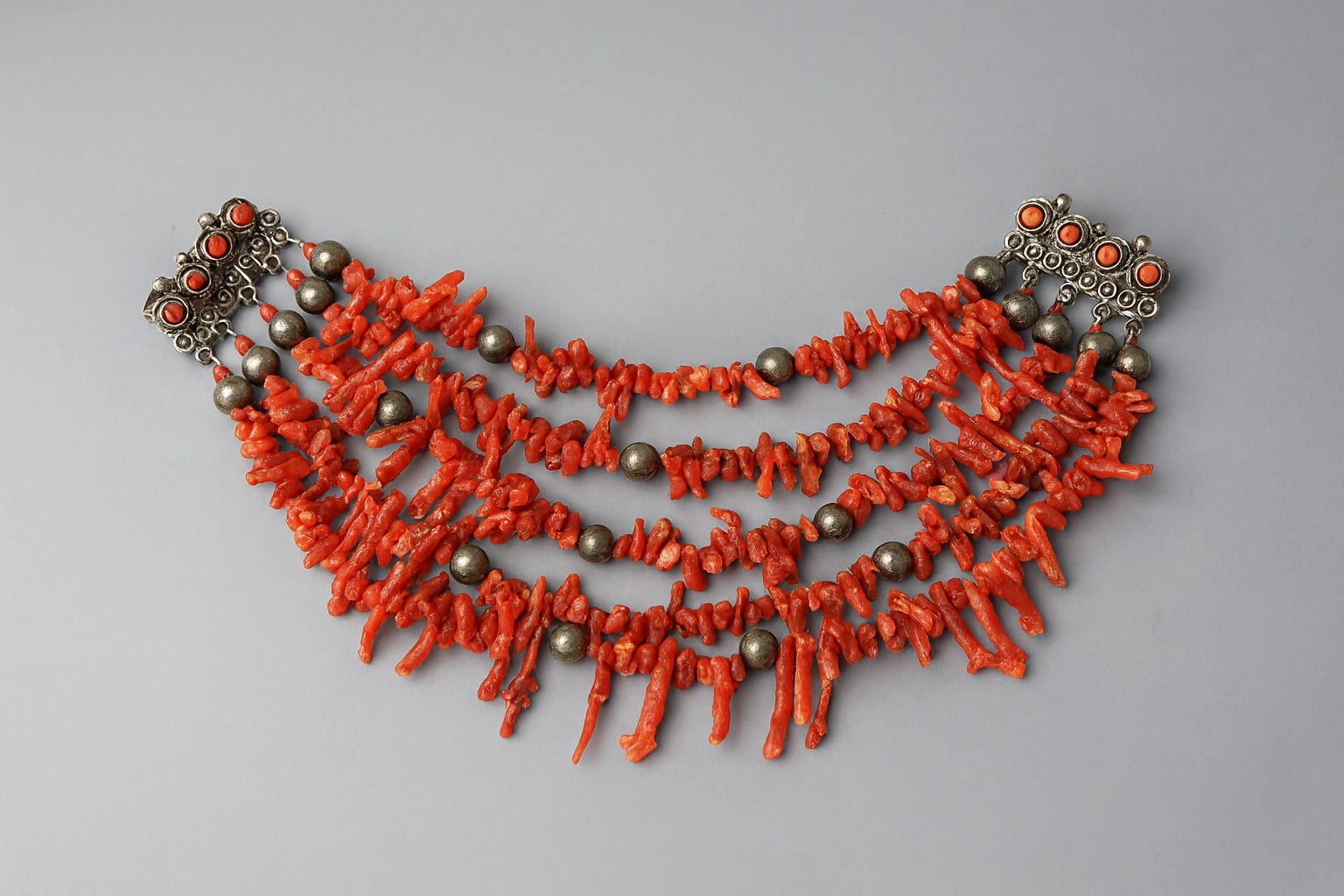
A dense curtain of coral drops turns color and movement into the organizing principle of this MATL necklace. Small beads and carved coral gather into a fringe that swings from a silver framework, so that the ornament reads first as a field of warm red before the eye registers the metalwork that supports it. Matilde Poulat built her reputation on this saturation of surface, and here the coral does the primary compositional work, massing at the lower edge where the necklace would fall against the collarbone and settling into stillness only when the wearer is still.
The construction depends on the relationship between rigid silver and the loose weight of suspended coral. Where many bib necklaces flatten ornament into a single plane, this design lets the coral hang free, each strand or drop moving independently so the fringe shifts and catches light as the body turns. Silver scrollwork and set stones anchor the upper register, providing the fixed architecture from which the coral is released. The visual logic is additive and devotional in feeling, closer to the crowded ornament of Mexican colonial and popular religious objects than to the pared geometry associated with the Taxco School. Coral carries this reading through its color and opacity rather than through any single carved motif, and its density is what gives the piece its physical and optical weight.
Poulat, trained as a painter and designer at the Academy of San Carlos before she opened her shop in 1934, stands somewhat apart from the Spratling workshop lineage that shaped so much Taxco silver. Her registered trademark, MATL, adapted from a word for water, marks a body of work built around exuberant folk ornament, silver openwork, and combinations of coral, turquoise, and other stones set in dense, symmetrical arrangements. That vocabulary proved durable enough to outlive her: after her death in 1960, her nephew Ricardo Salas continued producing MATL designs, at times supervising several dozen silversmiths. Distinguishing an object made under Poulat's own direction from a later Salas production usually turns on the mark, since the workshop's earlier stamps give way after 1980 to forms that add the MS-12 registration. Without a documented hallmark reading here, this necklace should be placed within the MATL design tradition rather than assigned to a single fabrication date.
As a document of that tradition, the necklace shows how one strand of the Mexican silver renaissance drew directly on colonial and popular religious ornament instead of on international modernist geometry. Poulat's work demonstrates that the renaissance was not a single style but a set of divergent artistic choices, and that a painter's eye for color and massed pattern could shape silver as decisively as an architect's eye for structure. A collection that includes this piece can show viewers how coral functioned as a compositional material in Mexican jewelry, and how the MATL workshop sustained a recognizable ornamental language across two generations of makers.
Museum of Mexican Silver. “Fringe Necklace with Coral.” Catalog no. MoMS-002227. https://museumofmexicansilver.com/pieces/matl-coral-fringe-necklace
See something wrong with this record? Suggest a correction and the piece details fill in automatically.
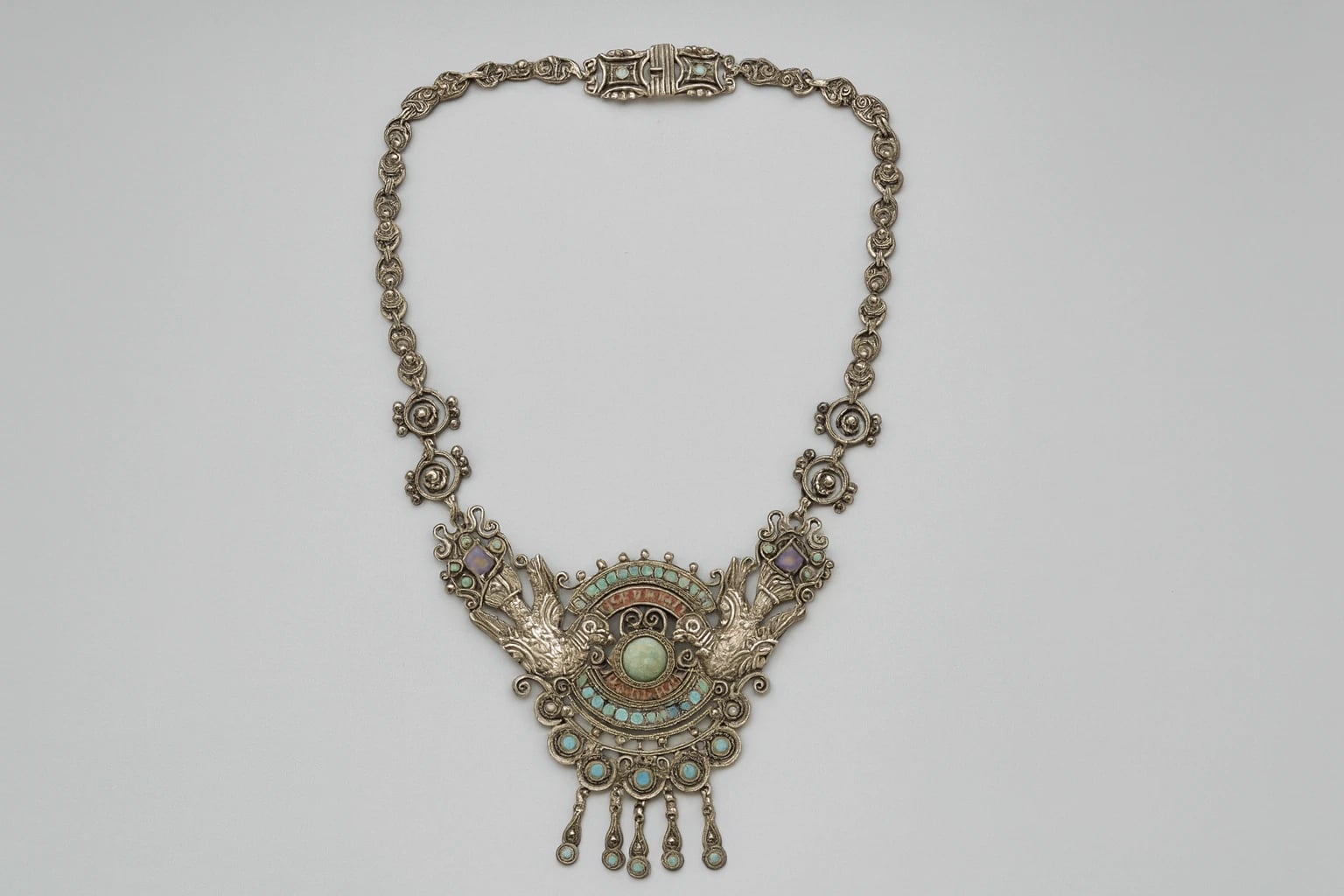
MATL (Matilde Poulat)
Dove Drop Necklace with Turquoise and Amethyst
1934 or later
Turquoise