Saves instantly, no account needed. Already a member? Sign in.
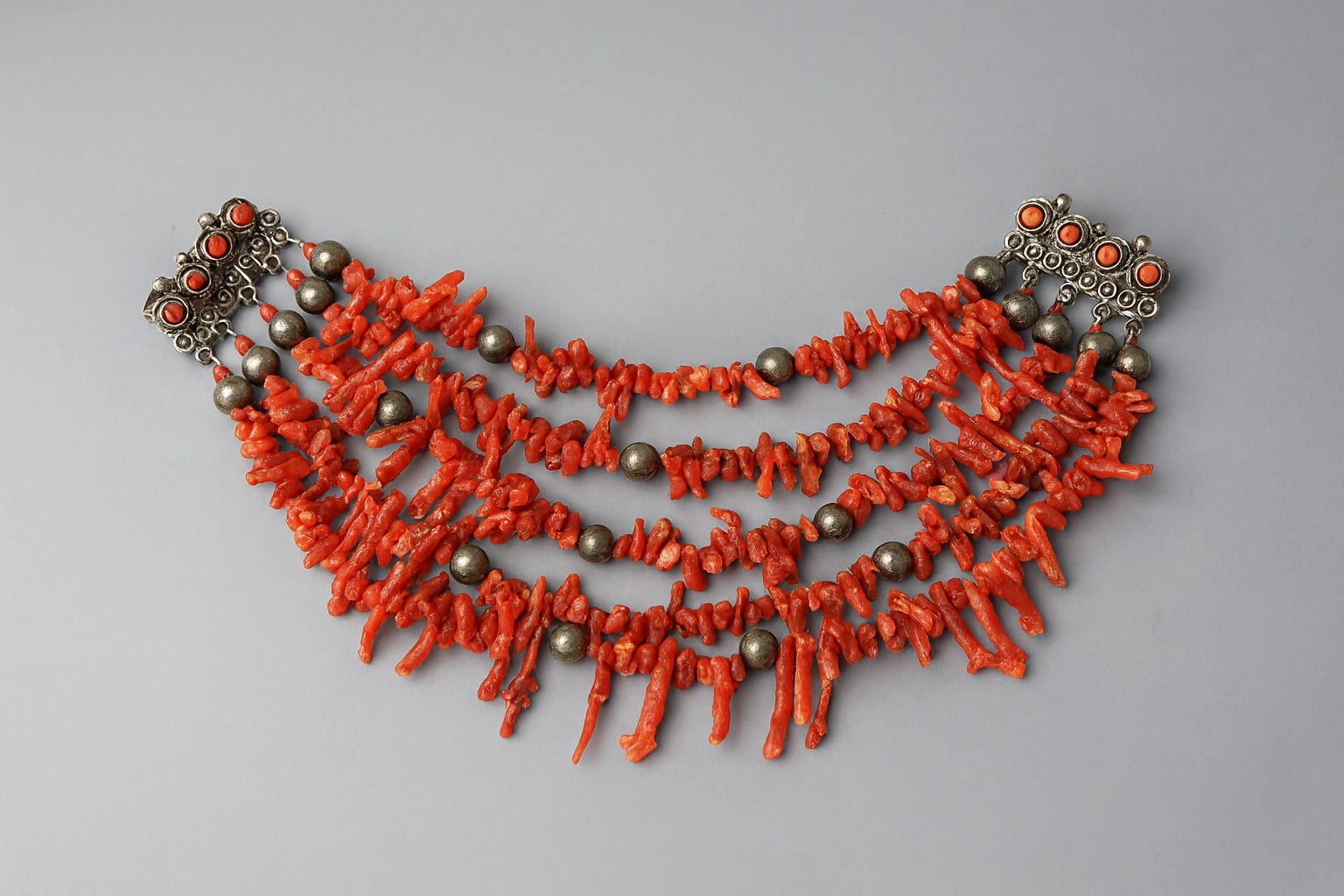
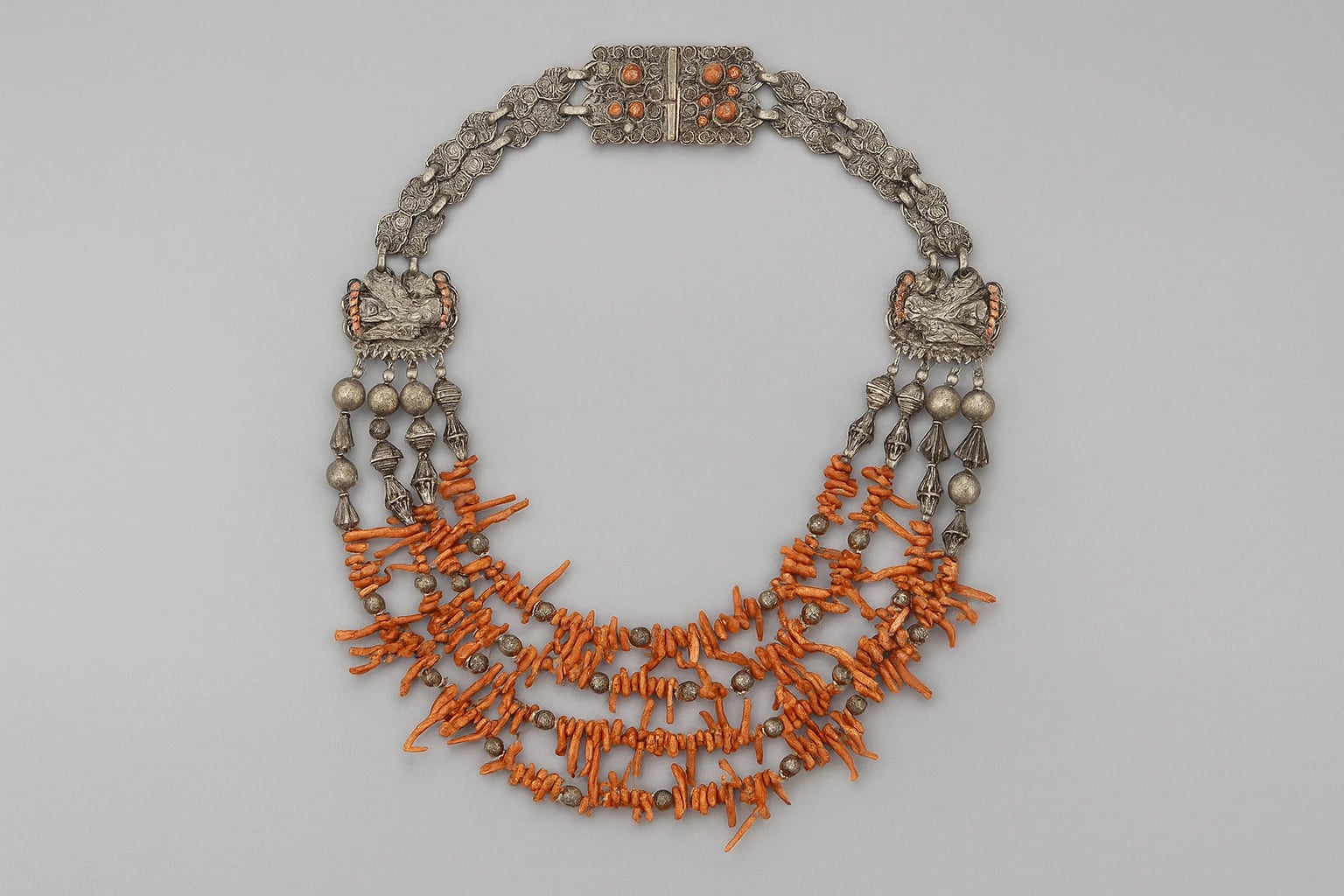
A dense curtain of coral drops turns the lower edge of this collar into pure movement, each bead suspended so that the fringe sways and reclaims light as the wearer turns. Above that fringe, the silver body of the necklace holds a bilaterally symmetrical arrangement of scrollwork, small blossoms, and set stones, the ornamental vocabulary that Matilde Poulat made into a recognizable language under the mark MATL. The design brings together two temperaments in one object: the disciplined, near-heraldic order of the silver register and the loose, kinetic play of the hanging coral.
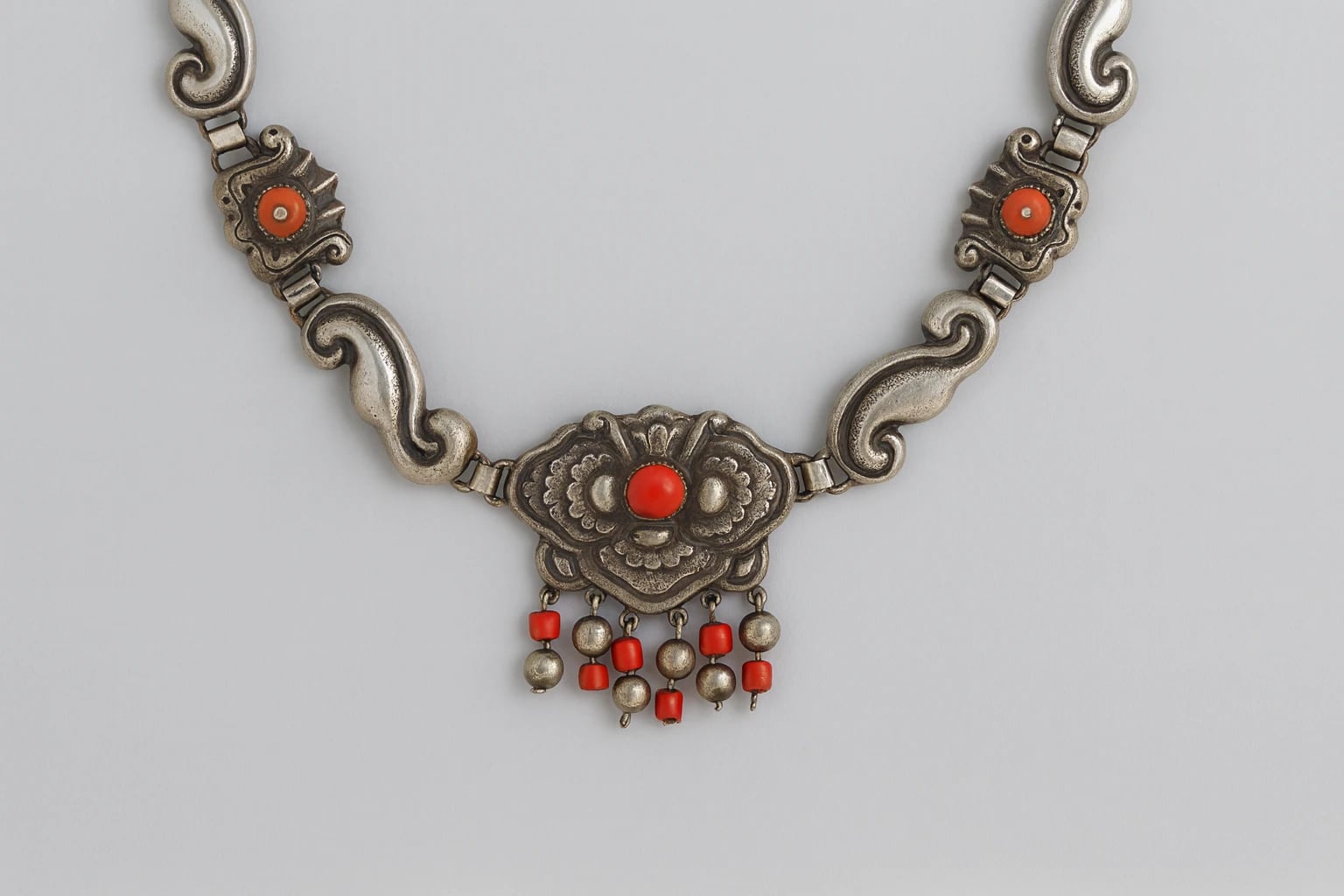
The color logic is the necklace's governing idea. Coral reads as warm and opaque, and Poulat used it here in two registers, as accents seated within the silver ornament and as the freely hanging fringe that gathers the most attention at the base. Because the drops are strung to move independently, the fringe behaves less like a fixed border and more like a fabric edge, shifting weight and reflectivity with the body. Set against oxidized silver, the coral's warmth is deepened, and the recessed shadows of the metalwork throw the beads forward. Poulat's compositions typically build outward from a central axis through paired scrolls and clustered flowerheads, and the collar form concentrates that symmetry at the throat while releasing it into the irregular shimmer of the fringe below.
Poulat trained as a painter and designer at the San Carlos Academy, and she opened her own shop in 1934, registering the MATL trademark (number 142093) that appears across her jewelry and decorative objects. Her work belongs to the strand of the Mexican silver renaissance rooted less in the geometric abstraction associated with the Taxco School and more in a personal folk vocabulary drawn from colonial devotional metalwork and popular ornament, birds, flowers, hearts, and dense scrollwork rendered in silver and set with coral, turquoise, and other stones. That vocabulary proved durable. Her nephew Ricardo Salas worked alongside her throughout her career and continued producing MATL designs after her death in 1960, at times supervising several dozen silversmiths who fabricated and assembled the pieces. This collaborative continuation is documented in the Museum's hallmark reference, rebuilt from Hougart, and it means that a MATL design and a specific MATL object need not share a single date.
For that reason, the hallmark determines how the object is placed in time rather than settling the question by itself. The Museum's reference records seven distinct MATL marks, from the early block-letter "MATL 0.900" through the script forms carrying "0.925 Hecho en Mexico DF," and later the registration mark "M. Regis 142093," with Salas-period marks after 1980 adding MS-12. The specific mark on this necklace fixes when it was fabricated within the long life of the MATL workshop, a life that spans Poulat's own hand and Salas's continuation of her designs. Read within that history, the collar records how a painter's ornamental sensibility became a workshop language, one that kept coral and oxidized silver in the same warm, deliberately old-fashioned register long after the harder geometries of Taxco had become the more familiar face of Mexican modernist silver.
Museum of Mexican Silver. “Fringe Collar Necklace with Coral.” Catalog no. MoMS-002213. https://museumofmexicansilver.com/pieces/matl-coral-fringe-collar-necklace
See something wrong with this record? Suggest a correction and the piece details fill in automatically.
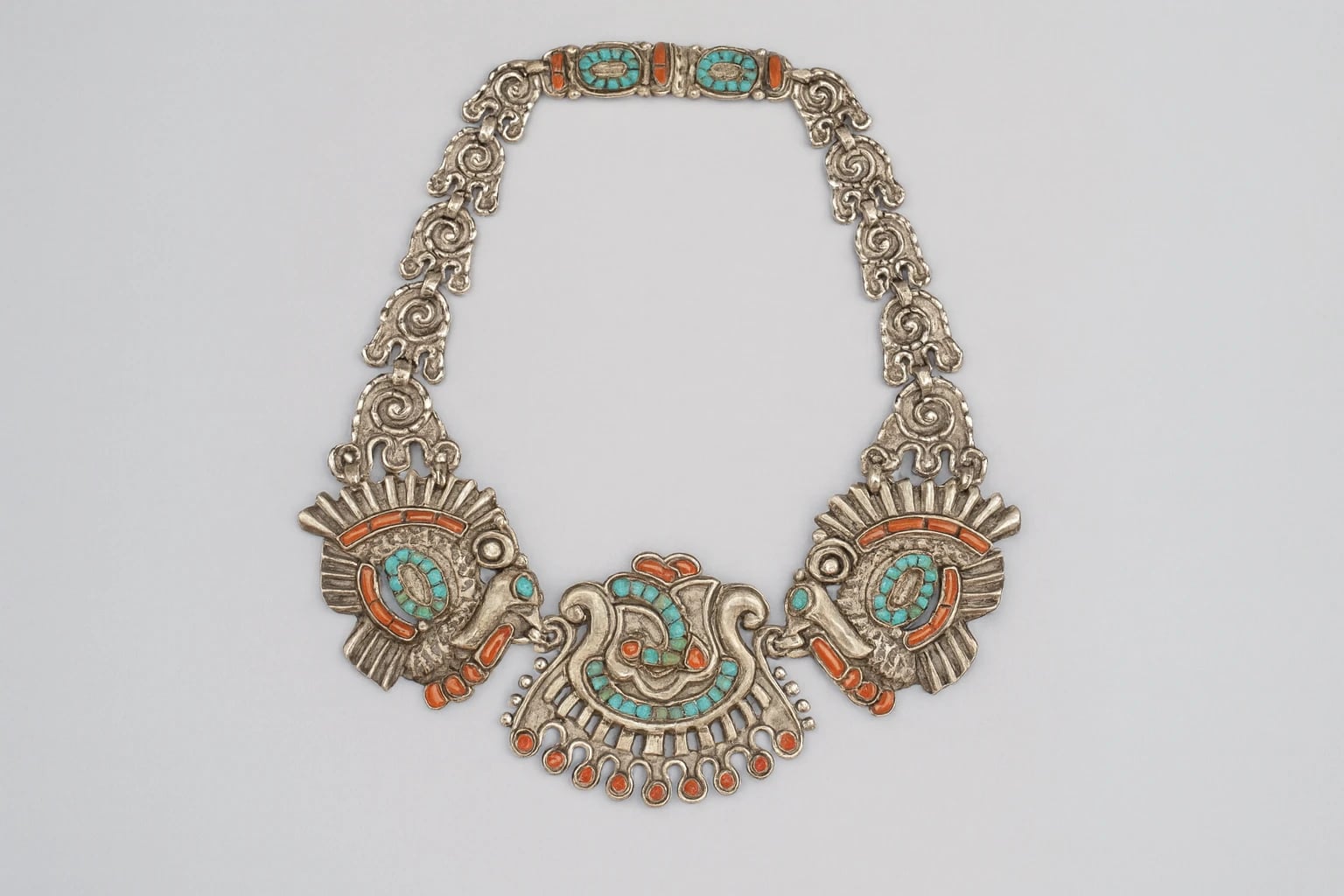
MATL (Matilde Poulat)
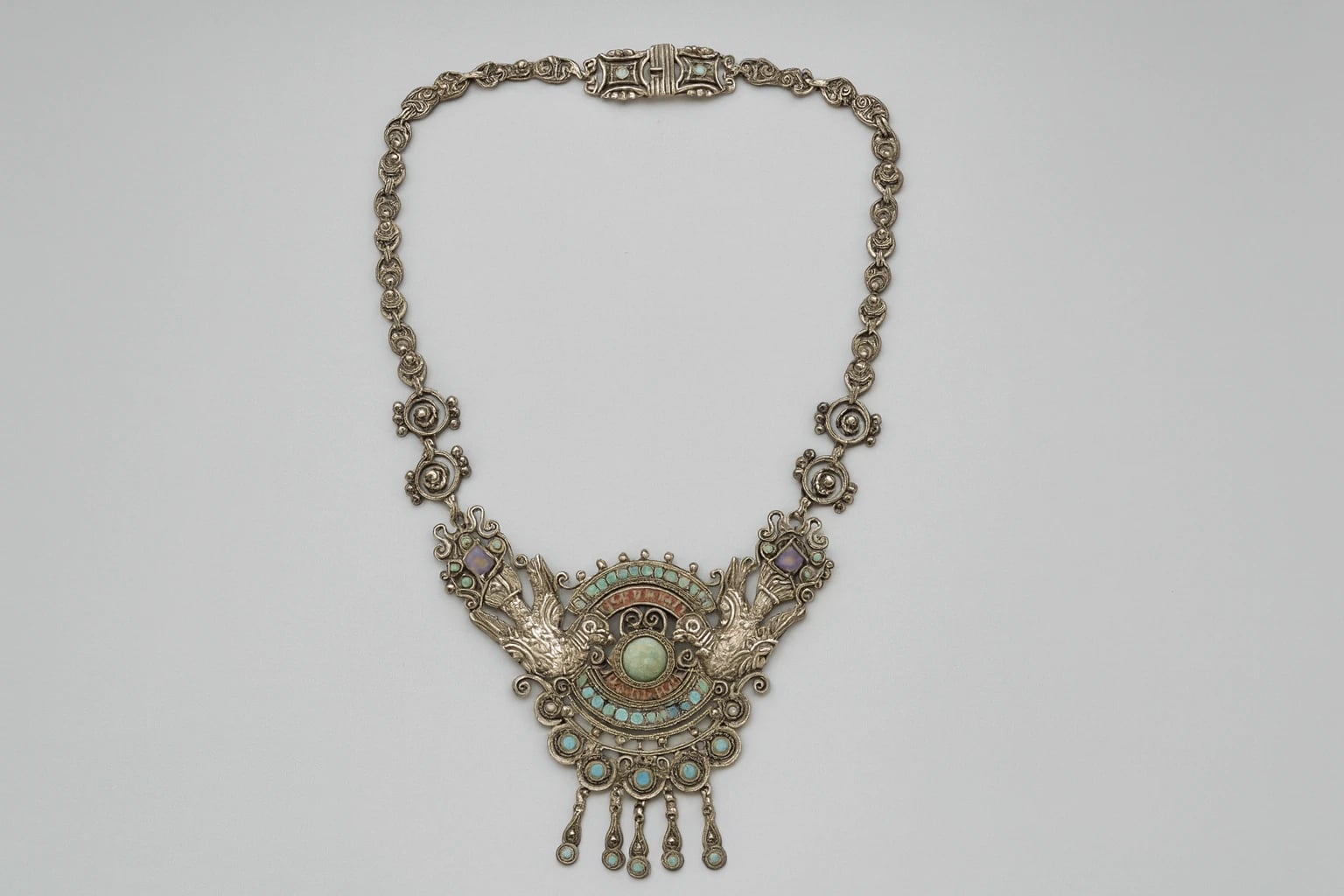
Dove and Rose Pendant Necklace with Turquoise and Coral
1934 or later
Silver