Saves instantly, no account needed. Already a member? Sign in.
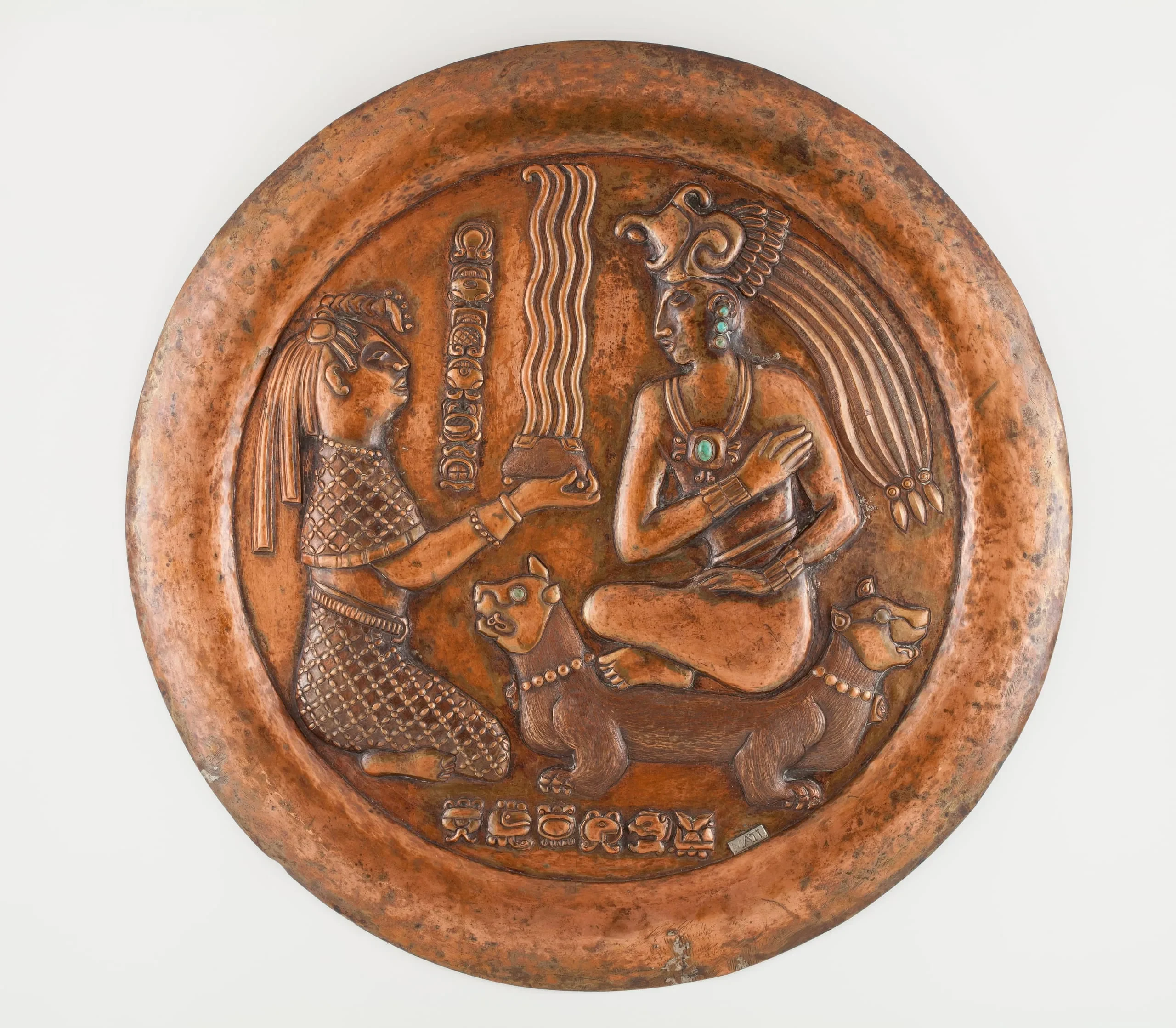
The charger translates a royal Maya accession scene into a broad copper field, using repoussé relief and small turquoise settings to give the vessel the character of an image as well as a serving form. Made by MATL around 1940 to 1950, it belongs to the part of Matilde Poulat’s production that carried her dense, image driven silver language into larger decorative objects. The circular format matters: the raised rim contains the scene like a medallion, while the shallow bowl shape keeps the figures close to the viewer rather than pushing them into pictorial distance. Copper supplies a warm, variable ground, mottled by age and handling, against which the turquoise appears sparingly and with purpose.
The composition is based on the Oval Palace Tablet at Palenque, Chiapas. It depicts the accession of Pakal, seated on a double headed jaguar throne, as his mother offers him a crown that signifies kingship. MATL’s version preserves the ceremonial relation between the two figures but adapts the stone tablet’s carved surface to metal. The raised lines of hair, feathered headdress, glyphs, throne, and regalia catch light at different angles, so the image is read through the movement of reflection across the copper. The turquoise is not scattered ornament. It is concentrated at points of bodily and ceremonial attention: the ear ornament, chest ornament, and animal form. Those blue green notes interrupt the reddish metal with the same careful emphasis that MATL often brought to coral, turquoise, and amethyst in jewelry.
The relief is unusually tactile. The kneeling figure’s garment is patterned with a close network of small raised bosses, a surface treatment that recalls MATL’s taste for elaborated, almost embroidered metal skins. The seated ruler is heavier and more compressed, enclosed by the curve of the throne and the animal body beneath him. Between them, the vertical glyph band and the lifted crown establish the ceremony’s axis. The repoussé does not attempt archaeological replication in a neutral documentary manner. It reworks a Maya source through a modern Mexican decorative vocabulary, one in which ancient imagery, hand worked metal, and applied color become part of a twentieth century object for the interior.
Matilde Poulat’s MATL workshop occupied a distinct position within the Mexican silver renaissance. Hougart records that Poulat studied at the San Carlos Academy of Art, opened her shop in 1934, and registered MATL, a name related to the Nahuatl word for water, as a trademark. Morrill and Berk describe her designs as part of the postrevolutionary search for a Mexican aesthetic, shaped by pre conquest sources and popular art rather than by European academic subjects. Their account also stresses the richness of MATL surfaces, with applied wire, embossing, repoussé, and colored stones used to build complex ornament. This charger extends that practice beyond jewelry into a furnishing object, and its subject clarifies the workshop’s larger ambition: Mexican antiquity is not treated as a borrowed motif, but as material for a living modern design language.
Museum of Mexican Silver. “Copper Charger with Turquoise.” Catalog no. MoMS-002274. https://museumofmexicansilver.com/pieces/matl-copper-charger-with-turquoise
See something wrong with this record? Suggest a correction and the piece details fill in automatically.
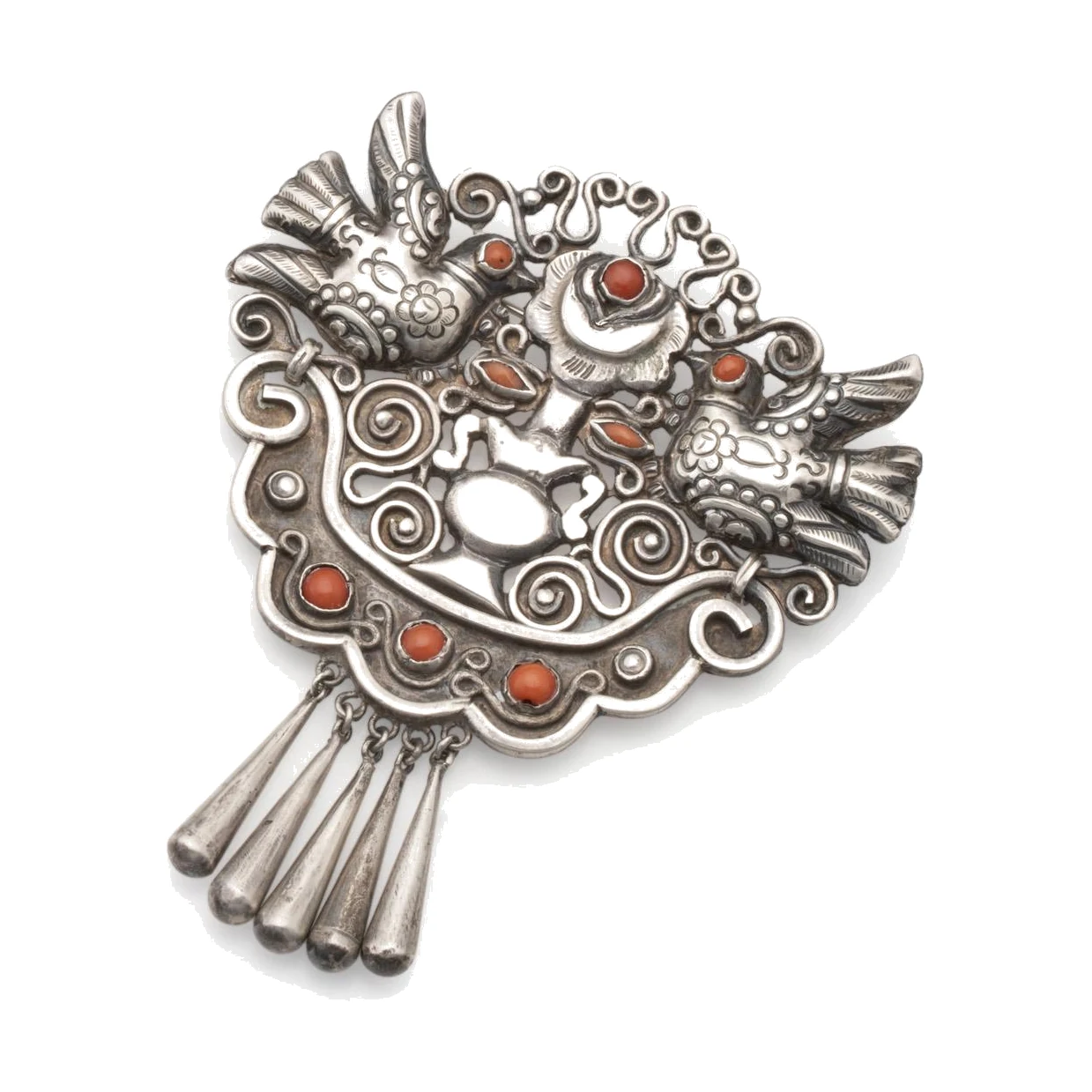
MATL (Matilde Poulat)
Paired-Dove Drop Brooch with Coral
1935-1948
Sterling silver