Saves instantly, no account needed. Already a member? Sign in.
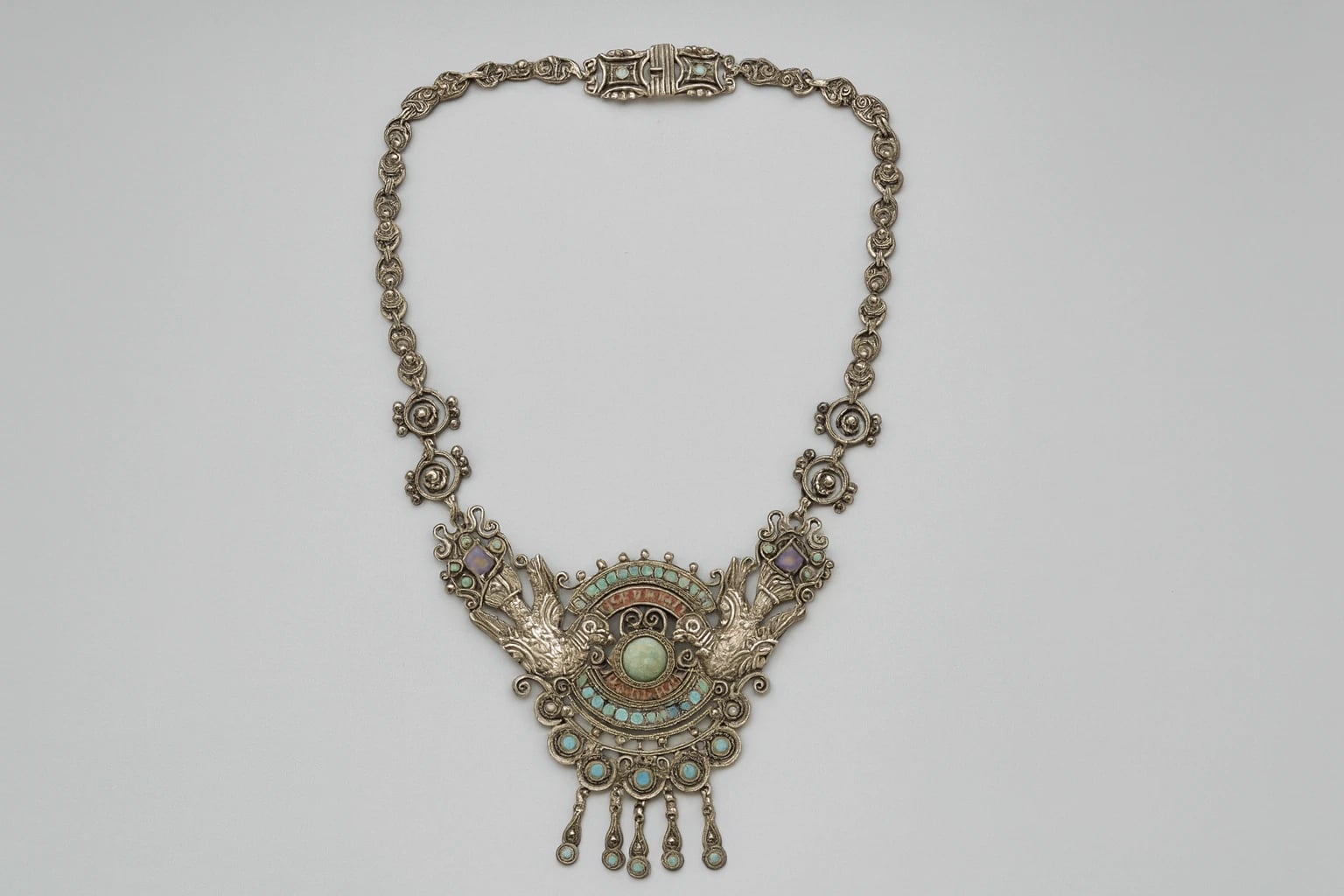
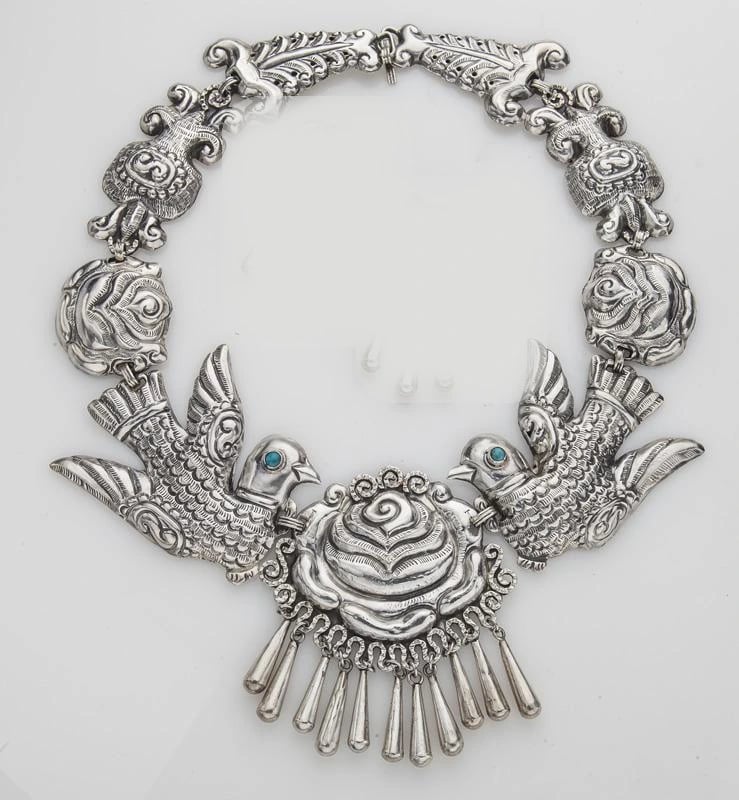
A silver dove drops from the center of this necklace like a pendant given the weight of an emblem, its body set with turquoise and its breast anchored by a faceted amethyst. The bird is the recurring signature of Matilde Poulat, and here it governs the entire composition. Scrolling silver tendrils, small beaded clusters, and cabochon turquoise gather around and above the dove, so the eye travels down the chain, through the ornamental field, and comes to rest on the descending bird and the purple stone it carries. The design fuses Mexican devotional and folk imagery with a jeweler's sense of symmetry, and it does so without diluting either.
The necklace depends on the contrast between opaque and transparent stone. Turquoise, matte and sky colored, spreads across the silverwork in irregular cabochons that read as color blocks rather than as isolated gems. The amethyst, faceted and translucent, catches and returns light where the turquoise absorbs it, and Poulat places it at the lowest and most visible point so that the one transparent element becomes the terminus of the whole ornament. Around these stones the silver is worked into dense curling scrolls and applied beads, a vocabulary drawn from colonial and popular Mexican ornament rather than from the streamlined geometry favored in much Taxco design of the same years. The result carries visual weight at the center and lightens toward the chain, a distribution that lets the pendant sit forward on the body.
Poulat trained as a painter and designer at the San Carlos Academy before opening her Mexico City shop in 1934, and her work stands somewhat apart from the Taxco workshops. She registered the name Matl, taken from an Aztec word for water, as trademark number 142093, a number that appears etched on later pieces. Her marks span an early block-letter MATL with a 0.900 fineness through script forms carrying 0.925 or 0.950, and the registration number enters the mark only around 1950. The dove, flowers, and scrollwork became so identified with her hand that after her death in 1960 her nephew Ricardo Salas continued the Matl designs for decades, and other makers produced work in her manner. Dating any single Matl object therefore requires care, since the design vocabulary was conceived early, produced across Poulat's lifetime, and carried forward by Salas under the same famous mark.
Within the broader silver renaissance, this necklace documents a strand that ran parallel to the Taxco School rather than through it. Where Spratling and his successors often abstracted ancient Mexican sources into severe modern form, Poulat elaborated colonial and folk ornament into richly worked, stone-set jewelry that remained legible as Mexican devotional imagery. A collection that includes this piece can show that the renaissance was not a single aesthetic but several, and that a Mexico City designer trained as a painter produced one of its most recognizable and enduring signatures in the dropping silver dove.
Museum of Mexican Silver. “Dove Drop Necklace with Turquoise and Amethyst.” Catalog no. MoMS-002229. https://museumofmexicansilver.com/pieces/matl-dove-drop-necklace-with-turquoise-and-amethyst
See something wrong with this record? Suggest a correction and the piece details fill in automatically.
MATL (Matilde Poulat)
Floral Necklace
1934 or later
Silver