Saves instantly, no account needed. Already a member? Sign in.
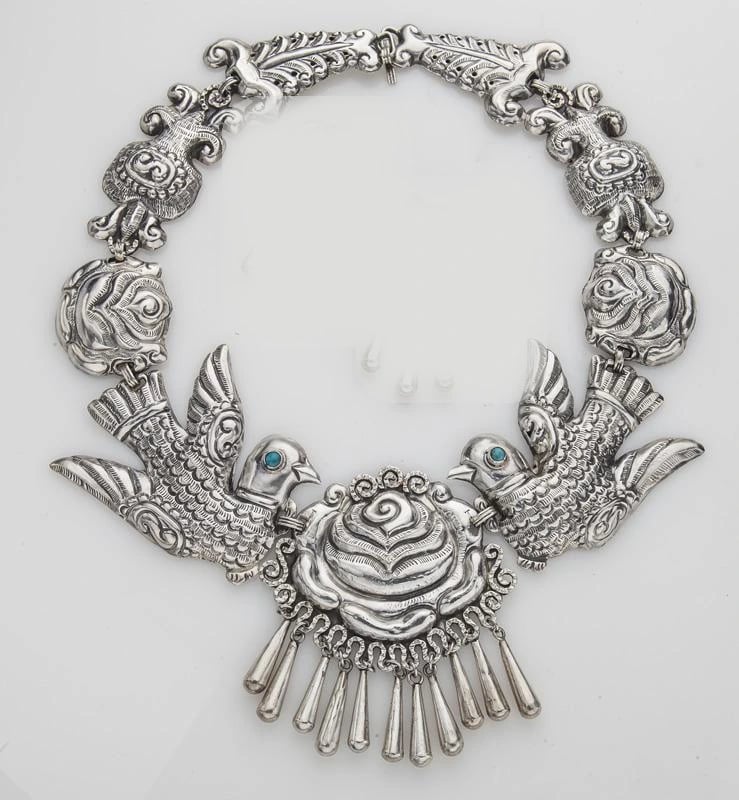
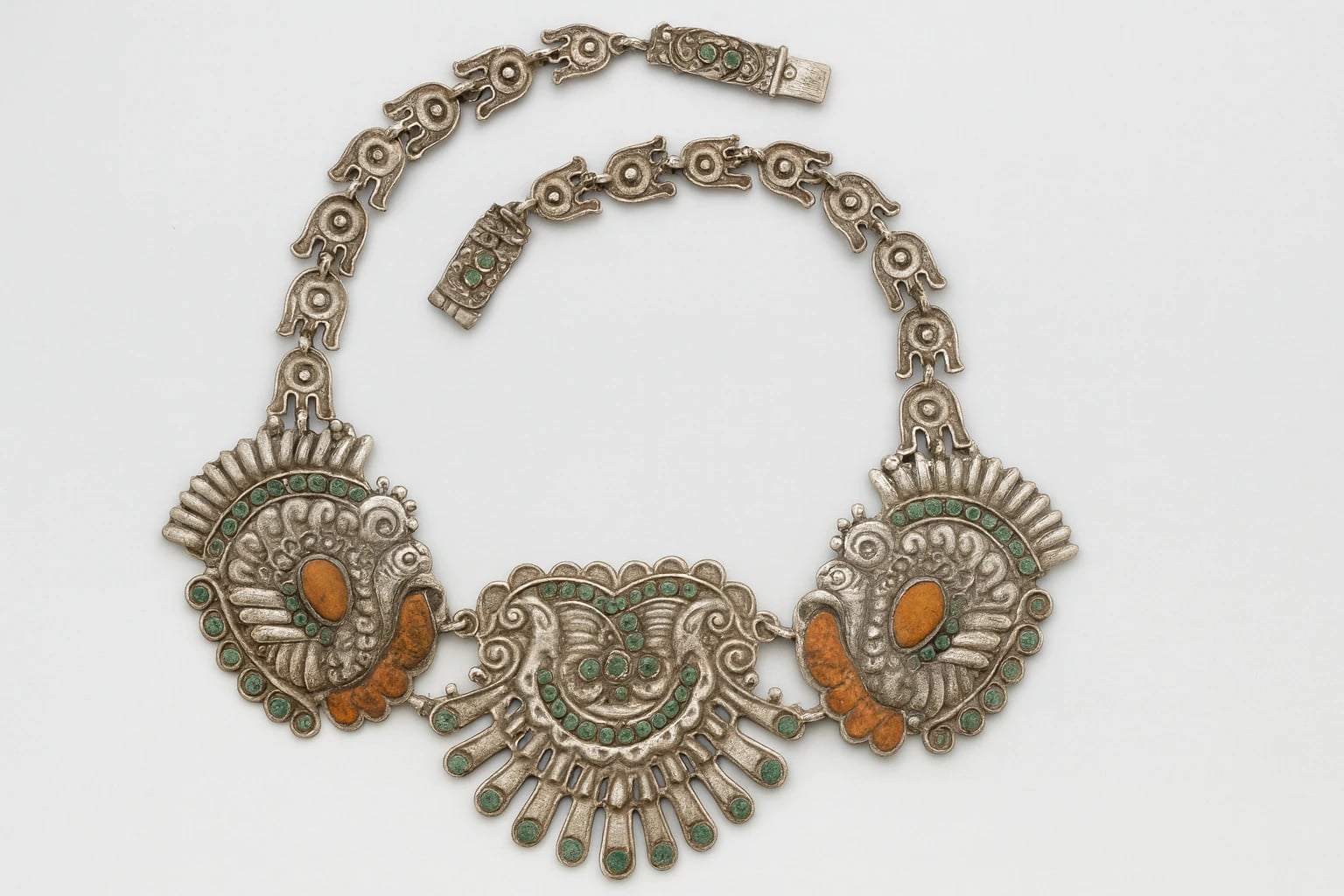
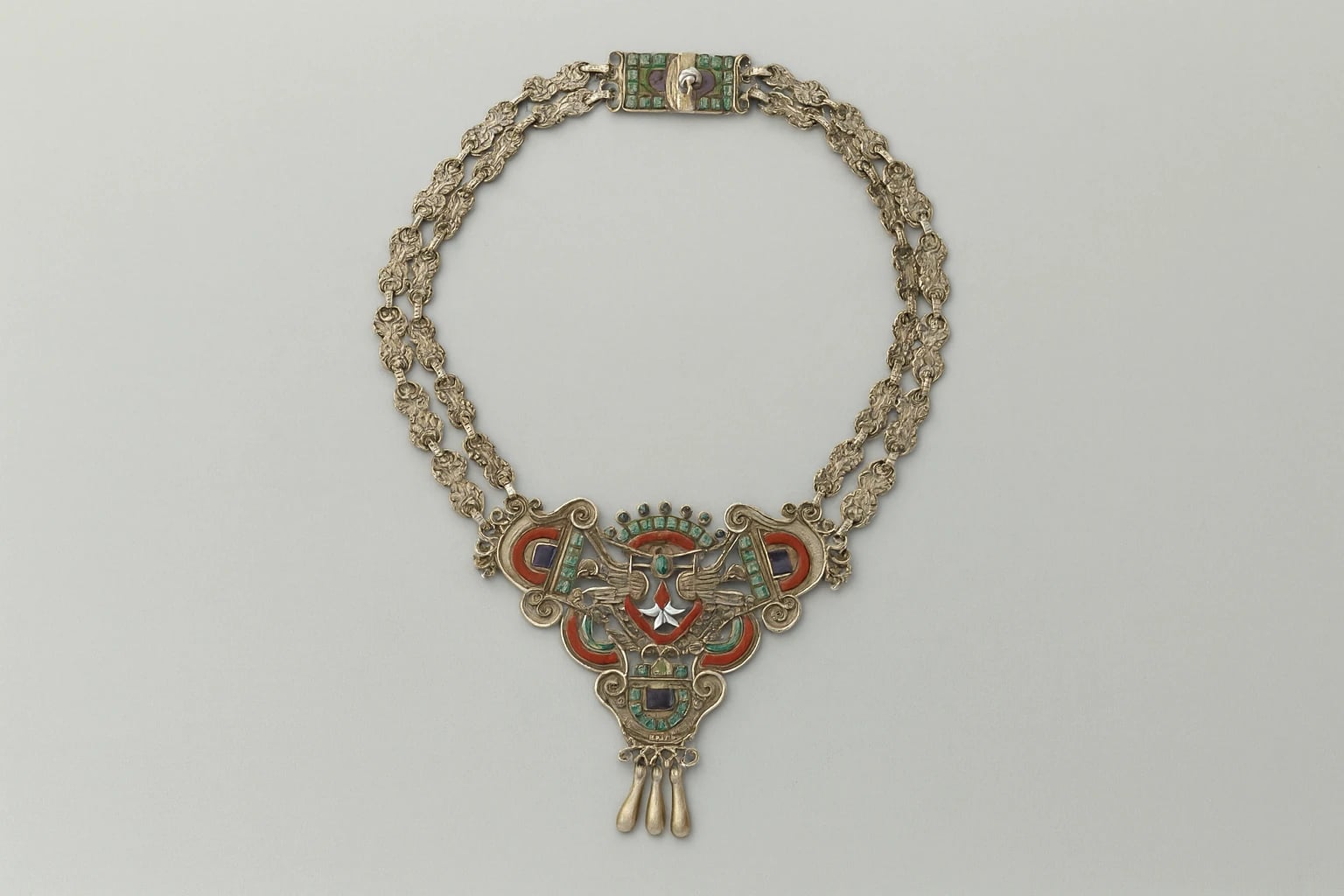
A silver dove with wings drawn back perches at the center of this necklace, its body set with turquoise and its breast studded with small cabochons of coral, framed by the dense scrollwork and beaded silver that identify the MATL workshop at a glance. The bird is the organizing motif, but the pendant reads as a small suspended field rather than a single figure: openwork curls, silver droplets, and stone accents fill the space around the dove so completely that the eye moves across a woven surface rather than resting on an isolated silhouette. This treatment of ornament, in which folk imagery is embedded in an all over pattern of scroll and bead, is the signature contribution of Matilde Poulat to Mexican silver, and it distinguishes her work from the cleaner geometric currents that ran through Taxco in the same decades.
The construction depends on layering. Coiled and scrolled silver wire builds up a lace like ground, and onto that ground the workshop set turquoise and coral in closed bezels, alternating the opaque blue green of the turquoise against the warmer red of the coral. The dove itself carries the largest turquoise passages, so color concentrates at the center and scatters outward into smaller points, giving the pendant a bright focus that dissolves at its edges. Silver beading, granulated clusters and applied droplets, catches light differently from the polished bezels and the flatter scrollwork, so the surface stays active across its whole area. The stones are set for color and pattern rather than for the display of a single large gem, which keeps the composition pictorial: this is a designer trained as a painter arranging hue and density across a plane.
Poulat studied at the San Carlos Academy and worked as a painter and designer before opening her shop in 1934, and she registered the name MATL, drawn from an Aztec word associated with water, as a trademark numbered 142093. Her imagery drew on colonial and popular Mexican sources, the dove among them, a bird long present in Mexican religious and folk art, rather than on Pre Columbian geometry or European modernism. Because the MATL style was continued after her death in 1960 by her nephew Ricardo Salas, and later carried a MS-12 registration alongside the MATL mark on pieces made from 1980 onward, the workshop's marks are the surest guide to when a given example was fabricated. The hallmark reference records early script MATL stamps with fineness marks used across the 1934 to 1948 period, an M. Regis 142093 registration form associated with roughly 1950 to 1960, and the later Salas era marks. Reading the mark on this necklace against that sequence separates a piece made under Matilde Poulat's own direction from a later continuation of her design.
Museum of Mexican Silver. “Perched-Dove Pendant Necklace with Turquoise and Coral.” Catalog no. MoMS-002223. https://museumofmexicansilver.com/pieces/matl-dove-pendant-necklace-with-turquoise-and-coral
See something wrong with this record? Suggest a correction and the piece details fill in automatically.
The dove, turquoise, and coral vocabulary became so closely identified with MATL that other workshops, including one marked Rivera, produced work in the same manner, which is itself evidence of how firmly Poulat fixed this idiom in the field. For a collection, a MATL dove pendant documents a distinct path within the Mexican silver renaissance, one rooted in painting and popular Catholic imagery rather than in the industrial modernism often treated as the movement's mainstream. It shows that the renaissance held room for a densely ornamented, color driven, figurative style, and that a woman trained as a painter built one of its most recognizable design languages and protected it under her own registered name.
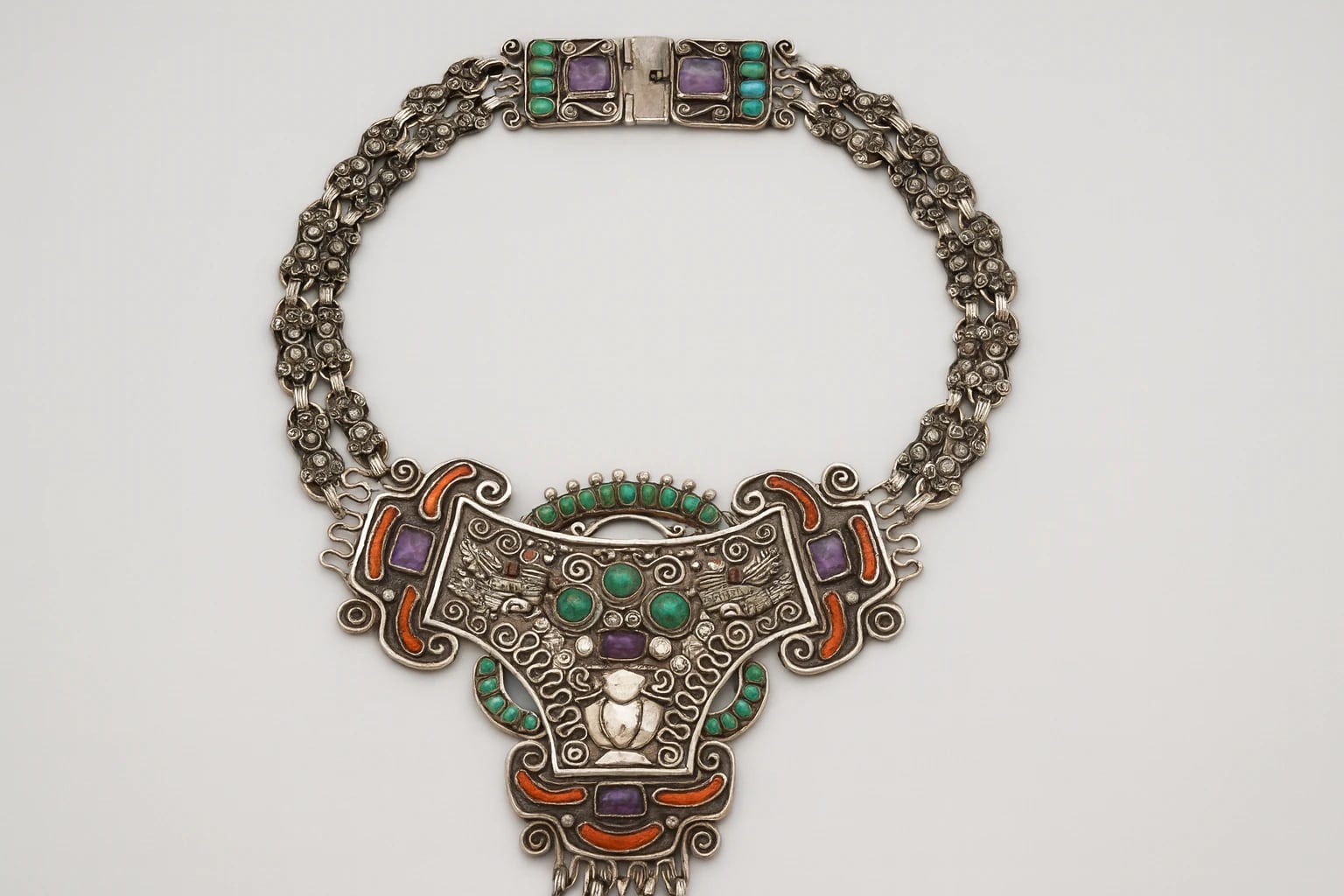
MATL (Matilde Poulat)
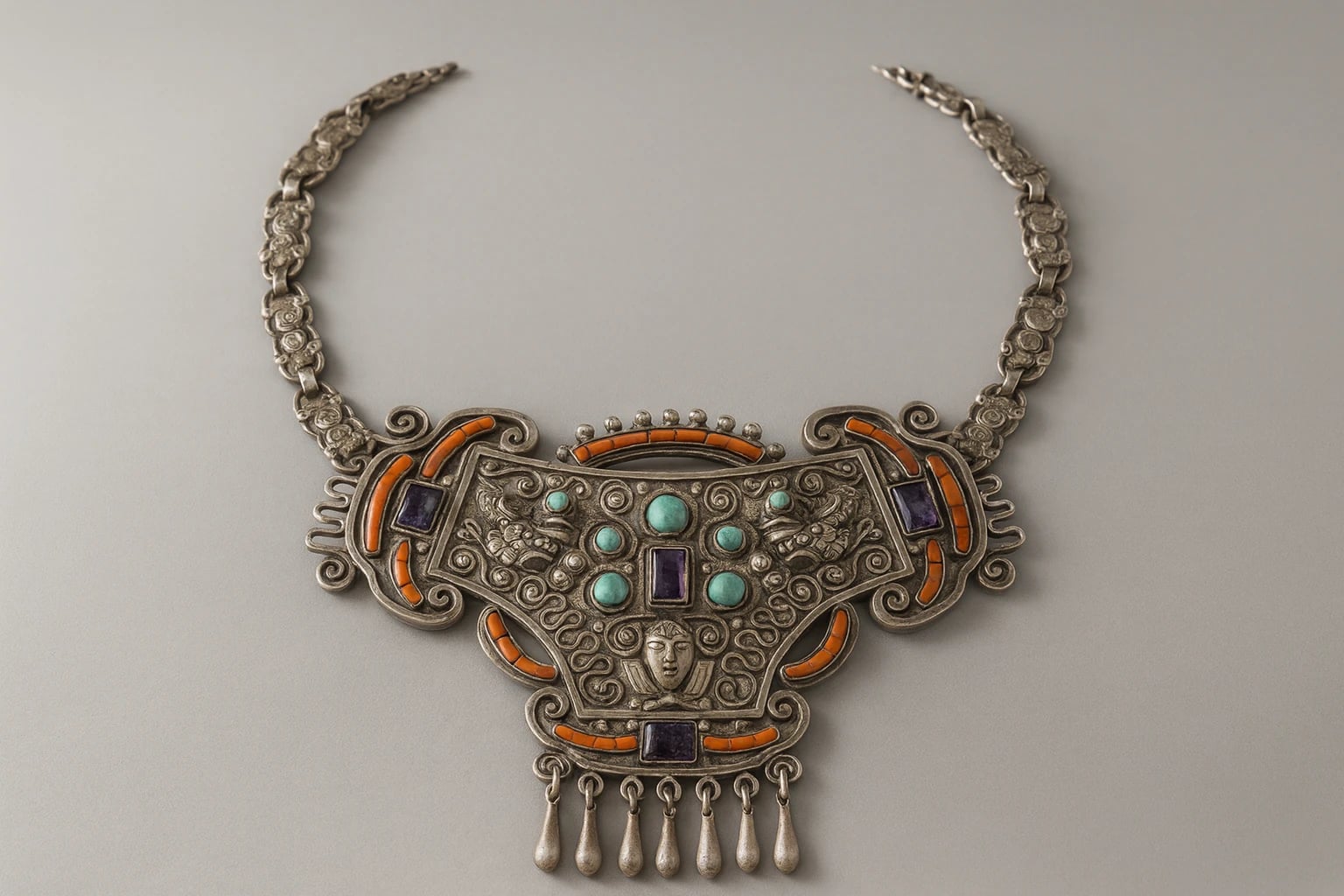
Mask-Pendant Necklace with Turquoise and Amethyst
1934 or later
Hardstone