Saves instantly, no account needed. Already a member? Sign in.
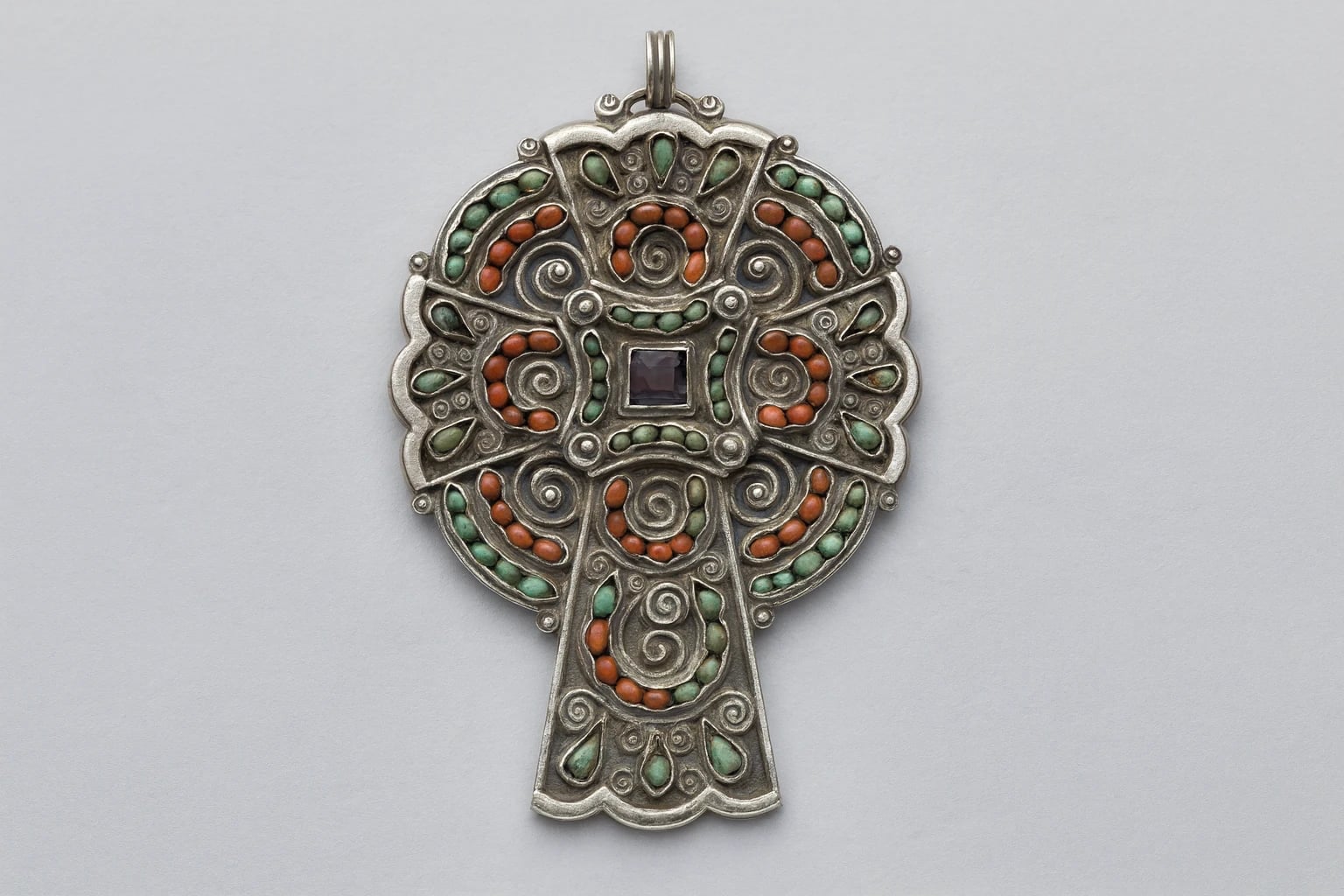
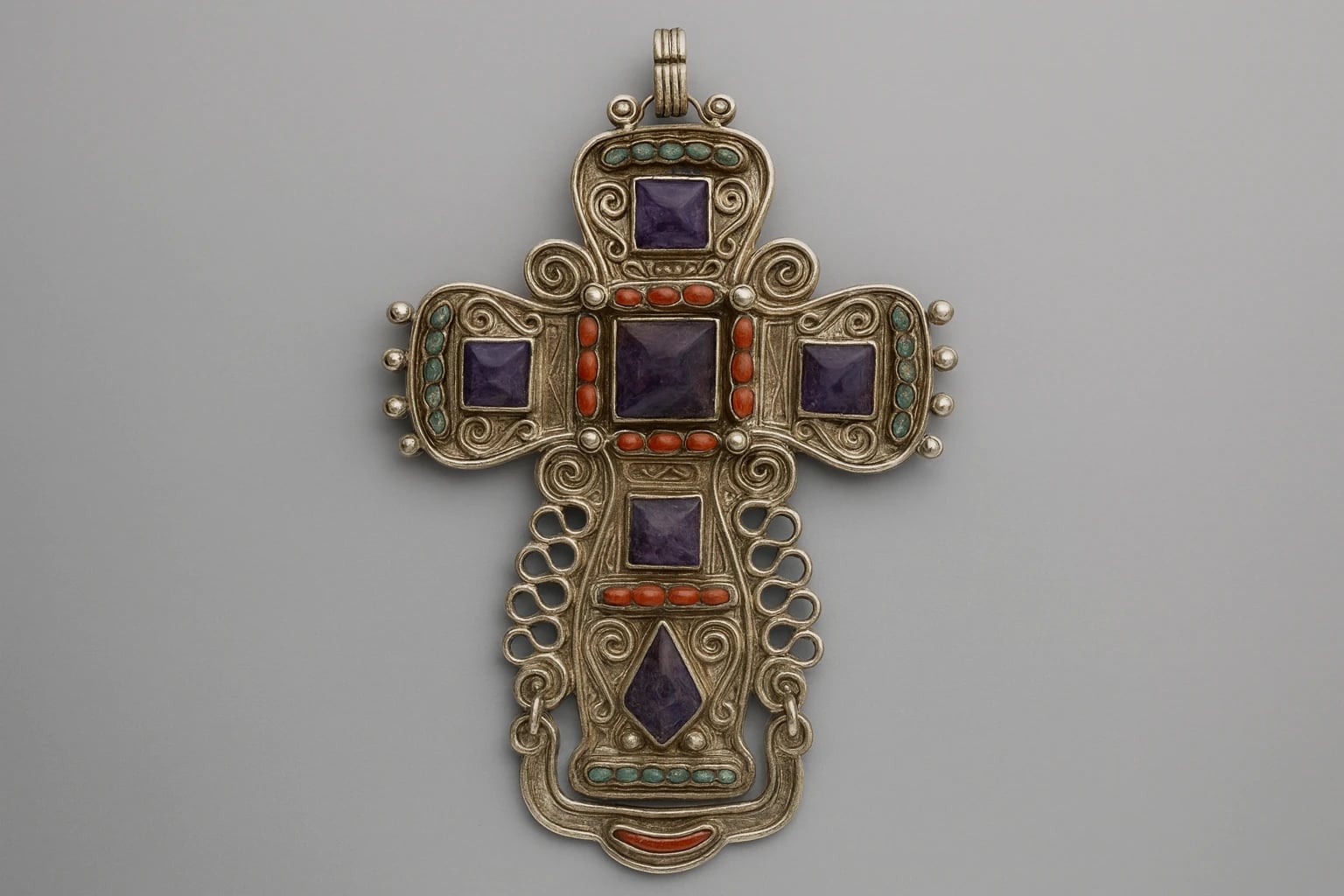
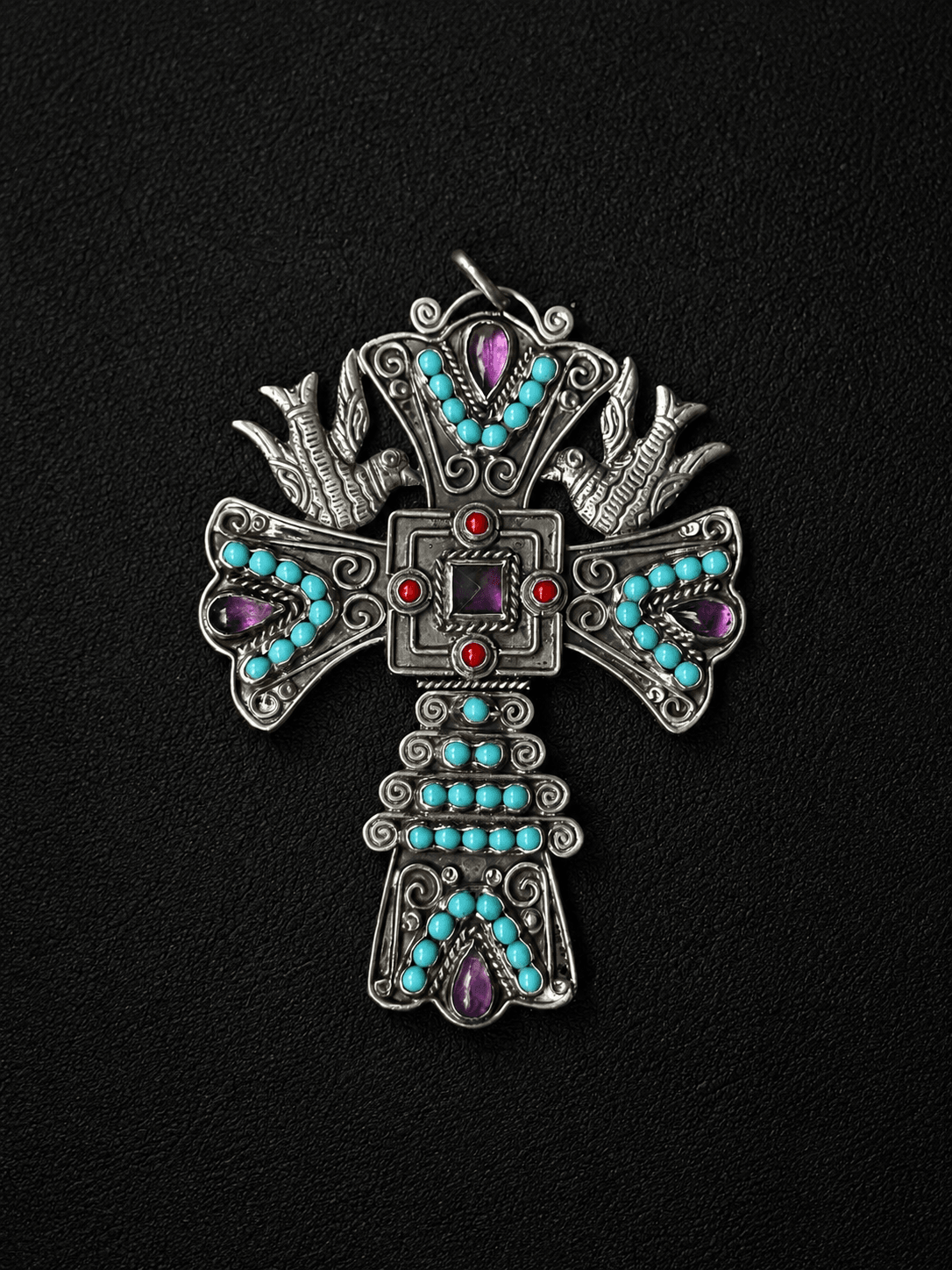
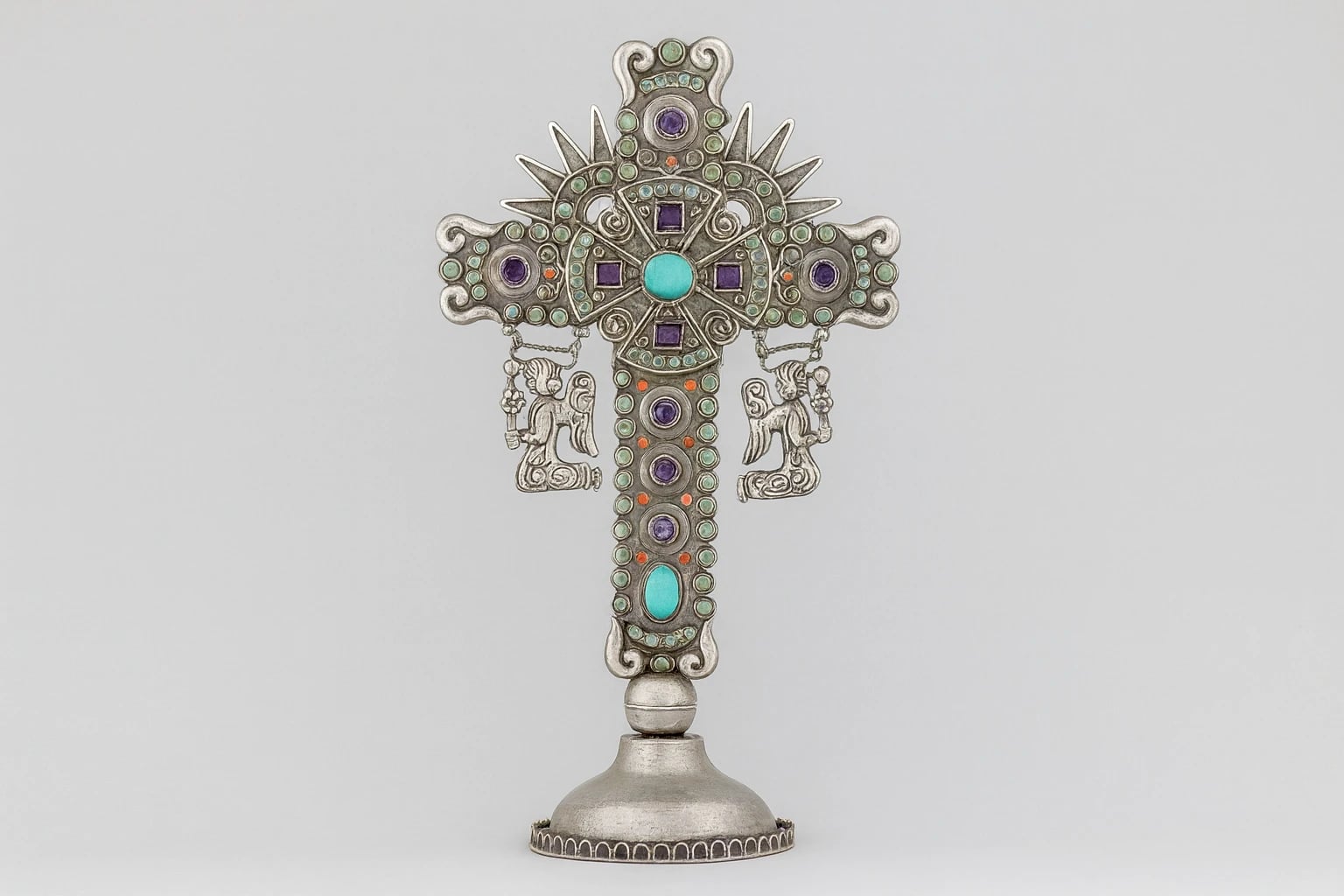
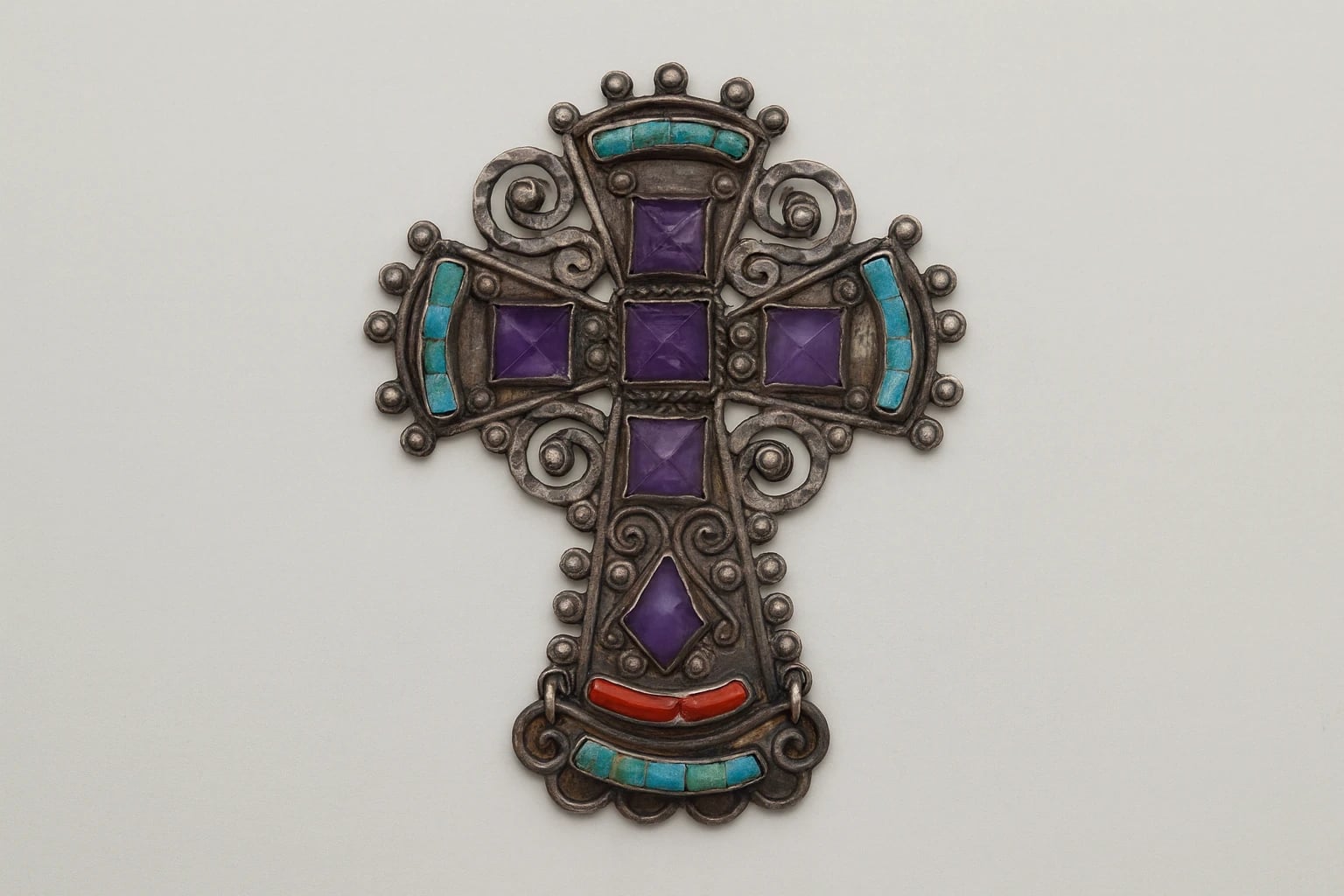
A Matl pendant compresses the whole vocabulary of Matilde Poulat's workshop into the plane of a cross: a flat silver body carrying turquoise and amethyst set close within a dense field of scrolls, beads, and small blossoms. The composition holds the eye at the center, where the stones cluster like a devotional focus, and lets the surrounding metalwork radiate outward to the arms. Where much Taxco silver of the period worked toward sculptural volume, this pendant treats ornament as a filled surface, an intricate two-dimensional pattern built up from many small elements rather than carved from mass.
The color logic is specific to Poulat's practice. Turquoise, opaque and greenish-blue, anchors the design, while amethyst introduces a translucent violet that catches light differently against the silver. The two stones are not interchangeable accents; their contrast in opacity is part of how the pendant reads, the turquoise sitting flat and matte, the amethyst admitting depth. Around them the silver is worked into the tight, curling repoussé-like scrollwork and applied beadwork that became the signature texture of Matl jewelry, a manner drawn from Mexican colonial and popular religious art rather than from the severe geometry favored by many of Poulat's contemporaries. The cross format reinforces that lineage, recalling the devotional silver and folk ornament of central Mexico.
Matilde Eugenia Poulat trained as a painter and designer at the San Carlos Academy before opening her shop in 1934, and the pictorial density of her jewelry reflects that formation: she composed a surface the way a painter composes a plane. She registered "Matl," a variation of an Aztec word for water, as trademark number 142093, and her workshop's marks span several forms, from early block-letter fineness stamps to the etched script carrying that registration number. After her death in 1960, her nephew Ricardo Salas continued the Matl designs, at times supervising several dozen silversmiths, so the design family remained in production for decades under the same mark. Establishing where a given Matl example falls within that long production depends on the specific mark it carries, since the workshop's script, fineness, and registration stamps shifted across the 1934 to 1960 period and again under Salas.
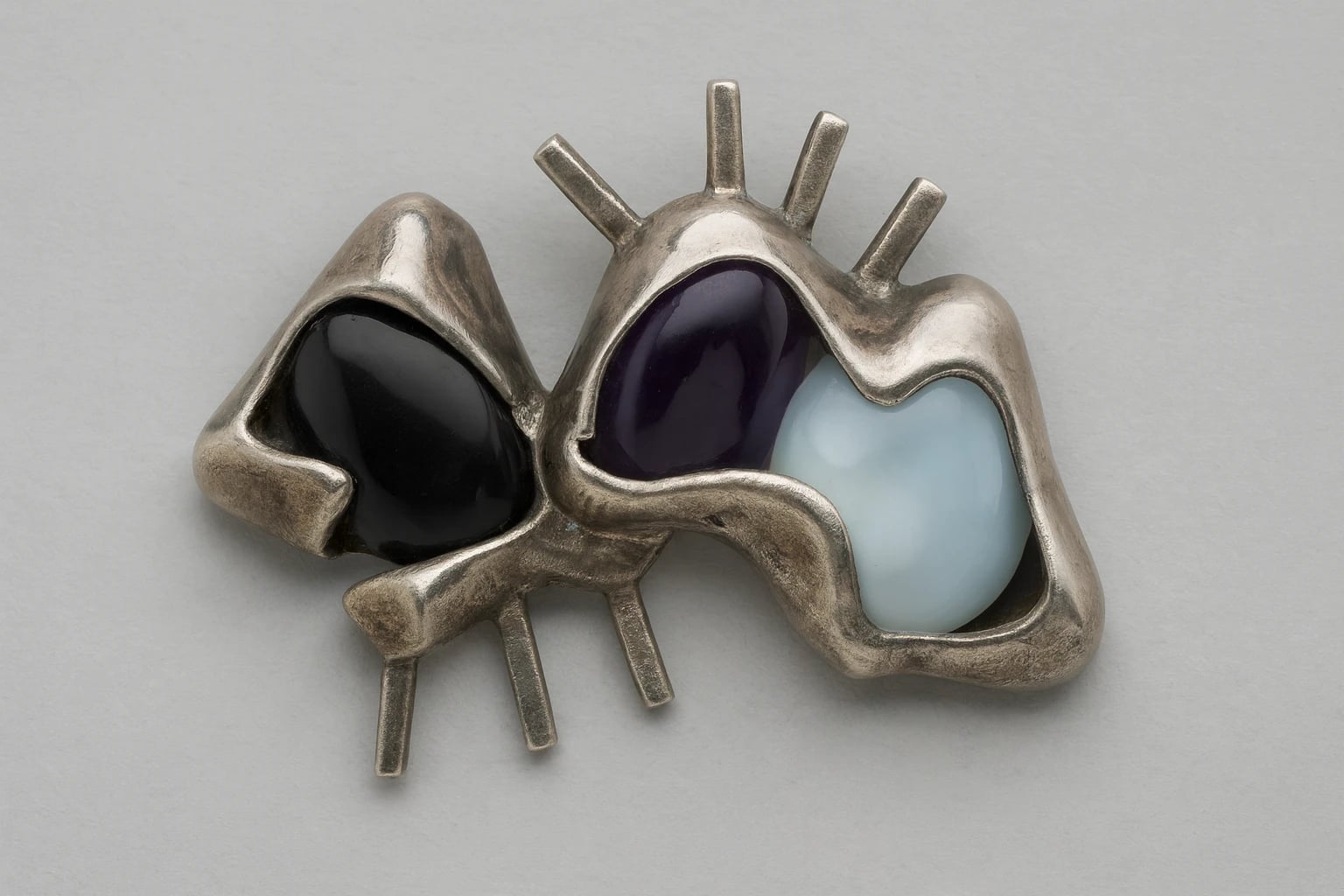
Within the Mexican silver renaissance, Poulat represents a current distinct from the Spratling-descended modernists of Taxco. Her work looked to devotional imagery, folk ornament, and the colored-stone palette of older Mexican silver, and it found a lasting audience precisely for that ornamental richness. A cross pendant of this kind shows how a single maker built an immediately recognizable idiom from repeated small forms and a fixed pair of stones, and it documents the persistence of religious and popular sources within a movement often described only through its geometric abstraction.
Museum of Mexican Silver. “Flat Cross Pendant with Turquoise.” Catalog no. MoMS-002219. https://museumofmexicansilver.com/pieces/matl-flat-cross-pendant-with-turquoise
See something wrong with this record? Suggest a correction and the piece details fill in automatically.
MATL (Matilde Poulat)
Rounded Cross Pendant with Turquoise and Amethyst
1934 or later
Turquoise