Saves instantly, no account needed. Already a member? Sign in.
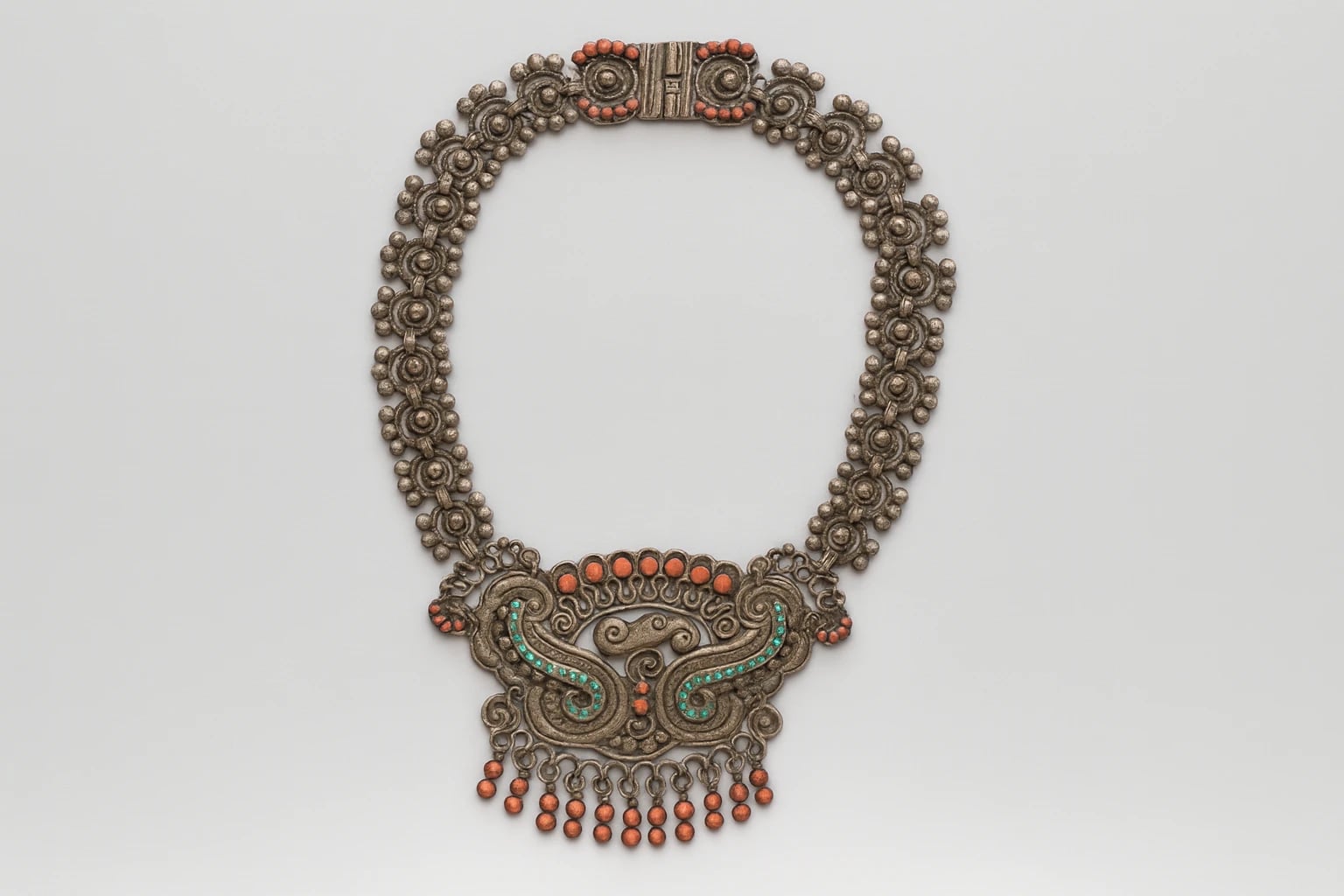
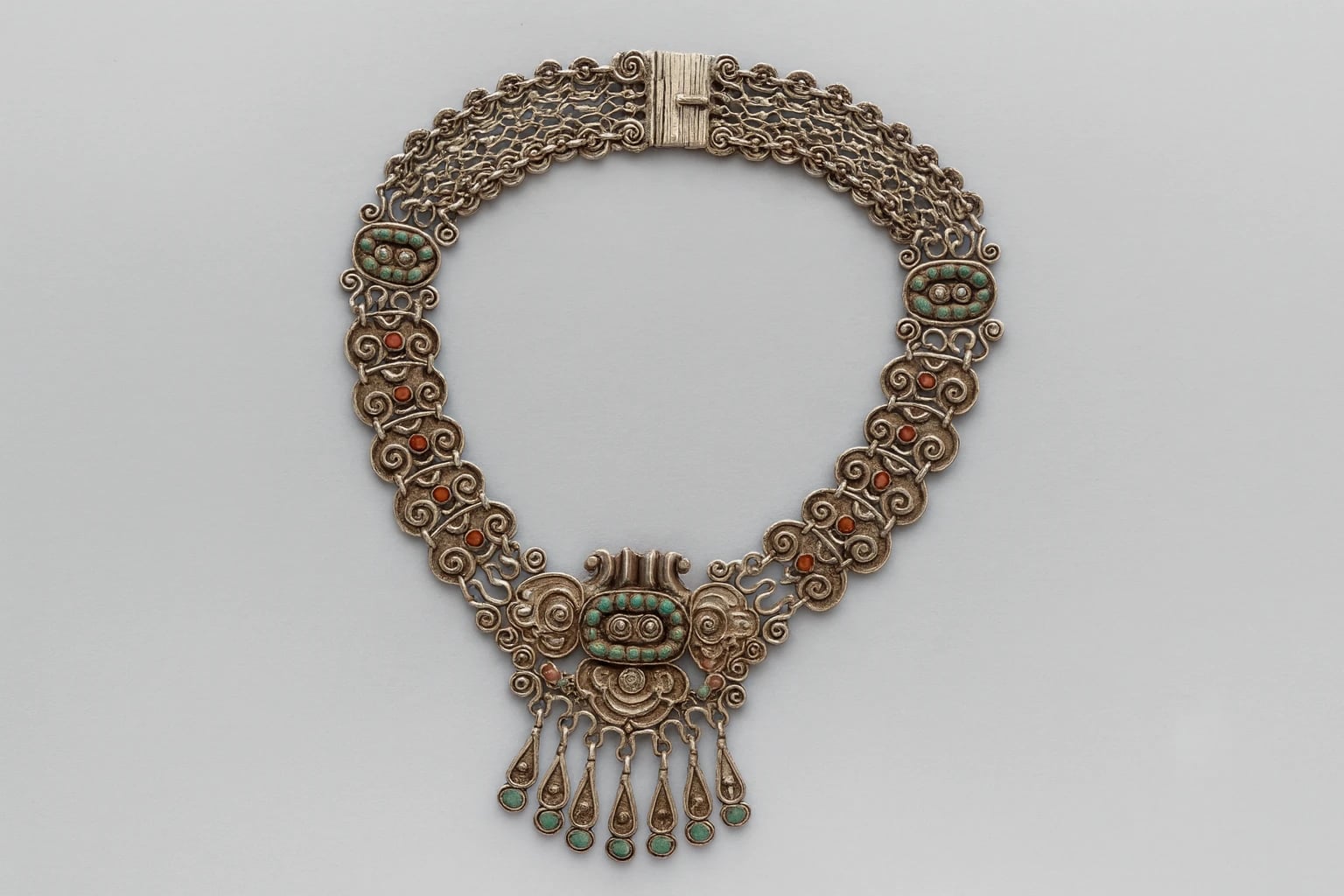
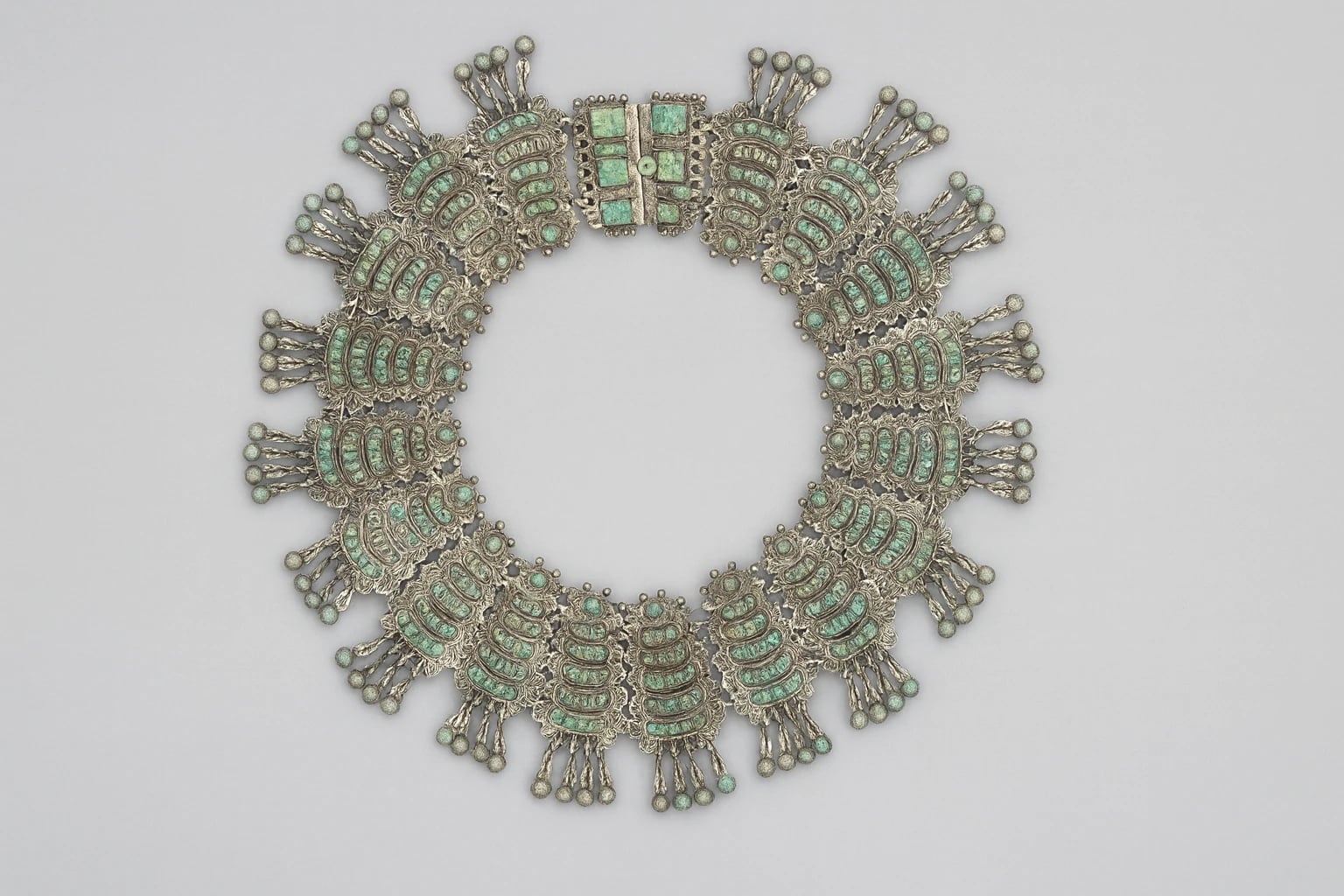
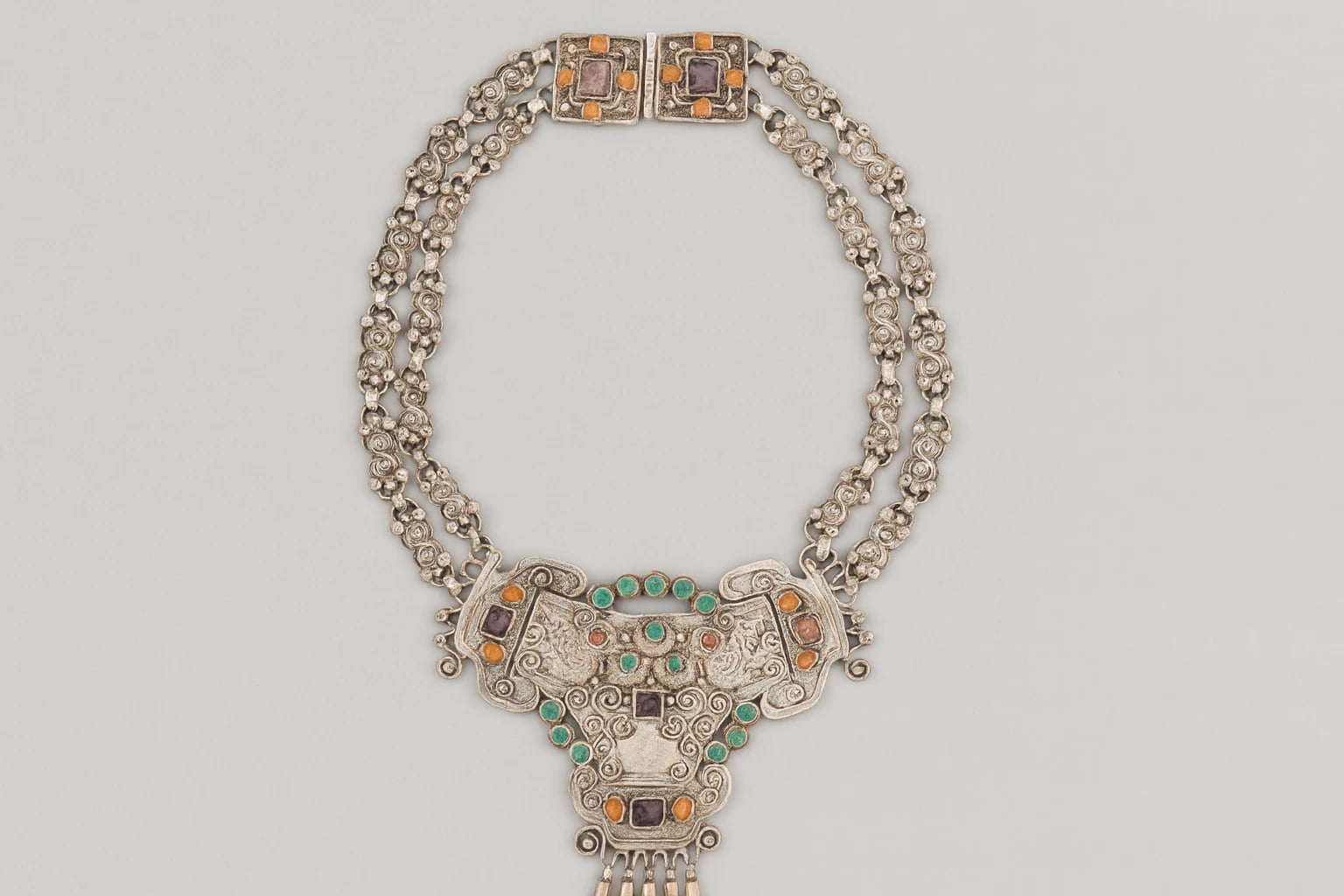
A dense band of turquoise, set close and continuous, forms the collar of this necklace, from which a fringe of beads hangs free along the lower edge. The design belongs to the folk art idiom that Matilde Poulat made her own: an ornate, densely worked surface in which color and silver are packed together rather than isolated in the spare geometries favored by many of her Taxco contemporaries. Where a designer working in the modernist current might strip ornament back to structure, MATL treats the whole collar as a field to be filled, and the pendant beads extend that fullness into movement against the body.
The turquoise carries much of the design's effect. Set in quantity across the collar, the stone reads as a sustained band of blue rather than as scattered accents, and its opacity gives the piece a weight of color that silver alone could not supply. The hanging beads introduce a second register: where the collar is fixed and continuous, the fringe swings and catches light independently, so the ornament reaches beyond the rigid band into the space just below the neckline. This pairing of a firm upper structure with a mobile lower edge is characteristic of MATL's approach to necklaces, in which stillness and motion are set against one another within a single object.
Matilde Poulat trained as a painter and designer at the San Carlos Academy, where Diego Rivera was among her contemporaries, and she opened her own shop in Mexico City in 1934. The name MATL, taken from an Aztec word for water, was her registered trademark, number 142093, a mark documented in several forms across the Hougart hallmark reference. Her workshop stood somewhat apart from the Taxco talleres: rooted in Mexico City, drawing on colonial religious silver and Mexican popular art, and committed to a decorative richness that distinguished her jewelry from the pared geometry associated with the Spratling circle. After her death in 1960, her nephew Ricardo Salas continued the MATL designs, at times supervising several dozen silversmiths, so that the idiom seen here outlived its originator and passed into a longer production history under the same mark.
Placing this necklace within MATL's output depends on its marks and construction rather than on the design alone, since the collar-and-fringe format continued under Salas after 1960 and again after 1980. The distinction between Poulat's own period of fabrication, the workshop's later continuation of her designs, and the various stamps that record each phase matters for reading any single example. What the piece makes clear is the durability of MATL's decorative language within the Mexican silver renaissance: a strand that drew on folk and colonial sources rather than international modernism, and that found a wide and lasting audience for exactly that reason.
Museum of Mexican Silver. “Collar Necklace with Turquoise and Hanging Beads.” Catalog no. MoMS-001469. https://museumofmexicansilver.com/pieces/matl-turquoise-collar-necklace
See something wrong with this record? Suggest a correction and the piece details fill in automatically.
MATL (Matilde Poulat)
Mask-Pendant Necklace with Turquoise and Coral
mid-20th century
Turquoise