Saves instantly, no account needed. Already a member? Sign in.
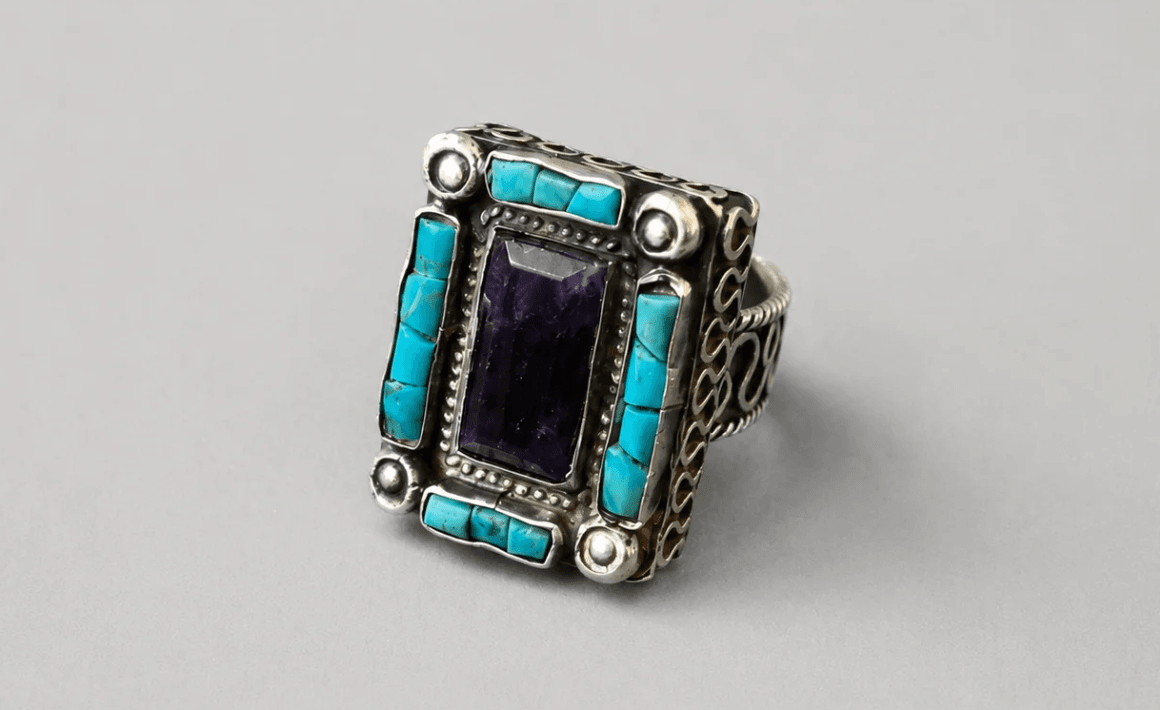
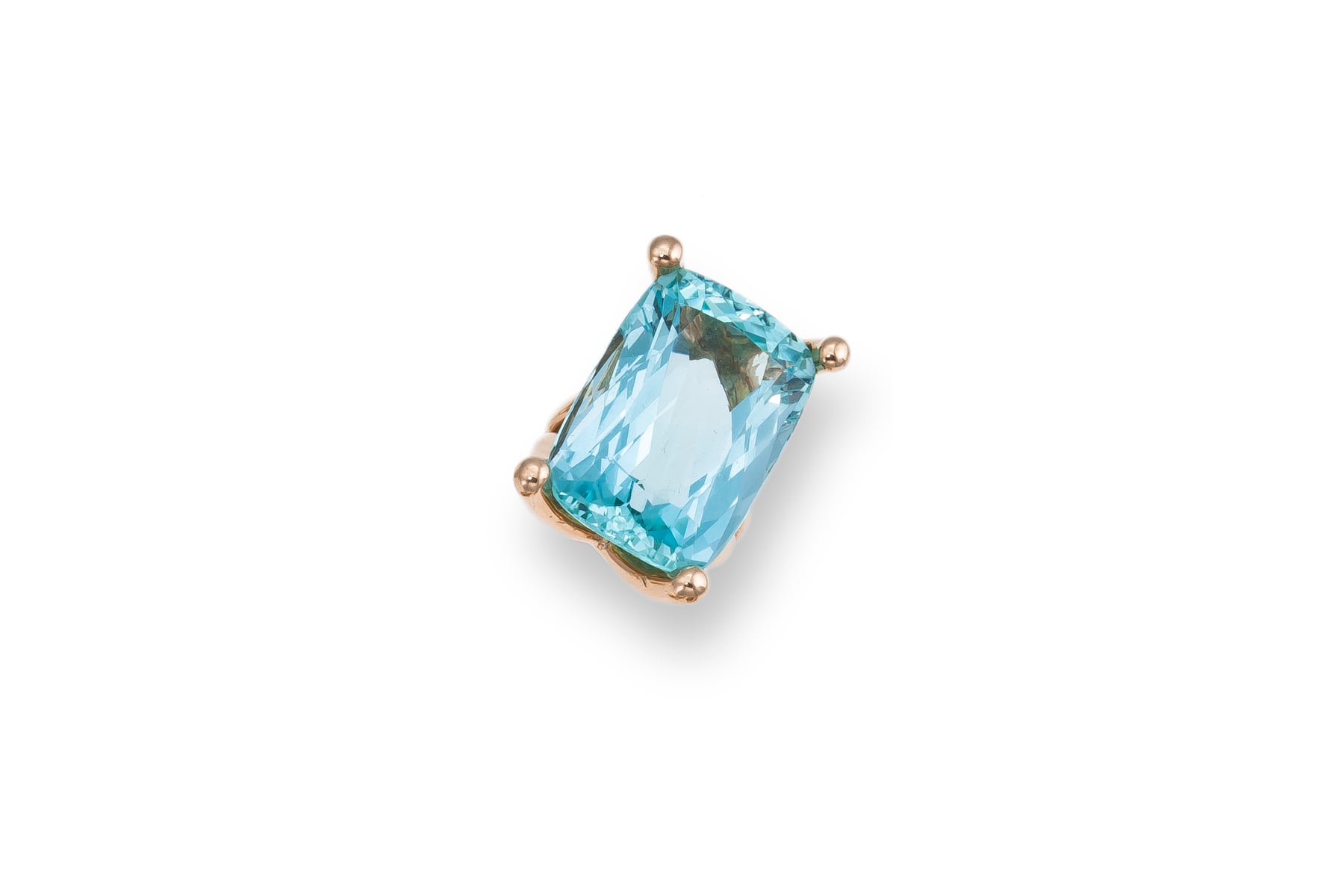
A ring built around turquoise concentrates the whole Matl language into a small compass. Matilde Poulat's jewelry is usually read at the scale of a pectoral or a large brooch, where dense silverwork carries clusters of stones, birds, and flowers. A ring forces that vocabulary to compress. The stone becomes the organizing center, and the silver frame must resolve its ornament around a single field of color rather than spreading across the chest. In Poulat's designs this compression tends to sharpen rather than dilute the effect, because the turquoise sets the color key and the surrounding metal answers it.
Turquoise gave Poulat an opaque, saturated blue that does not compete with silver by reflection but by contrast. Where a faceted stone would throw light, turquoise holds a matte, mineral surface that reads as a solid block of color against the brightness of the metal. That difference matters to how a Matl piece is composed. The silver can be worked into scrolls, beading, and small repoussé forms that catch light and move the eye, while the stone stays still at the center as a fixed anchor. The blue also carries a specifically Mexican association for Poulat's circle, drawn from colonial religious silver and from popular art, where turquoise and coral were the familiar companions to worked metal.
Poulat trained as a painter and designer at the San Carlos Academy before opening her shop in 1934, and her jewelry has always been understood as folk art translated into precious material rather than as an extension of the Taxco workshop system. She worked apart from the Spratling lineage, in Mexico City rather than Taxco, and her registered trademark, number 142093, marks a body of work with its own iconography of doves, hearts, flowers, and dense ornamental grounds. The documented marks for MATL span an early block-letter fineness stamp through several script forms, and later pieces carry the registration number etched into the metal. Her nephew Ricardo Salas worked with her throughout her career and continued the Matl designs after her death in 1960, which means the same design vocabulary was produced across decades. A Matl object should therefore be read for its design and mark together, since the style persisted well beyond Poulat's own lifetime.
Within a collection, a turquoise ring documents how the Matl idiom operates at intimate scale and how Poulat used an opaque local stone as the fixed point of an otherwise busy silver composition. It also records a strand of the Mexican silver renaissance that ran outside Taxco entirely, rooted in academic training, Mexico City retail, and a folk-art sensibility that Poulat and Salas sustained as a continuous workshop practice. The ring is a modest but exact witness to that parallel current.
Museum of Mexican Silver. “Ring with Turquoise.” Catalog no. MoMS-002263. https://museumofmexicansilver.com/pieces/matl-turquoise-ring
See something wrong with this record? Suggest a correction and the piece details fill in automatically.
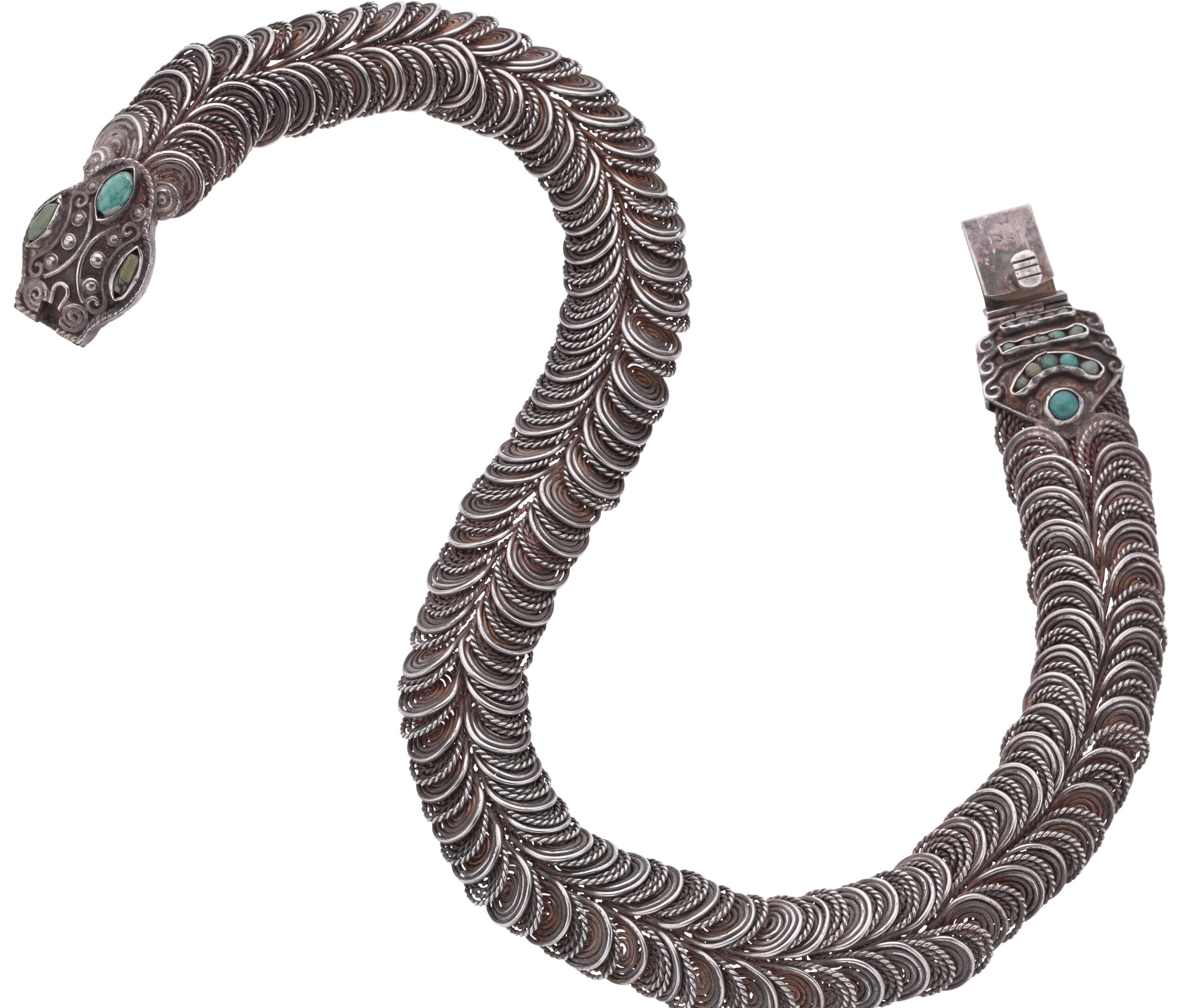
MATL (Matilde Poulat)
Snake Necklace with Turquoise
1934 or later
Turquoise