Saves instantly, no account needed. Already a member? Sign in.
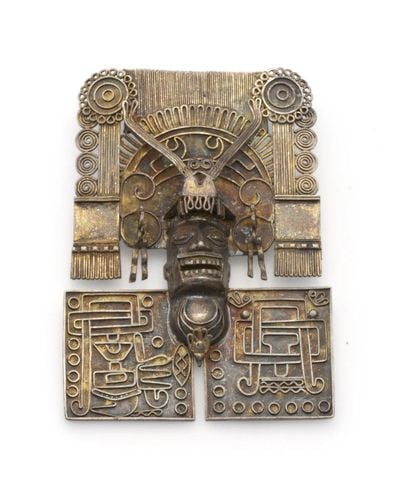
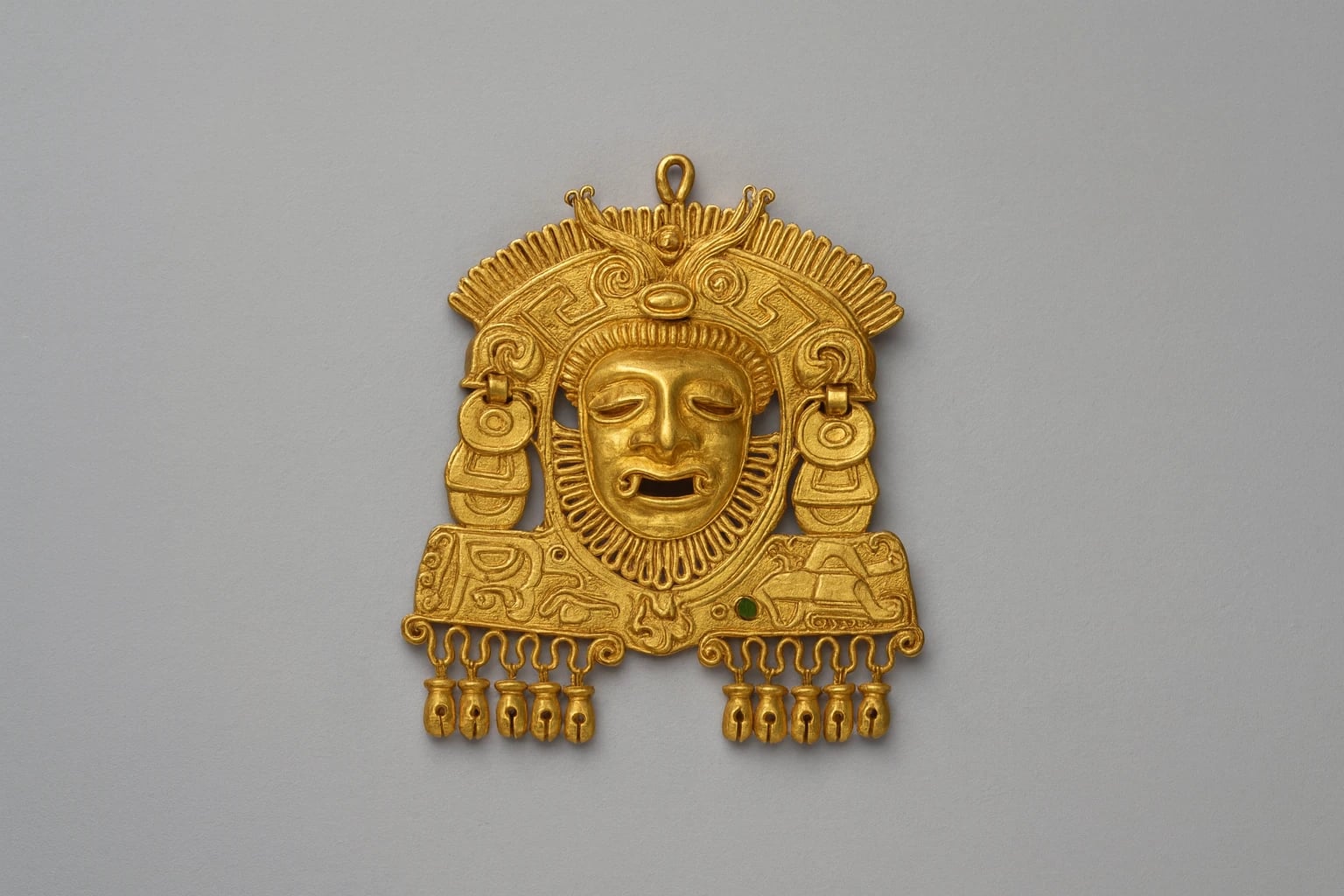
A gilded face looks out from a nest of silver scrollwork, and the contrast between the two surfaces organizes the whole pendant. The mask itself is vermeil, silver washed with gold, so it reads warm and solid against the cooler white metal that surrounds it. This is a characteristic strategy in the work marked MATL: a central figurative motif set within dense curling ornament, small beads, and flowering scrolls that fill the field without crowding the face. The gold tone lifts the mask forward and makes it the fixed point around which the silver rhythm turns.
The construction depends on the relationship between the smooth planes of the face and the busy metalwork framing it. Where the mask presents broad unbroken surfaces, the surround is built from tight coils, ropework, and clustered ornament, a decorative vocabulary drawn from Mexican folk art and colonial religious silver rather than from the austere geometry favored in much Taxco design of the same years. Matilde Poulat trained as a painter and designer at the San Carlos Academy, and her jewelry carries a painter's sense of a composition anchored by a single face. The vermeil treatment is integral to that composition. Gilding a silver mask is not merely surface luxury here; it separates figure from ground and gives the eye a warm center to return to.
Poulat opened her shop in 1934 and registered the trademark "Matl," a form of an Aztec word for water, as number 142093, a number that appears etched on later Matl pieces. Her work stands somewhat apart from the mainstream of the Taxco School. Rather than the modernist abstraction associated with the Spratling circle, she developed an ornamental, folk-rooted idiom that looked back to popular art and devotional metalwork, and she made that idiom modern by concentrating it into wearable, tightly designed objects. The style proved durable enough to outlast her. After her death in 1960 her nephew Ricardo Salas continued producing Matl designs, at peak supervising several dozen silversmiths, and the marks and registration number carried forward under his direction. The published hallmark record for MATL distinguishes early fineness stamps from later etched-script marks bearing the registration number, so the specific mark on a given pendant helps place its fabrication within that long production history.
Within a collection of Mexican silver, a vermeil Matl mask pendant documents a strand of the renaissance that ran alongside, not behind, the geometric modernists. It shows how a designer with an academic painting background translated folk and colonial ornament into a personal jewelry language, and how the gold-and-silver contrast served as a compositional tool rather than decoration alone. The piece is a clear example of the Matl workshop's approach to figure, frame, and surface, the qualities that kept these designs in production for decades.
Museum of Mexican Silver. “Double-Mask Pendant with Vermeil.” Catalog no. MoMS-002226. https://museumofmexicansilver.com/pieces/matl-vermeil-mask-pendant
See something wrong with this record? Suggest a correction and the piece details fill in automatically.
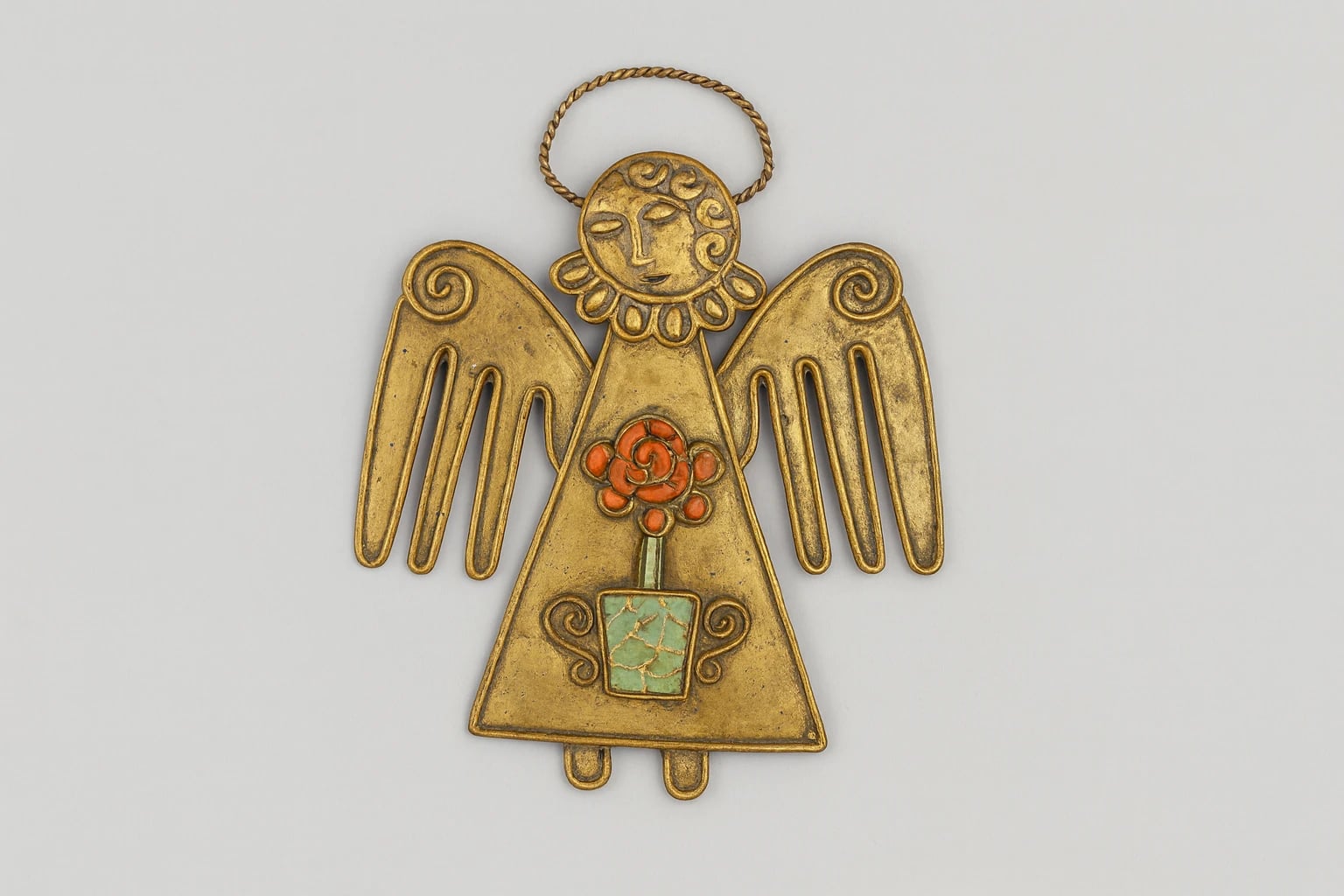
MATL (Matilde Poulat)
Angel Pendant with Copper, Coral, and Turquoise
circa 1960
Copper