Saves instantly, no account needed. Already a member? Sign in.
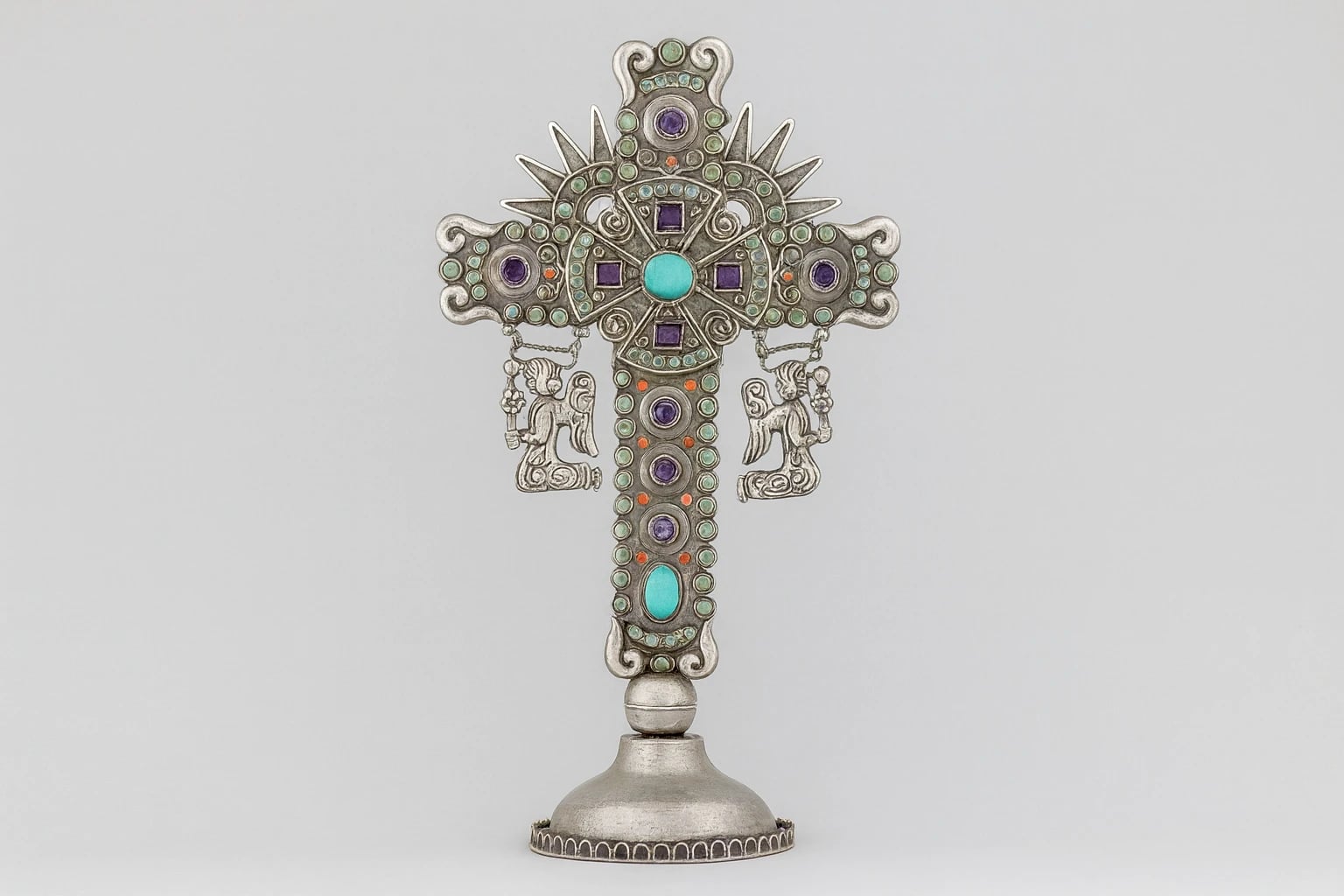
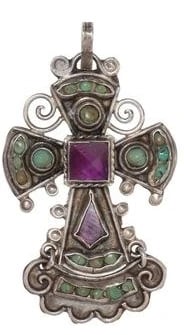
The Angel Cross Pendant compresses two devotional forms, the cross and the winged figure, into a single dense composition of scrolled silver, turquoise, and amethyst. The turquoise sets the color key, a field of opaque blue-green stones that fills the arms of the cross and surrounds a central figure, while amethyst supplies a cooler violet counterpoint. This is the visual language for which Matilde Poulat became known: a colonial and folk vocabulary of doves, flowers, hearts, and crosses rendered in tight silver scrollwork and set with stones chosen for saturated color rather than transparency. The pendant belongs to a tradition Poulat drew from Mexican religious ornament and popular art, reworked into a personal ornamental style that her workshop repeated and refined across decades.
The construction organizes small silver scrolls and beads around the stones so that metal and color read as a continuous surface rather than as settings applied to a plain ground. Turquoise, opaque and matte, absorbs light where the polished silver scrolls reflect it, and the contrast gives the piece its density and its handmade character. The amethyst, faceted and translucent, interrupts that opacity at chosen points, most often at a center or a terminal, drawing the eye through the busy field. The design favors symmetry and accumulation over open space, a decorative logic closer to Mexican colonial silver and retablo ornament than to the reductive geometry that other Taxco workshops pursued in the same years. Poulat trained as a painter and designer at the San Carlos Academy before opening her shop in 1934, and that background shows in the careful control of color across a crowded surface.
Attribution and dating for MATL objects depend on distinguishing the designer, the workshop, and the long afterlife of the designs. Matilde Poulat established the MATL mark, registered as trademark number 142093, and worked until her death in 1960. Her nephew Ricardo Salas worked alongside her throughout her career and continued producing the MATL designs after 1960, supervising as many as several dozen silversmiths at peak production. The hallmark record set out by Hougart separates these phases: early script MATL marks with 0.925 or 0.950 fineness, marks incorporating the M. Regis 142093 registration from roughly 1950 to 1960, and post-1980 Salas-era marks that add MS-12 or Salas to the MATL stamp. A given Angel Cross design may therefore have been conceived by Poulat yet fabricated years later under Salas, and the specific mark on any one example fixes its period of manufacture more reliably than the design date alone. Without the mark on this pendant identified in the record, it should be placed with the MATL design tradition rather than assigned to a single year.
Museum of Mexican Silver. “Angel Cross Pendant with Turquoise and Amethyst.” Catalog no. MoMS-002261. https://museumofmexicansilver.com/pieces/matl-angel-cross-pendant-with-turquoise-and-amethyst
See something wrong with this record? Suggest a correction and the piece details fill in automatically.
Within the Mexican silver renaissance, MATL occupies a position distinct from the Spratling-derived workshops of Taxco. Poulat worked in Mexico City, not Taxco, and her ornamental, color-saturated, folk-derived style stands apart from the pared geometry associated with the Taxco School. The Angel Cross Pendant illustrates that alternative current clearly: it treats silver as a matrix for turquoise and amethyst, and it looks to colonial devotional imagery and popular art rather than to modernist abstraction. For a collection tracing the full breadth of twentieth-century Mexican silver, a MATL pendant of this type documents both a recognizable workshop hand and a strand of the renaissance that drew its authority from Mexican religious and folk ornament rather than from international modernism.

MATL (Matilde Poulat)
Fish Pendant with Turquoise
1934 or later
Turquoise