Saves instantly, no account needed. Already a member? Sign in.
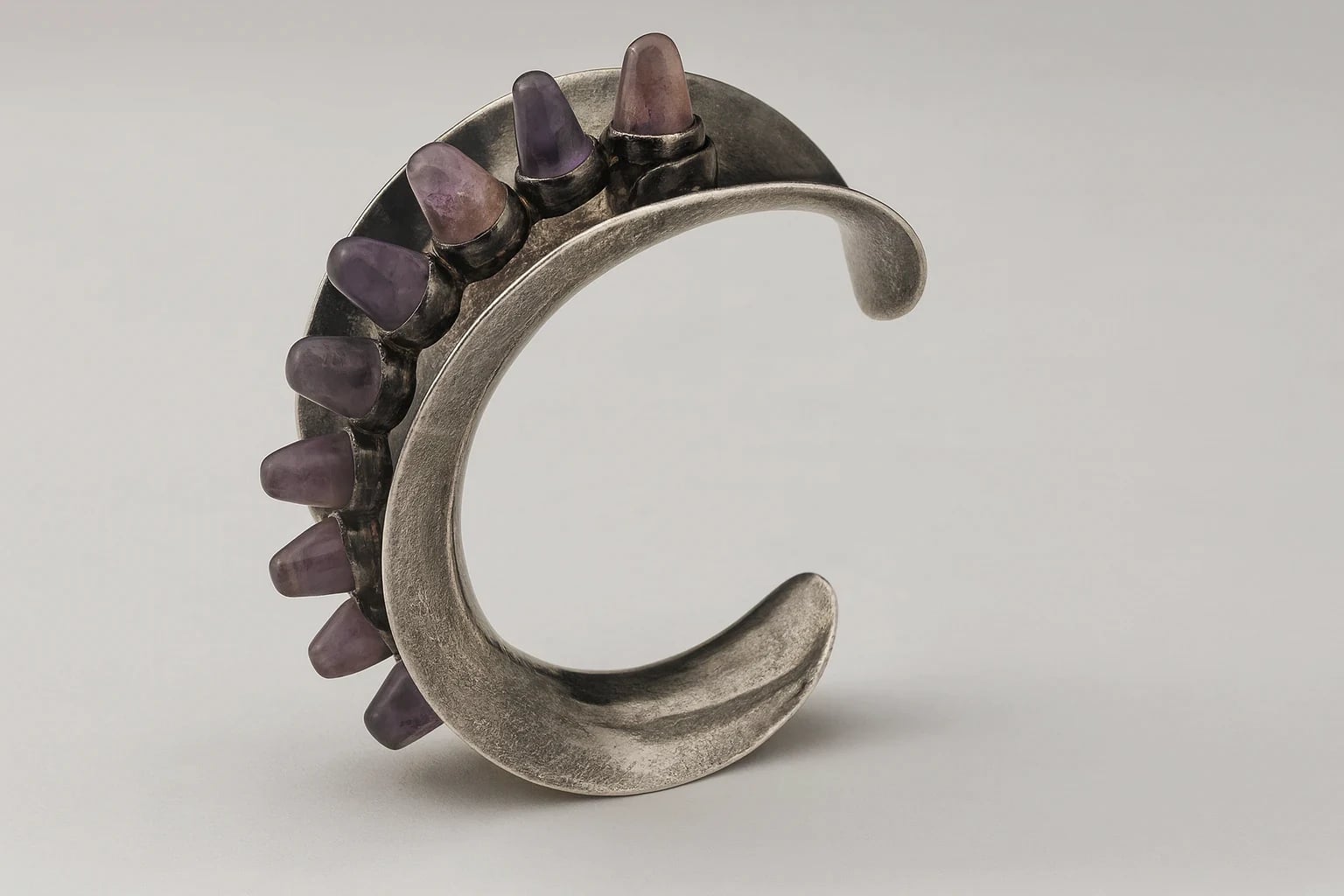
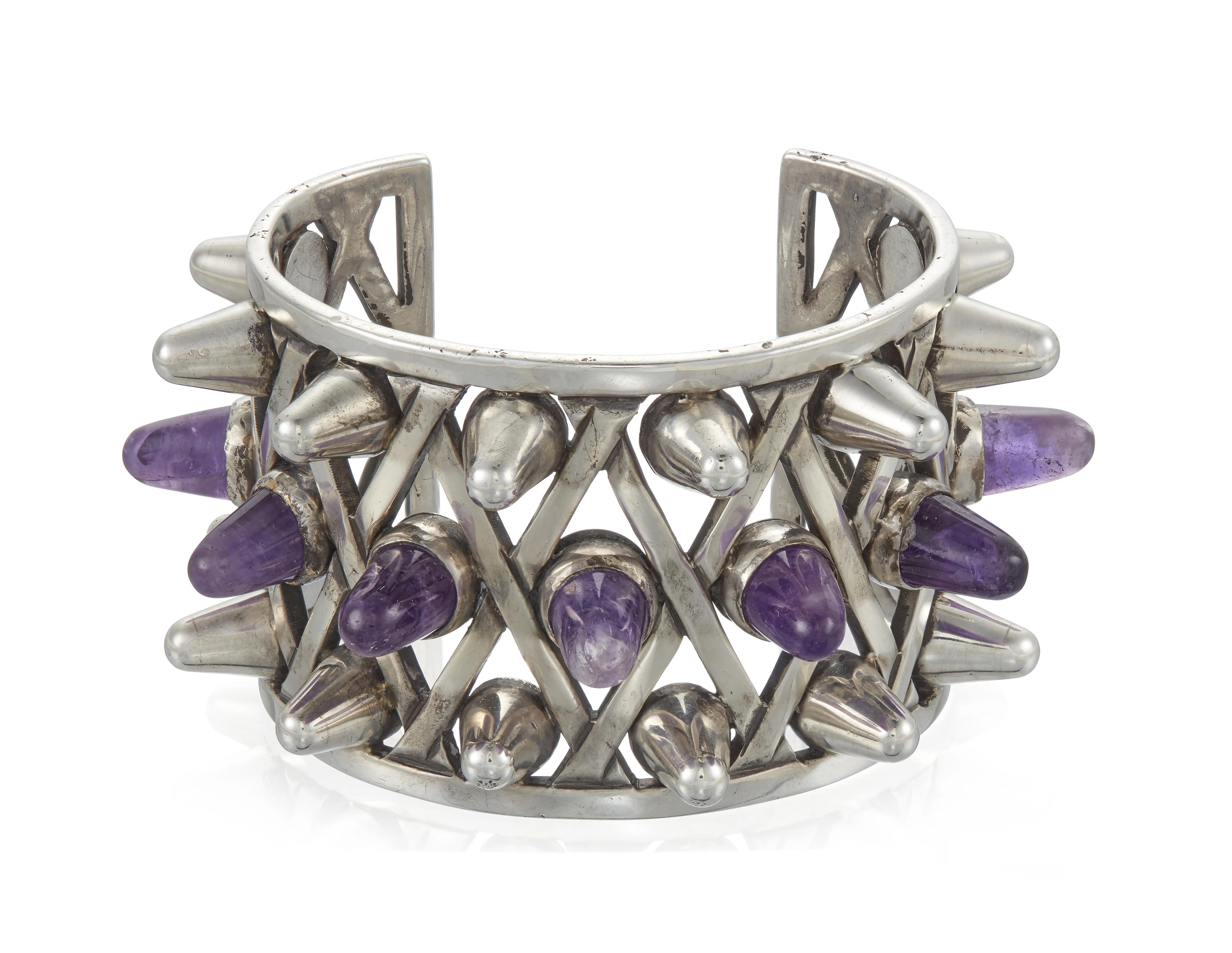
Few forms in Antonio Pineda's output declare his ambition as plainly as a wide cuff like this one, where the wrist becomes a small architecture rather than a surface to decorate. The piece is built as an open silver trellis spanning nearly the full width of the forearm, its diagonal lattice studded at every crossing with projecting cones, some rendered in polished silver and some capped with amethyst. The alternation of metal and stone across a rigid geometric grid is the whole idea: a rhythm of light and violet that reads as sculpture first and jewelry second. Bold, frankly architectural cuffs of this scale sit at the more demanding end of Pineda's bracelet production, the kind of statement object that the Fowler Museum's 2008 retrospective held up as evidence of why he is counted a world-class modernist designer and not merely a Taxco workshop master.
The marks confirm the maker and the standard without ambiguity. The cuff carries the "Antonio Taxco" crown signature, the eagle assay number 17, and the 970 fineness stamp, the same constellation of marks Penny C. Morrill records again and again across Pineda's 1950s bracelets in her 1996 Aguilar study (Morrill, pp. 180-181). The 970 standard was Pineda's signature alloy, richer in silver than ordinary sterling, and he used it as a deliberate quality signal across the work of his mature taller. That dating is consistent with the piece itself: the reductive geometry and the disciplined repetition of cone elements belong to the same vocabulary Morrill catalogues in her mid-1950s 970 bracelets.
The construction rewards a close look. The lattice is openwork, so the cuff carries its considerable visual mass on a skeleton rather than a solid sheet, and the silver and amethyst cones are set to stand proud of that frame in three dimensions. The amethyst is used as accent rather than as the field, the cool violet pulling against the silver cones in a way that keeps the eye moving across the grid. It is a substantial, broad piece on the wrist, and the design solves the problem of weight the way Pineda's best bracelets do, by making the structure itself part of the ornament rather than hiding it.
Within the maker's story this cuff belongs to the moment when Taxco silver had matured from souvenir craft into a recognized modern decorative art, and Pineda was among the figures who pushed it there. A cuff that treats the wrist as a field for geometric, gem-punctuated sculpture is exactly the kind of object that earned him a full museum retrospective and a lasting place in the canon of Mexican modernist silver.
Museum of Mexican Silver. “Amethyst Gladiator Cuff.” Catalog no. MoMS-001769. https://museumofmexicansilver.com/pieces/pineda-cuff-amethyst-silver-cones
See something wrong with this record? Suggest a correction and the piece details fill in automatically.
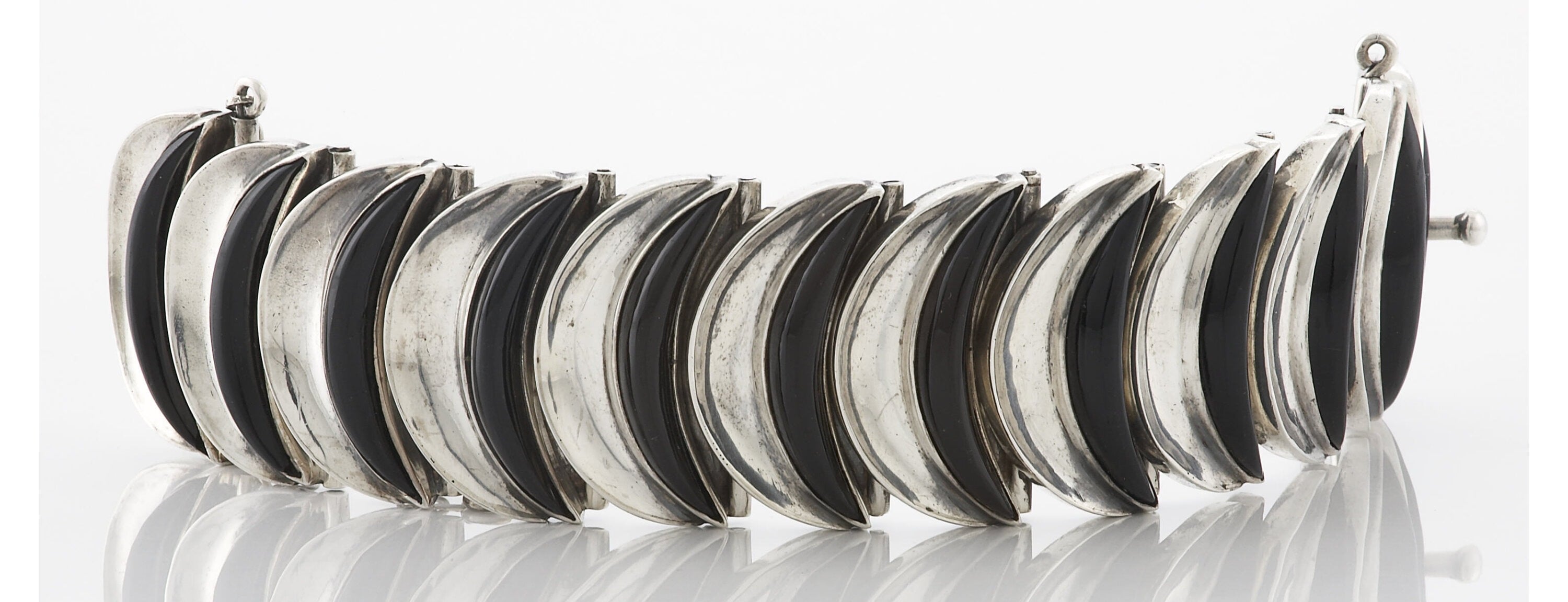
Antonio Pineda
Silver and Onyx Crescent Bracelet
c. 1970
Sterling silver